| Ultimi arrivi - Mars Reconnaissance Orbiter (MRO) |

ESP_020323_2050_RED_abrowse-PCF-LXTT.jpgFan-shaped Deposit (Absolute Natural Colors; credits for the additional process. and color.: Dr Paolo C. Fienga - Lunexit Team:)117 visiteThis HiRISE image shows a Fan-shaped Deposit at the distal end of a Valley. The Fan is approximately 3,5x3,7 Km in size. While other similar Fans on Mars display stair-step terracing along their edges, this particular Fan does not show any Terraces. There is a Valley, instead, that appears to be the source of material that now composes much of the Fan.
Martian Fans are thought to be either Alluvial or Deltaic in origin.
On Earth, Alluvial Fans form when material upslope is eroded and transported by water down a confined Valley until reaching a flatter, broader surface downslope where the material is deposited to produce a Fan-shaped Surface Feature .
Deltaic Fans, on the other hand, form when rivers transport sediment downstream until an unconfined and flatter surface is reached under water, at which time the sediment is deposited in a Fan-shape.
Whether the Martian Fan formed by Alluvial or Deltaic processes in unknown, but both processes require a fluid (most likely water) that carved the Valley and transported the sediment downstream.MareKromiumGen 08, 2011
|
|

ESP_020395_1260_RED_abrowse.jpgFeatures of Liu Hsin Crater (Absolute Natural Colors; credits for the additional process. and color.: Dr Paolo C. Fienga - Lunexit Team)129 visitenessun commentoMareKromiumGen 07, 2011
|
|

PSP_005409_1530_RED_abrowse-00.jpgUnnamed Southern Crater with Central Peak (CTX Frame - Enhanced Natural Colors; credits for the additional process. and color.: Dr Paolo C. Fienga - Lunexit Team)117 visitenessun commentoMareKromiumGen 07, 2011
|
|

PSP_005409_1530_RED_abrowse-01.jpgUnnamed Southern Crater with Central Peak (EDM - Enhanced Natural Colors; credits for the additional process. and color.: Dr Paolo C. Fienga - Lunexit Team)102 visitenessun commentoMareKromiumGen 07, 2011
|
|

ESP_019987_1095_RED_abrowse.jpgHigh Southern Latitude "Dunes' Gullies" (Absolute Natural Colors; credits for the additional process. and color.: Elisabetta Bonora and Paolo C. Fienga - Lunexit Team)116 visitenessun commentoMareKromiumGen 07, 2011
|
|

ESP_020163_0980_RED_abrowse.jpgSouth Polar Features (Absolute Natural Colors; credits: Dr Paolo C. Fienga - Lunexit Team)105 visiteHiRISE images are monochromatic across much of the scene, but in the center we return color data. The color strip down the center of this image gives us insight into Aerosols (such as particles of Dust and Frost) suspended in the Atmosphere and the seasonal processes that get them there. In the Winter Mars' South Polar Region is covered by a layer of CO2 ice (dry ice).
In the Spring this ice evaporates from the top and the bottom of the Seasonal Ice Layer (typically a few centimeters thick). Where there are cracks in the ice, the gas from below escapes, carrying fine particles from the Surface up to the top of the ice. Larger particles fall back onto the ground in Fan-shaped Deposits pointing in a direction determined by the local winds. We see the smaller particles (Dust) suspended in the air locally over the cracks as the bluish tone over the Regions with Fans.
Over Regions without Fans, where Gas and Dust from the Surface are not escaping into the Atmosphere, the Surface is a more pinkish tone.MareKromiumGen 07, 2011
|
|

ESP_020204_1835_RED_abrowse-00.jpgNorthern Meridiani Planum (CTX Frame - Absolute Natural Colors; credits for the additional process. and color.: Dr Paolo C. Fienga - Lunexit Team:)88 visitenessun commentoMareKromiumGen 07, 2011
|
|

ESP_020297_2045_RED_abrowse.jpgFeatures of Mawrth Vallis - Layering (Absolute Natural Colors; credits for the additional process. and color.: Dr Paolo C. Fienga - Lunexit Team)107 visiteMawrth Vallis is a Martian Region that is famous for its "Mineral Diversity", which includes Clay minerals that formed by the chemical alteration of both rocks and loose “Regolith” (such as Soil) by water.
There is a high surface area of bedded Phyllosilicate (Clay) exposures (in a range of tens of kilometers), located in the Bright-Toned Materials.
The CRISM instrument working on the MRO Spacecraft detects a variety of Clay minerals here, which could signify different processes of formation.
The High Resolution of the HiRISE camera helps us to see and trace out Layers, Polygonal Fractures and, with CRISM, to examine the distribution of various minerals across the entire Surface.
In the light of the above considerations and data, this Surface comes out as scientifically compelling for the Mars Science Laboratory (MSL) Rover 'Curiosity' (this Region is one of the four candidate Landing Sites for the MSL).MareKromiumGen 07, 2011
|
|
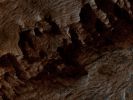
PSP_003830_1740_RED_abrowse-02.jpgLayered Bedrock in Candor Chasma (EDM n.2 - Absolute Natural Colors; credits for the additional process. and color.: Dr Paolo C. Fienga - Lunexit Team)84 visitenessun commentoMareKromiumGen 06, 2011
|
|
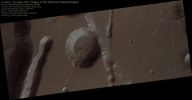
PSP_004046_2080_RED_browse-PCF-LXTT.jpgFeatures of Elysium Fossae (Absolute Natural Colors; credits for the additional process. and color.: Dr Paolo C. Fienga - Lunexit Team:)115 visitenessun commentoMareKromiumDic 31, 2010
|
|

PSP_006133_1410_RED_abrowse-PCF-LXTT.jpgComplex "Folded Terrain" in Hellas Planitia (Absolute Natural Colors; credits for the additional process. and color.: Dr Paolo C. Fienga - Lunexit Team)110 visitenessun commentoMareKromiumDic 31, 2010
|
|
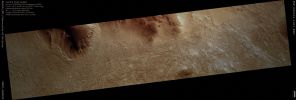
PSP_006162_1365_RED_abrowse-PCF-LXTT.jpgCentral Peak Gullies (Absolute Natural Colors; credits for the additional process. and color.: Dr Paolo C. Fienga - Lunexit Team)116 visitenessun commentoMareKromiumDic 31, 2010
|
|
| 2237 immagini su 187 pagina(e) |
 |
|
|
|
|
66 | |
|
|
|
|





