| Ultimi arrivi - Mars Reconnaissance Orbiter (MRO) |
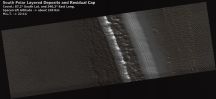
PSP_002856_0875_red-PCF-LXTT.jpgSouth Polar Layered Deposits and Scarp (Absolute Natural Colors; credits: Dr Paolo C. Fienga - Lunexit Team)126 visitenessun commentoMareKromiumGen 27, 2011
|
|

PSP_003063_2050_red.jpgProposed MSL Landing Site in Mawrth Vallis (Natural Colors; credits for the additional process. and color.: Dr Paolo C. Fienga - Lunexit Team) 151 visitenessun commentoMareKromiumGen 26, 2011
|
|

South_Polar_Feature-PIA13727.jpgBizarre-looking Surface Feature - Sol 2467 (EDM - Absolute Natural Colors; credits for the additional process. and color.: Dr Paolo C. Fienga - Lunexit Team)145 visiteThis approx. 4 Km diameter Surface Feature near the edge of the South Polar Residual Cap was recognized in Mariner 9 and Viking Orbiter images taken in the 1970s, but its origin could not be inferred. It was therefore targeted for HiRISE stereo imaging.
The bright areas in this image are covered by CO2 Frost, and the "Swiss Cheese" Terrain typical of the South Polar Residual Cap covers much of the imaged area.
The Dark Walls of the Circular Depression do not have as much Frost on them and are fractured in a Polygonal Pattern. Apparently the Surface of the Walls has been extensively modified by thermal expansion and contraction of water ice. It also appears that the "Swiss Cheese" Terrain of the Residual Cap has buried the Floor of the Circular Depression, as well as the Terrain surrounding the Feature, making it difficult to infer its origin.
Its circular symmetry is consistent with an impact origin, but there is no evidence of a Crater Rim or Ejecta Blanket (perhaps because they have been buried). The Depression may also have formed by Collapse, but there is little evidence of extensional fractures that would be expected around a Collapse Pit. Analysis of HiRISE stereo data may help the interpretation of this however really peculiar Surface Feature.MareKromiumGen 26, 2011
|
|

PSP_003086_2015_red-PCF-LXTT.jpgProposed MSL Landing Site in Nili Fossae (Natural Colors; credits for the additional process. and color.: Dr Paolo C. Fienga - Lunexit Team) 135 visitenessun commentoMareKromiumGen 26, 2011
|
|

PSP_003921_1690_RED_browse-PCF-LXTT.jpgProposed MSL Landing Site in Eos Chasma (Natural Colors; credits for the additional process. and color.: Dr Paolo C. Fienga - Lunexit Team) 142 visitenessun commentoMareKromiumGen 18, 2011
|
|
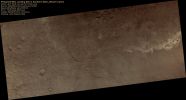
PSP_003972_1305_RED_browse-PCF-LXTT.jpgProposed MSL Landing Site in an Unnamed Southern Crater (Natural Colors; credits for the additional process. and color.: Dr Paolo C. Fienga - Lunexit Team) 94 visitenessun commentoMareKromiumGen 18, 2011
|
|

ESP_020204_1835_RED_abrowse-01.jpgNorthern Meridiani Planum (EDM - Enhanced Absolute Natural Colors; credits for the additional process. and color.: Dr Paolo C. Fienga - Lunexit Team:) 111 visitenessun commentoMareKromiumGen 16, 2011
|
|

PSP_004052_2045_RED_abrowse-02-PIA13726.jpgUnnamed Crater with Layers near Mawrth Vallis (Enhanced Natural Colors; credits: NASA/JPL-Caltech/University of Arizona)114 visiteThis image covers part of an Unnamed Impact Crater roughly 4 Km (approx. 2,5 miles) in diameter; the upper portion of the picture shows a one Km segment of the Crater's Inner Wall and Rim.
The Surface outside the Crater is relatively dark, while the Inner Wall of the Crater exposes lighter, Layered Bedrock of diverse colors. A few dark patches on the Crater Wall have small Dunes or Ripples on their surfaces, and are likely Pits filled with Dark Sand. This Crater provides a window into the Sub-Surface of Mars, revealing Layered Sedimentary Deposits.
Just about 30 Km (approx. 18,6 miles) to the East of this Crater lies Mawrth Vallis, an ancient Channel that may have been carved by catastrophic Floods.
In Layered Deposits surrounding Mawrth Vallis, the orbiting spectrometers OMEGA (on Mars Express) and CRISM (on MRO) have detected Phyllosilicate (such as Clay) minerals, which must have formed in the presence of water.
In this Region on Mars, the colors of the Layers seen by HiRISE often correlate with distinct water-bearing minerals observed by CRISM, so the color diversity seen here may reflect a dynamic environment at this location on early Mars.
Note: the color in these images is enhanced; it is not as it would normally appear to the human eye.MareKromiumGen 12, 2011
|
|
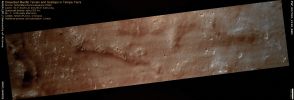
PSP_007930_2310_RED_abrowse-PCF-LXTT.jpgFeatures of Tempe Terra (Absolute Natural Colors; credits for the additional process. and color.: Dr Paolo C. Fienga - Lunexit Team)77 visitenessun commentoMareKromiumGen 12, 2011
|
|

ESP_020319_1470_RED_abrowse-PCF-LXTT.jpgIce-rich Lobate Debris-Aprons in Terra Promethei (Absolute Natural Colors; credits for the additional process. and color.: Dr Paolo C. Fienga - Lunexit Team)168 visiteThis image shows a portion of a Lobate "Debris-Apron! along the bottom of a Hill in the Promethei Terra Region of Mars. This Region contains many such Mesas surrounded by Lobate Debris-Aprons that are thought to be ice-rich.
These Aprons have been interpreted as a variety of possible features including Rock Glaciers, ice-rich Mass Movements, or Debris-covered Glacial Flows. Recent radar data have shown them to be composed of nearly 100% pure ice.
Parallel Grooves and Ridges indicate the direction of flow.
Both the Debris-Apron and the Plains beyond it are blanketed with an ice-rich Mantle that is common throughout the Martian Mid-Latitudes. The Mantle Deposits are pitted and grooved perhaps due to the sublimation of ice. This Mantle is thought to have been deposited as snow around 10 million years ago during a period of high obliquity, when the Planet's Axis was more tilted and environmental conditions could have been more conducive to snowfall in these Regions.
Several small Impact Craters are visible on the Plains that appear to have been filled with Mantling Deposits that have subsequently been partially removed. These Craters give us clues to the erosional history of the Deposit.MareKromiumGen 09, 2011
|
|
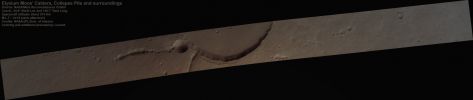
PSP_004903_2050_RED_browse-PCF-LXTT.jpgElysium Mons' Caldera and Collapse Pits (Absolute Natural Colors; credits for the additional process. and color.: Dr Paolo C. Fienga - Lunexit Team)126 visitenessun commentoMareKromiumGen 09, 2011
|
|

ESP_020061_1720_RED_abrowse-PCF-LXTT.jpgBright and Dark Plains (Absolute Natural Colors; additional process. and color.: Dr Paolo C. Fienga - Lunexit Team)126 visiteThis HiRISE image shows a mixture of bright and dark Terrain along the plains just West of Ganges Chasma.
The concentration of these bright patches adjacent to an old Impact Crater suggests that the bright patches could represent Ejecta from when the crater formed.
This would be an interesting discovery because it would mean that a different unit underlies the Surface we now see. Alternatively, much of the Plains in this Region seem to have a dark surficial cover (probably aeolian debris). Where this darker debris has been removed by the wind, the underlying brighter substrate would be exposed.
Mineralogic information from the CRISM instrument would be very useful for determining if the bright patches contain minerals indicative of water - such as Clays - or if they are Basalts (produced from Volcanic Eruptions).MareKromiumGen 08, 2011
|
|
| 2237 immagini su 187 pagina(e) |
 |
|
|
|
|
65 | |
|
|
|
|





