| Ultimi arrivi - Mars Reconnaissance Orbiter (MRO) |
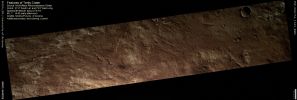
PSP_006752_1525_RED_abrowse-PCF-LXTT2.jpgFeatures of Terby Crater (Absolute Natural Colors; credits for the additional process. and color.: Dr Paolo C. Fienga - Lunexit Team)86 visitenessun commentoMareKromiumGen 31, 2011
|
|
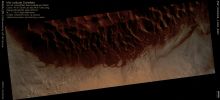
PSP_006648_1300_RED_abrowse-00-PCF-LXTT.jpgSouthern Dunefield (Absolute Natural Colors; credits: Dr Paolo C. Fienga - Lunexit Team)74 visiteSeen here is the Eastern Edge of a Dunefield located in a large, degraded crater in the Southern Hemisphere.
Similar to other Dunes on Mars, these Dunes are dark-toned and contain Gullies. Gullies are features found on Slopes and Dunes in the Mid-Latitudes of both Hemispheres. Both Slope and Dune Gullies were initially suggested to be a result of liquid water from the Surface or Subsurface. Slope and Dune Gullies usually have different morphologies: Dune Gullies are more linear and have Levees bordering their Channels. They typically have no distinguishable, or very small, Alcove and Debris Aprons.
Slope gullies, on the other hand, often have deeply incised Alcoves and Channels that exhibit fluvial characteristics such as Streamlined Islands.
What is highly unusual about this Dunefield is that one of its Gullies has the morphology of a "Slope Gully! (approx. 3 Km across)! This Dune Gully has a very incised Alcove, what appears to be Streamlined Islands on the Channel Floor, and a large, and "feathery" Debris Apron.MareKromiumGen 31, 2011
|
|
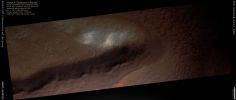
PSP_006648_2255_RED_abrowse-PCF-LXTT.jpgScarps in Deuteronilus Mensae (Absolute Natural Colors; credits for the additional process. and color.: Dr Paolo C. Fienga - Lunexit Team:)80 visiteThis image shows Scarps (such as "Steep Slopes") in Deuteronilus Mensae, a Region of distinctive Terrain in the Northern Hemisphere of Mars. Polygonal fractures, possibly formed by thermal cycles in ice-rich ground, are visible throughout the scene.
The high-standing topography at the top of the Scarps have several muted circles: these are Remnant Impact Craters that have degraded throughout time and their degradation process might have been enhanced by the presence of ground ice.
The two Scarps have different morphologies: the lower (East-facing) side has a Debris Apron with a wave-like texture at its base.
This is suggestive of material that has moved down the Scarp and gradually flowed away from it. Such a process would be expected if the material were ice-rich. There is no counterpart of this feature at the base of the upper (such as the West-facing) side.MareKromiumGen 31, 2011
|
|
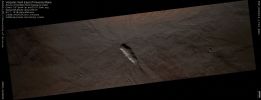
PSP_006653_1795_RED_abrowse-PCF-LXTT.jpgVolcanic Vent, East of Pavonis Mons (Absolute Natural Colors; credits for the additional process. and color.: Dr Paolo C. Fienga - Lunexit) 85 visiteThis image shows an Equatorial Volcanic Vent. A Volcanic Vent is an opening in the Crust of a Planet that emits Lava (such as "molten rock") and Volcanic Gases. The rough texture of the Plains surrounding the Vent is indicative of Lava.
There is a large number of snake-like features emanating from the Vent. The parallel lines that outline the features are "Levees", which mark the edges of Channels that carried molten Lava. As Lava flows, it moves slowest at its edges and bottom because the Lava sticks to the non-flowing rocks; as a consequence of this event, the lava slows down, cools off and, in the end, it hardens.
Levees, on their side, form when the sides of the Lava Flow harden but the center of it keeps moving. As the eruption episode ends, and the Lava drains, the center is left lower than the sides producing these high-standing structures.MareKromiumGen 31, 2011
|
|
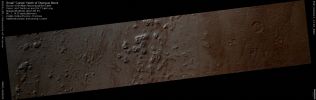
PSP_006667_2150_RED_abrowse-00-PCF-LXTT.jpgSmall "Cones", North of Olympus Mons (Absolute Natural Colors; credits for the additional process. and color.: Dr Paolo C. Fienga - Lunexit) 83 visiteOlympus Mons is the largest Volcano in the Solar System and is thought to have been active in the relatively recent past (which on Mars means many millions of years ago). While this towering giant gets a lot of the attention, it is surrounded by a vast field of other Volcanic Features. This HiRISE image takes a close look at one set of intriguing landforms: small Cones.
Cones similar to these are found atop the freshest Lava Flows on Mars in Athabasca Valles. In that location, HiRISE found proof that they formed by steam exploding through the Lava Flow. The steam was produced by boiling water (or ice) in the ground underneath the Lava Flow. Could the same thing have happened here?
Unfortunately, HiRISE finds that this area north of Olympus Mons is covered in a thick layer of Dust. While the wonderful resolution of HiRISE reveals details of the Ripples in the Dust, it cannot show us what is underneath the Dust. Therefore we cannot prove that these Cones formed the same was as the Athabasca Valles ones.
They could be small Volcanic Vents, but it is unlikely that so many small eruptions would have taken place so close together.
However, since we cannot show that the ground under the Dust is actually Lava, we cannot rule out non-volcanic processes. Still, the similarity in the shapes and sizes of these Cones to the ones in Athabasca Valles leaves open the possibility that Water and Lava interacted explosively here.MareKromiumGen 31, 2011
|
|
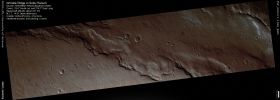
PSP_006573_1560_RED_abrowse-PCF-LXTT.jpgWrinkle Ridge in Solis Planum (Absolute Natural Colors; credits for the additional process. and color.: Dr Paolo C. Fienga)70 visiteThis observation shows a "Wrinkle Ridge" in Solis Planum, located in the Thaumasia Region of Mars, a high-elevation Volcanic Plain located South of the Valles Marineris Canyon System and East of the Tharsis Volcanic Complex.
Solis Planum contains some of the most distinct and well studied arrays of Wrinkle Ridges on Mars. Wrinkle Ridges are long, winding topographic highs and are often characterized by a broad arch topped with a crenulated ridge. These features have been identified on many other planetary bodies such as the Moon, Mercury and Venus.
On Mars, they are many tens to hundreds of kilometers long, tens of kilometers wide, and have a relief of a few hundred meters.
Wrinkle Ridges are most commonly believed to form from horizontal compression or shortening of the Crust due to Faulting and are often located in Volcanic Plains. They commonly have asymmetrical cross sectional profiles and an offset in elevation on either side of the ridge. Large Dunes are also visible bordering the Wrinkle Ridge. The reddish colors seen in this image most likely indicate the presence of Dust (or indurated Dust) and the darker, bluish colors most likely indicate the presence of larger Rocks and Boulders on the Wrinkle Ridge.MareKromiumGen 31, 2011
|
|
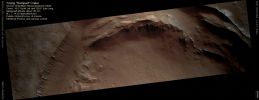
PSP_006588_1615_RED_abrowse-PCF-LXTT.jpgRelatively young "Rampart" Crater (Absolute Natural Colors; credits for the additional process. and color.: Dr Paolo C. Fienga - Lunexit Team)77 visiteThis image captures the Western Side of a relatively young “Rampart” Crater located in the Tharsis Region.
Rampart Craters are surrounded by a fluidized Ejecta Blanket (an Ejecta Blanket is the material thrown out around a Crater when the impact occured, in this case resembling the whites of a fried egg, where the crater is the yolk). Researchers speculate that these may form when an object impacts ground that contains fluid (liquid or frozen) that is released upon impact.
THEMIS images V06896002 and V10266002 provide context images for this side of the Crater and show better its Rampart.
Within the Crater we see evidence of Landslides originating at the upper edges. These Landslides have exposed individual Rocky Layers as well as Outcrops of stronger rock types which are more resistant to erosion.MareKromiumGen 31, 2011
|
|
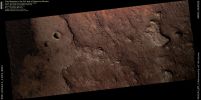
PSP_006625_1405_RED_abrowse-00-PCF-LXTT.jpgClay Minerals in the NW side of Bosporos Montes (Absolute Natural Colors; credits for the additional process. and color.: Dr Paolo C. Fienga - Lunexit Team)76 visiteThe Bosporos Montes make up part of the Rim of the giant Argyre Impact Basin on Mars. The Compact Reconnaissance Imaging Spectrometer (CRISM) identified this as a location with Clay Minerals (---> minerali a matrice argillosa). Such minerals contain water and may have formed under conditions favorable for life.
This HiRISE image was taken to support the CRISM Team’s investigation of this area. While HiRISE does not have the ability to identify minerals the way CRISM can, the enhanced colors in this image are similar to those seen in other Clay-containing parts of Mars.
The light-toned Mesas and Plains are crisscrossed with small Fractures that could have formed as a muddy Clay Deposit dried. However, this material is strong enough to form Boulders where it has been hit by Impact Craters.MareKromiumGen 31, 2011
|
|

PSP_005387_1935_RED_abrowse-00-PCF-LXTT.jpg"Sinuous" Collapse Pits on Ascraeus Mons (Absolute Natural Colors; credits for the additional process. and color.: Dr Paolo C. Fienga - Lunexit Team)77 visitenessun commentoMareKromiumGen 31, 2011
|
|
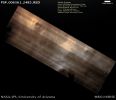
PSP_006561_2485_RED_abrowse.jpgWinter Sunrise in Vastitas Borealis (Absolute Natural Colors; credits for the additional process. and color.: Dr Paolo C. Fienga)72 visiteThis High Latitude image shows a portion of the Landing Ellipse for the Mars Scout Spacecraft Phoenix as seen during late Winter on Mars. Phoenix will land somewhere within the Ellipse on Memorial Day, 2008, but probably not within this image.
While the Phoenix Lander will land in Mid-Spring and operate through the Martian Summer, the current Winter landscape looks somewhat different. The Sun is beginning to rise from the Winter night and is only 10° above the horizon to illuminate the Surface in this image.
As a result, what few rocks are present cast noticeable shadows, and every bump and undulation of the Surface, now matter how small, is accentuated.
In this Winter image, a blanket of CO2 Frost (dry ice snow) about a foot deep covers the Surface. Bright patches in the image are areas where the Frost is relatively clean, while in darker areas over much of the image, the Frost is either dirty with Atmospheric dust or the Frost is somewhat translucent allowing us to see a little of the Soil forming the Surface.
Summertime images of this Region show that small Hexagonal and Polygonal Patterns a few meters (yards) in size ubiquitously cover the entire Region. These Patterns are the result of annual thermal contraction in ice-cemented soil forming a honeycomb network of small fractures below the Surface that manifest themselves as small shallow Troughs (---> canaletti) at the Surface.
Interestingly, these Patterns are not visible in this image. The shallow Troughs that mark the polygons are currently filled in with CO2 Frost making them virtually invisible.
As Spring approaches the CO2 Frost will slowly sublimate (changes directly from ice to gas) and the Polygons will once again become visible. MareKromiumGen 31, 2011
|
|

PSP_005149_1715_RED_browse-PCF-LXTT.jpgLight-toned Layering and a huge Collapse Feature near Jus Chasma (Absolute Natural Colors; additional process.: Dr Paolo C. Fienga - Lunexit Team)107 visitenessun commentoMareKromiumGen 30, 2011
|
|
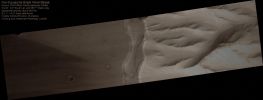
PSP_005109_1770_RED_browse-PCF-LXTT.jpgPeri-Equatorial Canyon and Winstreak (Absolute Natural Colors; credits for the additional process. and color.: Dr Paolo C. Fienga - Lunexit Team) 98 visitenessun commentoMareKromiumGen 30, 2011
|
|
| 2237 immagini su 187 pagina(e) |
 |
|
|
|
|
64 | |
|
|
|
|





