| Ultimi arrivi - Mars Reconnaissance Orbiter (MRO) |

PSP_005401_1960_RED_abrowse.jpgVolcanic Channels, East of Olympus Mons (Absolute Natural Colors; credits for the additional process. and color.: Dr Paolo C. Fienga - Lunexit) 109 visitenessun commentoMareKromiumFeb 02, 2011
|
|

ESP_020794_1860_RED_abrowse.jpg"!" (Absolute Natural Colors; credits for the additional process. and color.: Dr Paolo C. Fienga - Lunexit Team)110 visitenessun commentoMareKromiumFeb 02, 2011
|
|
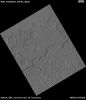
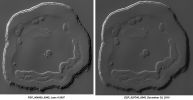
PSP_004000_0945_RED_abrowse-00.jpgChangings... (CTX Frame - credits: NASA/JPL/University of Arizona)93 visiteHiRISE is monitoring the Residual Carbon Dioxide Cap on (or near) the South Pole of Mars to see how it changes over time.
Some of this Terrain contains many Pits, earning it the nickname "Swiss Cheese Terrain". One of our monitoring spots is over what looks like a deranged "Happy Face". If you look closely, you'll see many changes since the first HiRISE image, PSP_004000_0945, was acquired in 2007. The news is that the Pits have grown larger. When this Pit growth was first discovered, it was suggested to be an indication of climate change on Mars. However, we now suspect that the CO2 that sublimates from the Pit Walls recondenses on the nearby surfaces, so there is no net change in the total amount of frozen CO2.
Acquisition date: December, 30th, 2010
Mars Local Time (M.L.T.): 18:03 (Late Afternoon)
Latitude (centered): 85,7° South
Longitude (East): 6,5°
Spacecraft Altitude (or Range to Target Site): 247,6 km (154,8 miles)
Original image scale range: 24,8 cm/pixel (with 1 x 1 binning) so objects ~74 cm across are resolved
Map Projected Scale: 25 cm/pixel
Map Projection: POLAR STEREOGRAPHIC
Emission Angle: 0,2°
Phase Angle: 78,9°
Solar Incidence Angle: 79° (with the Sun about 11° above the Local Horizon)
Solar Longitude: 207,7° (Northern Autumn)MareKromiumFeb 01, 2011
|
|
PSP_004000_0945_RED_abrowse-01.jpgChangings... (EDM - credits: NASA/JPL/University of Arizona)97 visitenessun commentoMareKromiumFeb 01, 2011
|
|

PSP_005392_0995_RED_abrowse-02~0.jpgImpact Crater on the South Polar Layered Deposits (EDM n.2 - Absolute Natural Colors; credits for the additional process. and color.: Dr Paolo C. Fienga - Lunexit Team)89 visiteOf particular interest is the small, approx. 330 meter (360 yard) diameter Impact Crater. The number of Impact Craters on a Planetary Surface is often used to estimate the age of that Surface (because the older a Surface is, the more time that Surface has had to accumulate Craters, and thus the more Craters that Surface will have on it - assuming, of course, a constant "Cratering Rate" - Nota Lunexit: questa è un'assunzione, a dir poco, azzardata...).
The SPLD on Mars are believed to be very young because there are no large Craters on them and very few small Craters. The high resolution of HiRISE will enable these Craters to be studied in detail, perhaps allowing the number of Craters — and thus the Surface age — to be better constrained.MareKromiumFeb 01, 2011
|
|

PSP_005369_1925_RED_abrowse.jpgFeatures of Terra Sabaea (Absolute Natural Colors; credits for the additional process. and color.: Dr Paolo C. Fienga - Lunexit Team)81 visitenessun commentoMareKromiumFeb 01, 2011
|
|
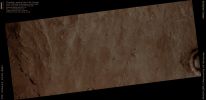
PSP_006633_2010_RED_abrowse~0.jpgPossible MSL Landing Site in Nili Fossae (Absolute Natural Colors; credits for the additional process. and color.: Dr Paolo C. Fienga - Lunexit Team) 81 visiteThe Nili Fossae are Valleys that have cut into the ancient crust of Mars, exposing Clay Minerals. These minerals formed in the presence of water and may be the result of chemical reactions between hot water and rocks. If so, this could have been a favorable location for Martian Life in ancient times.
This HiRISE image is part of a series in search for a safe place the Mars Science Laboratory Rover can land. In the central part of the image, the Terrain is a mix of Sand Dunes and relatively smooth rock exposures. There are some small Knobs but very few large rocks in the area. Instead, the multi-colored rock exposures seem to be mostly a mosaic of flat fractured rock.
On the Southern edge of the image (Dx), an Impact Crater is a potential hazard. In the Northern part of the image, the Scarp marking the boundary of the valley is visible.MareKromiumFeb 01, 2011
|
|

PSP_005370_1845_RED_abrowse-00.jpgExtremely unusually-looking Surface Feature in Sinus Meridiani (CTX Frame - Absolute Natural Colors; credits for the additional process. and color.: Dr Paolo C. Fienga - Lunexit Team)79 visitenessun commentoMareKromiumFeb 01, 2011
|
|
PSP_005370_1845_RED_abrowse-01.jpgExtremely unusually-looking Surface Feature in Sinus Meridiani (EDM - Absolute Natural Colors; credits for the additional process. and color.: Dr Paolo C. Fienga - Lunexit Team)82 visitenessun commentoMareKromiumFeb 01, 2011
|
|

PSP_005388_1975_RED_abrowse-00-PCF-LXTT.jpgPang Boche Crater (CTX Frame - Absolute Natural Colors; credits for the additional process. and color.: Dr Paolo C. Fienga - Lunexit Team) 100 visitenessun commentoMareKromiumGen 31, 2011
|
|

PSP_005361_2005_RED_abrowse-00.jpgCatastrophic Outflow Feature in Tharsis (Absolute Natural Colors; credits for the additional process. and color.: Dr Paolo C. Fienga - Lunexit Team)79 visitenessun commentoMareKromiumGen 31, 2011
|
|
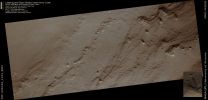
PSP_006569_1915_RED_abrowse-00-PCF-LXTT.jpgFeatures of Henry Crater (Absolute Natural Colors; credits for the additional process. and color.: Dr Paolo C. Fienga - Lunexit Team)87 visiteNamed after a 19th Century French Astronomer, Henry Crater is an about 165 Km (approx. 103 mile) diameter Impact Crater, located in Arabia Terra, on a portion of the Martian Highlands extending into the Northern Hemisphere. This observation shows multiple Layers on the Edge of a Mound on the Floor of the Crater, which is distinct from others in the immediate vicinity.
The Layers represent the eroded remains of Sedimentary Rocks that formed from Sediments deposited within the Crater sometime after its formation. The origin of the Sediments on the Crater Floor in not known but may be windblown Dust and Sand.
The Layers exhibit differences in degrees of hardness and resistance to erosion with resistant Layers forming Cliffs and more easily eroded Layers forming Ledges.
Inset: Several Dark Streaks are visible on the Slopes. Slope Streak formation is among the few known processes currently active on Mars. Streaks are believed to form by downslope movement of Dust in an almost fluid-like manner (analogous to a terrestrial Snow Avalanche) either exposing darker underlying material or creating a darker surface by increasing its roughness. MareKromiumGen 31, 2011
|
|
| 2237 immagini su 187 pagina(e) |
 |
|
|
|
|
63 | |
|
|
|
|





