| Ultimi arrivi - Mars Reconnaissance Orbiter (MRO) |
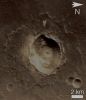
Craters-Unnamed_Crater-Arabia_Terra-1.jpgMartian "Love" (EDM - Absolute Natural Colors; credits for the additional process. and color.: Dr Paolo C. Fienga - Lunexit Team)94 visiteis picture of a "heart-shaped" feature in Arabia Terra on Mars was taken on May 23, 2010, by the Context Camera (CTX) on NASA's Mars Reconnaissance Orbiter. A small Impact Crater near the tip of the heart is responsible for the formation of the bright, heart-shaped feature. When the impact occurred, darker material on the Surface was blown away while brighter material beneath it was revealed.
Some of this brighter material appears to have flowed further downslope to form the heart, as the small impact occurred on the Ejecta Blanket of a much larger Impact Crater.
The heart-shaped feature is about 1 Km (0,6 mile) long and is centered at 21,9° North Lat. and 12,7° West Long.
These pictures are subframes of the full CTX image B21_017910_2002_XI_20N012W, taken just at the start of Northern Summer on Mars. North is to the right, and illumination is from the upper right.MareKromiumFeb 18, 2011
|
|

Craters-Unnamed_Crater-Arabia_Terra-2.jpgMartian "Love" (EDM - Absolute Natural Colors; credits for the additional process. and color.: Dr Paolo C. Fienga - Lunexit Team)100 visiteThis picture of a "heart-shaped" feature in Arabia Terra on Mars was taken on May 23, 2010, by the Context Camera (CTX) on NASA's Mars Reconnaissance Orbiter. A small Impact Crater near the tip of the heart is responsible for the formation of the bright, heart-shaped feature. When the impact occurred, darker material on the Surface was blown away while brighter material beneath it was revealed.
Some of this brighter material appears to have flowed further downslope to form the heart, as the small impact occurred on the Ejecta Blanket of a much larger Impact Crater.
The heart-shaped feature is about 1 Km (0,6 mile) long and is centered at 21,9° North Lat. and 12,7° West Long.
These pictures are subframes of the full CTX image B21_017910_2002_XI_20N012W, taken just at the start of northern summer on Mars. North is to the right, and illumination is from the upper right.MareKromiumFeb 18, 2011
|
|

ESP_020827_1595_RED_abrowse-PCF-LXTT.jpgOlivine-rich Terrain (Absolute Natural Colors; credits for the additional process. and color.: Dr Paolo C. Fienga - Lunexit Team)105 visitenessun commentoMareKromiumFeb 17, 2011
|
|
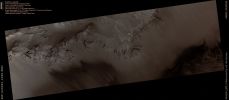
ESP_020945_1690_RED_abrowse-PCF-LXTT.jpgSouthern Landslide (Absolute Natural Colors; credits: Dr Paolo C. Fienga - Lunexit Team)101 visitenessun commentoMareKromiumFeb 17, 2011
|
|
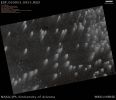
ESP_020953_0925_RED_abrowse-00.jpgSouthern Fans (Absolute Natural Colors; credits for the additional process. and color.: Dr Paolo C. Fienga - Lunexit Team)90 visitenessun commentoMareKromiumFeb 17, 2011
|
|
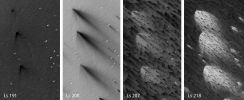
ESP_020953_0925_RED_abrowse-01.jpgEvolution of Southern Fans (an Image-Mosaic by NASA/JPL/University of Arizona)91 visiteThis is a sequence of 4 images acquired in Early Southern Spring over a particular spot in the South Polar Region. The changes in patterns are so great over just half a season that it is difficult to believe that the images cover the same ground. This composite helps by focusing on 3 distinctive Fans as they evolve. The Dark Fans turn into broad Bright Fans, then new small Dark Fans form inside the old Bright Fans. The newer Dark Fans form along cracks forming polygonal or other patterns.
These changes are driven by Sublimation and Condensation of volatiles, primarily CO2. Sunlight passes through the Ice to warm Subsurface Pockets of Gas which escape to form cold jets and the wind blows to form Fans on the Surface, depositing Dark Dust and Bright Frost.
Note: The Martian year is measured by 360° of Areocentric Longitude of the Sun or "Ls", where Ls 180-270 marks Southern Spring and Northern Fall. The Ls of each image is marked in each subframe and covers only 30% of the Spring.MareKromiumFeb 17, 2011
|
|
ESP_020940_1315_RED_abrowse-PCF-LXTT.jpgUnnamed Southern Crater with Gullies and Dark Dunes (Absolute Natural Colors; credits for the additional process. and color.: Dr Paolo C. Fienga - Lunexit Team)94 visitenessun commentoMareKromiumFeb 17, 2011
|
|

ESP_020812_1530_RED_abrowse-PCF-LXTT-1.jpgPossible MSL Landing Site inside Holden Crater (Absolute Natural Colors; credits for the additional process. and coloring: Dr Paolo C. Fienga - Lunexit Team)127 visitenessun commentoMareKromiumFeb 17, 2011
|
|

ESP_020245_2190_RED_abrowse.jpgUnnamed Northern Crater with Gullies (Natural Colors; credits for the additional process. and color.: Dr Paolo C. Fienga - Lunexit Team)90 visitenessun commentoMareKromiumFeb 17, 2011
|
|

ESP_020058_1300_RED_abrowse-01-PCF-LXTT.jpgDune-Gullies in Matara Crater (EDM - Absolute Natural Colors; credits for the additional process. and color.: Dr Paolo C. Fienga - Lunexit Team)83 visiteCaption NASA:"This image shows changing Dunes and incised Gullies (so-called "Dune-Gullies") in the Southern Matara Crater.
Repeat imaging of the Dunes in this Crater shows that material towards the top of the Gullies has moved downslope and the Channel Beds may have widened over time.
Since this activity occurs during Martian Southern Hemisphere Winter, it is believed to be related to Carbon Dioxide (CO2) Frost that forms as the area grows colder. Scientists continue to monitor this specific Region for changes in the Gullies and the Dunes themselves. This frame is approx. 1 (one) Km (0,6 miles) across".MareKromiumFeb 15, 2011
|
|

ESP_020058_1300_RED_abrowse-02.jpgDune-Gullies in Matara Crater (EDM - Approx. True Colors; credits for the additional process. and color.: NASA/JPL/University of Arizona)59 visiteCaption NASA:"This image shows changing Dunes and incised Gullies (so-called "Dune-Gullies") in the Southern Matara Crater.
Repeat imaging of the Dunes in this Crater shows that material towards the top of the Gullies has moved downslope and the Channel Beds may have widened over time.
Since this activity occurs during Martian Southern Hemisphere Winter, it is believed to be related to Carbon Dioxide (CO2) Frost that forms as the area grows colder. Scientists continue to monitor this specific Region for changes in the Gullies and the Dunes themselves. This frame is approx. 1 (one) Km (0,6 miles) across".MareKromiumFeb 15, 2011
|
|

ESP_020797_1280_RED_abrowse-01.jpgPossible Active Gullies' Activity on a Southern Dunefield (Natural Colors; credits for the coloring: Dr Paolo C. Fienga - Lunexit Team)111 visitenessun commentoMareKromiumFeb 15, 2011
|
|
| 2237 immagini su 187 pagina(e) |
 |
|
|
|
|
59 | |
|
|
|
|





