| |

| Ultimi arrivi - Mars Reconnaissance Orbiter (MRO) |
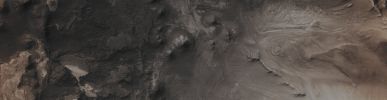
ESP_025231_1720-PCF-LXTT-IPF.jpgFeatures of Jus Chasma (Absolute Natural Colors; credits for the additional process. and color.: Dr Paolo C. Fienga/Lunar Explorer Italia/Italian Planetary Foundation)104 visiteThis image, taken by the NASA - Mars Reconnaissance Orbiter in December 2011, shows us a portion of Jus Chasma, a segment of the massive Martian Canyon System known as Vallis Marineris; the most important detail visible in the picture is given by the presence, within the Chasma, of a Fault (which, by the way, it had been previously imaged by the NASA - Mars Global Surveyor (MGS) - Mars Orbiter Camera (MOC).
If you look carefully towards the centre/right (Dx) side of the picture, you will also notice that a small Valley cuts across the Ridge. Planetary Scientists have asked themselves if what we see here could be the final result of the action of some Tectonic Process, and a Study that was carried out about this topic in the AD 2012, suggested that Mars actually possesses Tectonic Plates! However, and even admitting that what has been suggested by the aformentioned Study is actually true, the question about how these processes worked (or are still working, even though in just a "residual way"...) here and, perhaps, elsewhere on the Red Planet, is still unanswered.
Mars Local Time: 14:56 (Early Afternoon)
Coord. (centered): 7,899° South Lat. and 279,399° East Long.
Spacecraft altitude: 287,5 Km (such as about 178,53 miles)
Original image scale range: 28,8 cm/pixel (with 1 x 1 binning) so objects ~ 86 cm across are resolved
Map projected scale: 25 cm/pixel
Map projection: EQUIRECTANGULAR
Emission Angle: 24,3°
Phase Angle: 33,4°
Solar Incidence Angle: 50° (meaning that the Sun was about 40° above the Local Horizon at the time the picture was taken)
Solar Longitude: 43,2° (Northern Spring - Southern Fall)
Credits: NASA/JPL/University of Arizona
Additional process. and coloring: Lunar Explorer Italia
This picture (which is a NASA - Original Mars Reconnaissance Orbiter NON_Map Projected CTX b/w frame identified by the serial n. ESP_025231_1720 and a NASA - Original Mars Reconnaissance Orbiter EDM false-color frame identified by the serial n. ESP_025164_1655-1) have been additionally processed and then colorized (and re-colorized, respectively) in Absolute Natural Colors (such as the colors that a human eye would actually perceive if someone were onboard the NASA - Mars Reconnaissance Orbiter and then looked down, towards the Surface of Mars), by using an original technique created - and, in time, dramatically improved - by the Lunar Explorer Italia Team.MareKromiumApr 28, 2013
|
|

Gullies-ESP_020661_1440-PCF-LXTT-IPF.jpgGullies in Gasa Crater (Absolute Natural Colors; credits for the additional process. and color.: Dr Paolo C. Fienga/Lunar Explorer Italia/Italian Planetary Foundation)78 visiteThe so-called "Gully Landforms" - just like the ones shown here, in this NASA - Mars Reconnaissance Orbiter image - can often be found in the Inner Rims (or even below, along the Inner Slopes) of many Impact Craters that are located at the Martian Mid-Latitudes. Some changes in these Gully Landforms were first seen in frames taken by the NASA - Mars Global Surveyor - Mars Orbiter Camera (MGS-MOC) in the AD 2006, and studying such activity has been a high priority for HiRISE ever since (and, in fact, many examples of New Deposits located inside Gully Landforms are now well known).
This frame shows a New Deposit inside some Gully Landforms located on the Inner Rim of Gasa Crater; a very (relatively speaking) "fresh" approx. 7-Km diameter Impact Crater that is found in the Southern Mid-Latitudes of the Red Planet (to be precise, at 35,72° South Latitude and 129.45° East Longitude). Said New Deposit appears of a distinctive gray color, with some patches of white Material too, in this Absolute Natural Color version of the NASA - Mars Reconnaissance Orbiter image n. ESP_020661_1440. The picture was acquired during the Southern Spring of Mars, but the Flow that formed the Deposit occurred in the preceding Winter.
As a matter of fact, the current Gully Activities appear to be concentrated in periods going from the late Winter to the early Spring of Mars, and this circumstance may be a consequence of the Sublimation of the Seasonal Carbon Dioxide (CO2) Frost (which, by the way, is well visible in several Gully "Alcoves" during Wintertime).
Mars Local Time: 15:49 (Middle Afternoon)
Coord. (centered): 35,729° North Lat. and 129,386° East Long.
Spacecraft altitude: 258,2 Km (such as about 160,3 miles)
Original image scale range: 25,8 cm/pixel (with 1 x 1 binning) so objects ~ 78 cm across are resolved
Map projected scale: 25 cm/pixel
Map projection: EQUIRECTANGULAR
Emission Angle: 11,0°
Sun-Mars-Spacecraft (or Phase) Angle: 47,6°
Solar Incidence Angle: 58° (meaning that the Sun was about 32° above the Local Horizon at the time the picture was taken)
Solar Longitude: 203,7° (Northern Fall - Southern Spring)
Credits: NASA/JPL/University of Arizona
Additional process. and coloring: Lunar Explorer Italia
This picture (which is an Original Mars Reconnaissance Orbiter EDM enhanced color frame, identified by the serial n. ESP_020661_1440) has been additionally processed and then re-colorized in Absolute Natural Colors (such as the colors that a human eye would actually perceive if someone were onboard the NASA - Mars Reconnaissance Orbiter and then looked down, towards the Surface of Mars), by using an original technique created - and, in time, dramatically improved - by the Lunar Explorer Italia Team.MareKromiumMar 22, 2013
|
|

Craters-Kasimov_Crater-ESP_030609_1550-PCF-LXTT-IPF-3.jpgInverted Channels in Kasimov Crater (Absolute Natural Colors; credits for the additional process. and color.: Dr Paolo C. Fienga - Lunar Explorer Italia/Italian Planetary Foundation)73 visiteBy slightly enhancing an Absolute Natural Color image such as the EDM (see the inset to the right of the CTX Frame, which represents an about 1-Km wide - such as 0,621 miles - section of the whole area photographed by the NASA - Mars Reconnaissance Orbiter), can help us to achieve a better understanding of the imaged Surface Features, as well as to clearly distinguish between Surface Materials possessing different Histories, Textures and Mineral (---> Chemical) Compositions.
The whole image shows us a portion of the Floor of the Martian Impact Crater named "Kasimov" (a large - approx. 91 Km in diameter - and extremely ancient Impact Crater located in the Southern Hemisphere of the Red Planet), with several brown-gray (with subtle reddish nuances) Ridges that run from the bottom center to the upper left side of the frame. If you look carefully at all these different Ridges, you will notice that the Main Ridge is joined by a smaller one (look at the central portion of the CTX Frame) like small Tributary Rivers join together with larger ones on Earth. Indeed, this is exactly what happened here, on Mars, but - most likely - a few billions of years ago.
These Ridges are called "Inverted Channels" and they mark the locations of ancient Martian Riverbeds (in this case the Main River flowed towards the upper left of the image). Such Inverted Channels formed because the bottoms of these Rivers (---> Tributaries) were all full of Gravel-sized Rocks, whereas the areas around them were made of fine Clays. A VERY long time after the Rivers stopped flowing and dried-up, the Wind, slowly, removed completely the fine and light Clays, but it was not strong enough to blow away the heavy Gravel. In the end, after all the Clays were gone, the old Riverbeds were left as High-standing Gravel Ridges, such as the ones very well visible here (both in the CTX Frame as well as in the EDM).
Mars Local Time: 15:49 (Middle Afternoon)
Coord. (centered): 35,729° North Lat. and 129,386° East Long.
Spacecraft altitude: 258,2 Km (such as about 160,3 miles)
Original image scale range: 25,8 cm/pixel (with 1 x 1 binning) so objects ~ 78 cm across are resolved
Map projected scale: 25 cm/pixel
Map projection: EQUIRECTANGULAR
Emission Angle: 11,0°
Sun-Mars-Spacecraft (or Phase) Angle: 47,6°
Solar Incidence Angle: 58° (meaning that the Sun was about 32° above the Local Horizon at the time the picture was taken)
Solar Longitude: 203,7° (Northern Fall - Southern Spring)
Credits: NASA/JPL/University of Arizona
Additional process. and coloring: Lunar Explorer Italia
The CTX Frame (which is an Original Mars Reconnaissance Orbiter non-map projected b/w frame, identified by the serial n. ESP_030609_1550) and the EDM (which is an Original Mars Reconnaissance Orbiter enhanced color frame, identified by the serial n. ESP_030609_1550-1) have both been additionally processed and then colorized (as far as the EDM is concerned, re-colorized) in Absolute Natural Colors (such as the colors that a human eye would actually perceive if someone were onboard the NASA - Mars Reconnaissance Orbiter and then looked down, towards the Surface of Kasimov Crater - Mars), by using an original technique created - and, in time, dramatically improved - by the Lunar Explorer Italia Team. Different colors, as well as different shades of the same color, mean, among others, the existence of different Elements present on the Surface of Kasimov Crater, each having a different Albedo (---> Reflectivity) and Chemical Composition.MareKromiumMar 22, 2013
|
|
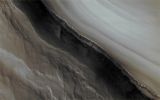
ESP_025010_2650-PCF-LXTT-IPF.jpgOn the North Polar Scarp (EDM - Absolute Natural Colors; credits for the additional process. and color. Dr Paolo C. Fienga/Lunar Explorer Italia/Italian Planetary Foundation)76 visiteThis image, taken by the NASA - Mars Reconnaissance Orbiter in the late November of the AD 2011, was acquired in order to monitor the effects on the North Polar Scarp of the so-called "Frost Avalanches" that occurred the year prior. HiRISE often re-images certain areas of Mars so to track those changes which, over time, might have occurred in some particularly interesting Regions and, in this case, the NASA People wanted to photograph the North Polar Scarp near the onset of the Martian Springtime, so to get a better understanding, among other things, of the number, extent and frequency of these Frost Avalanches; their possible causes (beside the thawing ---> the fact that Ice, Snow, or other frozen substances, start to become liquid, or just soft, as a result of warming) and the role that they have in the evolution of the North Poalr Scarp itself.
It is a fact that, even though the HiRISE has captured the occurrence of many other Frost Avalanches in the past, their view never ceases to amaze, since it demonstrates (but we, as IPF, just like many other Researchers and Scientists all over the World, had no doubts about it) that there still are, even at present time, several Active Geologic and Atmospheric Processes which keep happening (or regular bases) on the Red Planet. And this one, in other words, is just "one of the many"...
Mars Local Time: 12:33 (Early Afternoon)
Coord. (centered): 84,995° North Lat. and 151,528° East Long.
Spacecraft altitude: 320,4 Km (such as about 200,2 miles)
Original image scale range: 32,1 cm/pixel (with 1 x 1 binning) so objects ~ 96 cm across are resolved
Map projected scale: 25 cm/pixel
Map projection: POLAR STEREOGRAPHIC
Emission Angle: 0,5°
Phase Angle: 71,1°
Solar Incidence Angle: 71° (meaning that the Sun was about 19° above the Local Horizon at the time the picture was taken)
Solar Longitude: 35,4° (Northern Spring - Southern Fall)
Credits: NASA/JPL/University of Arizona
Additional process. and coloring: Lunar Explorer Italia
This picture (which is a cropped and NON-Map Projected NASA - Original Mars Reconnaissance Orbiter CTX b/w frame, identified by the serial n. ESP_025010_2650) has been additionally processed and then colorized in Absolute Natural Colors (such as the colors that a human eye would actually perceive if someone were onboard the NASA - Mars Reconnaissance Orbiter and then looked down, towards the Surface of Mars), by using an original technique created - and, in time, dramatically improved - by the Lunar Explorer Italia Team.MareKromiumFeb 14, 2013
|
|

Nereidum_Montes-Dunefield-ESP_029608_1390-PCF-LXTT-IPF-1.jpgDunefield in Nereidum Nontes (CTX Frame - Absolute Natural Colors; credits for the additional process. and color.: Dr Paolo C. Fienga/Lunar Explorer Italia/IPF)55 visiteMars Local Time: 15:43 (Middle Afternoon)
Coord. (centered): 40,495° North Lat. and 309,939° East Long.
Spacecraft altitude: 254,8 Km (such as about 159,3 miles)
Original image scale range: 25,5 cm/pixel (with 1 x 1 binning) so objects ~ 76 cm across are resolved
Map projected scale: 25 cm/pixel
Map projection: EQUIRECTANGULAR
Emission Angle: 1,0°
Phase Angle: 57,3°
Solar Incidence Angle: 56° (meaning that the Sun was about 34° above the Local Horizon at the time the picture was taken)
Solar Longitude: 209,9° (Northern Autumn - Southern Spring)
Credits: NASA/JPL/University of Arizona
Additional process. and coloring: Lunar Explorer ItaliaMareKromiumGen 11, 2013
|
|

Nereidum_Montes-Dunefield-ESP_029608_1390-PCF-LXTT-IPF-2.jpgDunefield in Nereidum Nontes (EDM - Absolute Natural Colors; credits for the additional process. and color.: Dr Paolo C. Fienga/Lunar Explorer Italia/IPF)55 visiteMars Local Time: 15:43 (Middle Afternoon)
Coord. (centered): 40,495° North Lat. and 309,939° East Long.
Spacecraft altitude: 254,8 Km (such as about 159,3 miles)
Original image scale range: 25,5 cm/pixel (with 1 x 1 binning) so objects ~ 76 cm across are resolved
Map projected scale: 25 cm/pixel
Map projection: EQUIRECTANGULAR
Emission Angle: 1,0°
Phase Angle: 57,3°
Solar Incidence Angle: 56° (meaning that the Sun was about 34° above the Local Horizon at the time the picture was taken)
Solar Longitude: 209,9° (Northern Autumn - Southern Spring)
Credits: NASA/JPL/University of Arizona
Additional process. and coloring: Lunar Explorer ItaliaMareKromiumGen 11, 2013
|
|

ESP_029516_1730-PCF-LXTT-IPF-2.jpgFeatures of Hydrae Chasma (Absolute Natural Colors; credits for the additional process. and color.: Dr Paolo C. Fienga/Lunar Explorer Italia/Italian Planetary Foundation)82 visiteHydrae Chasma is a deep, almost Circular Depression approximately 50 Km across, situated between Juventae Chasma (to the North) and the large Canyon System known as Valles Marineris (to the South). This Chasma (---> Abyss) has steep Walls, flanked by numerous Landslides and a massive Scarp along its Southern Boundary, just where the Surface has collapsed into the Depression.
The EDM shows us an isolated flat-topped and small Mountain (known as a "Mesa") rising out of a Sea of Dunes located in the center of Hydrae Chasma. Darker-toned Dunes, likely composed of Basaltic Sands, form an Apron along the base of the Mesa's Northern Margin. The Western Side of the Mesa is gently sloping and is composed of a highly fractured light-toned Rubbly Base. It is overlaid by alternating light and dark Layered Cliff-forming Units and is covered by a Sediment Cap containing still more Dunes.
The Layered Sequences are present only in the Interior Deposits and not in the Walls of the Chasma. Similar Deposits can also be found on the Floor of the Valles Marineris Canyon System, as well as in other Chasmata (like Juventae, for instance), and may represent the Sedimentary Remnants of ancient (relatively) deep and quiet (---> with probably minimal Internal Streams) Martian Lakes that formed, eons ago, within all these Canyon and Depression Systems and which, in (a, likely, extremely long) time, slowly disappeared (---> evaporated, sublimed or just froze).
Mars Local Time: 15:39 (Middle Afternoon)
Coord. (centered): 6,825° South Lat. and 297,987° East Long.
Spacecraft altitude: 268,4 Km (such as about 167,8 miles)
Original image scale range: 26,9 cm/pixel (with 1 x 1 binning) so objects ~ 81 cm across are resolved
Map projected scale: 25 cm/pixel
Map projection: EQUIRECTANGULAR
Emission Angle: 8,5°
Phase Angle: 45,9°
Solar Incidence Angle: 54° (meaning that the Sun was about 36° above the Local Horizon at the time the picture was taken)
Solar Longitude: 205,5° (Northern Autumn - Southern Spring)
Credits: NASA/JPL/University of Arizona
Additional process. and coloring: Lunar Explorer Italia
These two pictures (which are a NASA - Original Mars Reconnaissance Orbiter CTX b/w frame and an EDM color frame, both identified by the serial n. ESP_029516_1730) have been additionally processed and then colorized and re-colorized (as far as the EDM is concerned), respectively, in Absolute Natural Colors (such as the colors that a human eye would actually perceive if someone were onboard the NASA - Mars Reconnaissance Orbiter and then looked down, towards the Surface of Mars), by using an original technique created - and, in time, dramatically improved - by the Lunar Explorer Italia Team.MareKromiumDic 19, 2012
|
|

ESP_029660_1350-PCF-LXTT-IPF-2.jpgAsymmetrical Dune (Absolute Natural Colors; credits for the additional process. and color.: Dr Paolo C. Fienga/Lunar Explorer Italia/Italian Planetary Foundation)95 visiteMars Local Time: 15:44 (Middle Afternoon)
Coord. (centered): 44,715° South Lat. and 331,100° East Long.
Spacecraft altitude: 255,8 Km (such as about 159,9 miles)
Map projection: EQUIRECTANGULAR
Emission Angle: 1,1°
Phase Angle: 56,1°
Solar Incidence Angle: 57° (meaning that the Sun was about 33° above the Local Horizon of the imaged Region, at the time that the picture was taken)
Solar Longitude: 212,3° (Northern Autumn - Southern Spring)
Credits: NASA/JPL/University of Arizona
Additional process. and coloring: Lunar Explorer Italia MareKromiumDic 13, 2012
|
|

ESP_028321_1785_RED_NOMAP_browse-PCF-LXTT-IPF.jpgUnnamed Crater with "Lava-carved Gullies" (Absolute Natural Colors; credits for the additional process. and color.: Dr Paolo C. Fienga/Lunar Explorer Italia/Italian Planetary Foundation)127 visiteMars Local Time: 15:33 (Middle Afternoon)
Coord. (centered): 1,258° South Lat. and 161,856° East Long.
Spacecraft altitude: 270,3 Km (such as about 168,9 miles)
Original image scale range: 27,0 cm/pixel (with 1 x 1 binning) so objects ~ 81 cm across are resolved
Map projected scale: 25 cm/pixel
Map projection: EQUIRECTANGULAR
Emission Angle: 3,6°
Sun-Mars-MRO (or "Phase") Angle: 51,0°
Solar Incidence Angle: 54° (meaning that the Sun was about 36° above the Local Horizon of the imaged Region, at the time that the picture was taken)
Solar Longitude: 153,3° (Northern Summer- Southern Winter)
Credits: NASA/JPL/University of Arizona
Additional process. and coloring: Lunar Explorer ItaliaMareKromiumNov 25, 2012
|
|

ESP_028957_2085-PCF-LXTT-IPF-01.jpgInteresting Surface Feature in Nilosyrtis Mensae (EDM - Absolute Natural Colors; credits for the additional process. and color.: Dr Paolo C. Fienga - Lunar Explorer Italia/Italian Planetary Foundation)71 visiteNilosyrtis Mensae is an ancient Terrain with a wonderful variety of Landforms and Rock Types. And so: what is this Circular Landform? It probably got its shape from an Impact Crater long ago, but was subsequently eroded and filled in, and then eroded again, so that now it is something like a "Low Mesa", surrounded by a Boulder-rich Geological Unit.
Mars Local Time: 15:34 (Middle Afternoon)
Coord. (centered): 28,286° North Lat. and 75,424° East Long.
Spacecraft altitude: 287,8 Km (such as about 179,9 miles)
Original image scale range: 28,8 cm/pixel (with 1 x 1 binning) so objects ~ 86 cm across are resolved
Map projected scale: 25 cm/pixel
Map projection: EQUIRECTANGULAR
Emission Angle: 8,5°
Sun-Mars-MRO (or "Phase") Angle: 50,4°
Solar Incidence Angle: 59° (meaning that the Sun was about 31° above the Local Horizon of the imaged Region, at the time that the picture was taken)
Solar Longitude: 180,1° (Northern Autumn - Southern Spring)
Credits: NASA/JPL/University of Arizona
Additional process. and coloring: Lunar Explorer ItaliaMareKromiumNov 03, 2012
|
|

ESP_028957_2085-PCF-LXTT-IPF-00A.jpgFeatures of Nilosyrtis Mensae (CTX Frame "A" - Absolute Natural Colors; credits for the additional process. and color.: Dr Paolo C. Fienga - Lunar Explorer Italia/Italian Planetary Foundation)100 visiteMars Local Time: 15:34 (Middle Afternoon)
Coord. (centered): 28,286° North Lat. and 75,424° East Long.
Spacecraft altitude: 287,8 Km (such as about 179,9 miles)
Original image scale range: 28,8 cm/pixel (with 1 x 1 binning) so objects ~ 86 cm across are resolved
Map projected scale: 25 cm/pixel
Map projection: EQUIRECTANGULAR
Emission Angle: 8,5°
Sun-Mars-MRO (or "Phase") Angle: 50,4°
Solar Incidence Angle: 59° (meaning that the Sun was about 31° above the Local Horizon of the imaged Region, at the time that the picture was taken)
Solar Longitude: 180,1° (Northern Autumn - Southern Spring)
Credits: NASA/JPL/University of Arizona
Additional process. and coloring: Lunar Explorer ItaliaMareKromiumNov 03, 2012
|
|

ESP_028957_2085-PCF-LXTT-IPF-00B.jpgFeatures of Nilosyrtis Mensae (CTX Frame "B" - Absolute Natural Colors; credits for the additional process. and color.: Dr Paolo C. Fienga - Lunar Explorer Italia/Italian Planetary Foundation)83 visiteMars Local Time: 15:34 (Middle Afternoon)
Coord. (centered): 28,286° North Lat. and 75,424° East Long.
Spacecraft altitude: 287,8 Km (such as about 179,9 miles)
Original image scale range: 28,8 cm/pixel (with 1 x 1 binning) so objects ~ 86 cm across are resolved
Map projected scale: 25 cm/pixel
Map projection: EQUIRECTANGULAR
Emission Angle: 8,5°
Sun-Mars-MRO (or "Phase") Angle: 50,4°
Solar Incidence Angle: 59° (meaning that the Sun was about 31° above the Local Horizon of the imaged Region, at the time that the picture was taken)
Solar Longitude: 180,1° (Northern Autumn - Southern Spring)
Credits: NASA/JPL/University of Arizona
Additional process. and coloring: Lunar Explorer ItaliaMareKromiumNov 03, 2012
|
|
| 2237 immagini su 187 pagina(e) |
|
3 | |
|
|
|
|
|
|
|
|
|
|





