| |

| Ultimi arrivi - Mars Reconnaissance Orbiter (MRO) |

ESP_023790_2160_RED_abrowse.jpgPossible Phyllosilicate-Rich Terrain in Mamers Vallis (Absolute Natural Colors; credits for the additional process. and color.: Dr Gianluigi Barca - Lunexit Team) 192 visiteMars Local Time: 14:07 (Early Afternoon)
Coord. (centered): 35,6° North Lat. and 13,7° East Long.
Spacecraft altitude: 298,2 Km (such as about 186,4 miles)
Original image scale range: 59,7 cm/pixel (with 2 x 2 binning) so objects ~ 1 mt and 79 cm across are resolved
Map projected scale: 50 cm/pixel
Map projection: EQUIRECTANGULAR
Emission Angle: 8,6°
Sun-Mars-Spacecraft (or "Phase") Angle: 43,9°
Solar Incidence Angle: 50° (meaning that the Sun is about 40° above the Local Horizon)
Solar Longitude: 349,7° (Northern Winter)
Credits: NASA/JPL/University of Arizona
Additional process. and coloring: Dr Paolo C. Fienga - Lunar Explorer ItaliaMareKromiumNov 01, 2011
|
|
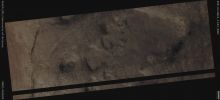
ESP_023803_1345_RED_abrowse.jpgClay-bearing Layered Deposit located within an Unnamed Crater, North of Proctor Crater (Absolute Natural Colors; credits for the additoonal process. and color.: Dr Paolo C. Fienga - Lunexit Team)206 visiteMars Local Time: 14:19 (Early Afternoon)
Coord. (centered): 45,4° South Lat. and 28,0° East Long.
Spacecraft altitude: 253,0 Km (such as about 158,1 miles)
Original image scale range: 25,3 cm/pixel (with 1 x 1 binning) so objects ~ 76 cm across are resolved
Map projected scale: 25 cm/pixel
Map projection: EQUIRECTANGULAR
Emission Angle: 6,5°
Sun-Mars-Spacecraft (or "Phase") Angle: 55,9°
Solar Incidence Angle: 51° (meaning that the Sun is about 39° above the Local Horizon)
Solar Longitude: 350,2° (Northern Winter)
Credits: NASA/JPL/University of Arizona
Additional process. and coloring: Dr Paolo C. Fienga - Lunar Explorer ItaliaMareKromiumNov 01, 2011
|
|

ESP_023796_1010_RED_abrowse.jpgUSGS Dune Database Entry Number 2325-787 (Absolute Natural Colors; credits for the additional process. and color.: Dr Paolo C. Fienga - Lunexit Team)219 visiteMars Local Time: 15:03 (Early Afternoon)
Coord. (centered): 78,8° South Lat. and 232,5° East Long.
Spacecraft altitude: 249,5 Km (such as about 155,9 miles)
Original image scale range: 49,9 cm/pixel (with 2 x 2 binning) so objects ~ 1 mt and 50 cm across are resolved
Map projected scale: 50 cm/pixel
Map projection: POLAR STEREOGRAPHIC
Emission Angle: 1,9°
Sun-Mars-Spacecraft (or "Phase") Angle: 79,1°
Solar Incidence Angle: 78° (meaning that the Sun is about 12° above the Local Horizon)
Solar Longitude: 349,9° (Northern Winter)
Credits: NASA/JPL/University of Arizona
Additional process. and coloring: Dr Paolo C. Fienga - Lunar Explorer ItaliaMareKromiumNov 01, 2011
|
|
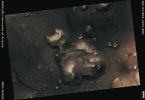
ESP_023804_2205_RED_abrowse.jpgFeatures of Cydonia Mensae (Enhanced Absolute Natural Colors; credits for the additional process. and color.: Dr Paolo C. Fienga - Lunexit Team) 187 visiteMars Local Time: 14:02 (Early Afternoon)
Coord. (centered): 40,3° North Lat. and 349,9° East Long.
Spacecraft altitude: 298,7 Km (such as about 186,7 miles)
Original image scale range: 59,8 cm/pixel (with 2 x 2 binning) so objects ~ 1 mt and 79 cm across are resolved
Map projected scale: 50 cm/pixel
Map projection: EQUIRECTANGULAR
Emission Angle: 0,4°
Sun-Mars-Spacecraft (or "Phase") Angle: 52,9°
Solar Incidence Angle: 53° (meaning that the Sun is about 57° above the Local Horizon)
Solar Longitude: 350,5° (Northern Winter)
Credits: NASA/JPL/University of Arizona
Additional process. and coloring: Dr Paolo C. Fienga - Lunar Explorer ItaliaMareKromiumNov 01, 2011
|
|
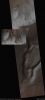
ESP_024315_1435_RED_abrowse-PCF-LXTT-000.jpgGullies on the South Wall of Dao Vallis near the Confluence with Niger Vallis (Absolute Natural Colors; credits for the additional process. and color.: Dr Paolo C. Fienga - Lunexit Team)184 visiteMars Local Time: 14:32 (Early Afternoon)
Coord. (centered): 36,1° South Lat. and 90,3° East Long.
Spacecraft altitude: 258,3 Km (such as about 161,4 miles)
Original image scale range: 51,7 cm/pixel (with 2 x 2 binning) so objects ~ 1 mt and 55 cm across are resolved
Map projected scale: 50 cm/pixel
Map projection: EQUIRECTANGULAR
Emission Angle: 5,6°
Sun-Mars-Spacecraft (or "Phase") Angle: 50,5°
Solar Incidence Angle: 54° (meaning that the Sun is about 36° above the Local Horizon)
Solar Longitude: 10,1° (Northern Spring)
Credits: NASA/JPL/University of Arizona
Additional process. and coloring: Dr Paolo C. Fienga - Lunar Explorer MareKromiumOtt 31, 2011
|
|
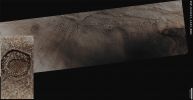
ESP_024315_1435_RED_abrowse-PCF-LXTT-001.jpgUnusually-looking Unnamed Crater near the Confluence of Dao Vallis with Niger Vallis (Absolute Natural Colors; credits for the additional process. and color.: Dr Paolo C. Fienga - Lunexit Team)180 visiteMars Local Time: 14:32 (Early Afternoon)
Coord. (centered): 36,1° South Lat. and 90,3° East Long.
Spacecraft altitude: 258,3 Km (such as about 161,4 miles)
Original image scale range: 51,7 cm/pixel (with 2 x 2 binning) so objects ~ 1 mt and 55 cm across are resolved
Map projected scale: 50 cm/pixel
Map projection: EQUIRECTANGULAR
Emission Angle: 5,6°
Sun-Mars-Spacecraft (or "Phase") Angle: 50,5°
Solar Incidence Angle: 54° (meaning that the Sun is about 36° above the Local Horizon)
Solar Longitude: 10,1° (Northern Spring)
Credits: NASA/JPL/University of Arizona
Additional process. and coloring: Dr Paolo C. Fienga - Lunar Explorer MareKromiumOtt 31, 2011
|
|

ESP_023314_1440_RED_abrowse-PCF-LXTT-01.jpgUnusual Surface Features in Hellas Planitia (EDM - Enhanced Absolute Natural Colors; credits for the additional process. and color.: Dr Paolo C. Fienga - Lunexit Team)155 visiteMars Local Time: 14:16 (Early Afternoon)
Coord. (centered): 35,9° South Lat. and 58,6° East Long.
Spacecraft altitude: 261,1 Km (such as about 163,2 miles)
Original image scale range: 52,2 cm/pixel (with 2 x 2 binning) so objects ~ 1 mt and 57 cm across are resolved
Map projected scale: 50 cm/pixel
Map projection: EQUIRECTANGULAR
Emission Angle: 6,0°
Sun-Mars-Spacecraft (or "Phase") Angle: 34,3°
Solar Incidence Angle: 39° (meaning that the Sun is about 51° above the Local Horizon)
Solar Longitude: 329,9° (Northern Winter)
Credits: NASA/JPL/University of Arizona
Additional process. and coloring: Dr Paolo C. Fienga - Lunar Explorer ItaliaMareKromiumOtt 31, 2011
|
|

ESP_023314_1440_RED_abrowse-PCF-LXTT-00.jpgUnusual Surface Features in Hellas Planitia (CTX Frame - Enhanced Absolute Natural Colors; credits for the additional process. and color.: Dr Paolo C. Fienga - Lunexit Team)165 visiteMars Local Time: 14:16 (Early Afternoon)
Coord. (centered): 35,9° South Lat. and 58,6° East Long.
Spacecraft altitude: 261,1 Km (such as about 163,2 miles)
Original image scale range: 52,2 cm/pixel (with 2 x 2 binning) so objects ~ 1 mt and 57 cm across are resolved
Map projected scale: 50 cm/pixel
Map projection: EQUIRECTANGULAR
Emission Angle: 6,0°
Sun-Mars-Spacecraft (or "Phase") Angle: 34,3°
Solar Incidence Angle: 39° (meaning that the Sun is about 51° above the Local Horizon)
Solar Longitude: 329,9° (Northern Winter)
Credits: NASA/JPL/University of Arizona
Additional process. and coloring: Dr Paolo C. Fienga - Lunar Explorer ItaliaMareKromiumOtt 31, 2011
|
|

PSP_001942_2310_RED_abrowse-00.jpgSigns of Fluids and Ice in an Unnamed Crater in Acidalia Planitia (CTX Frame - Absolute Natural Colors; credits for the additional process. and color.: Dr Paolo C. Fienga - Lunexit Team) 192 visiteThis image shows an Unnamed Crater approx. 11 Km (about 7 miles) in diameter, located in Acidalia Planitia, part of the Northern Plains. Several features in and around this Crater are suggestive of fluids and ice at and near the surface.
The muted topography of the Crater and its surroundings, the relatively shallow floor (300 mt or 330 yards), the convex slope of its Walls — all are consistent with ice being present under the Surface, mixed with rocks and soil. Ice would have acted as a lubricant, facilitating the flow of rocks and soils and hence smoothing landscape's features such as ridges and Craters' Rims.
The concentric and radial fissures in the Crater's Floor may indicate decrease of volume due to loss of underground ice. Piles of rocks aligned along these fissures and arranged forming polygons are similar to features observed in terrestrial periglacial regions such as Antarctica.
Antarctica's features are produced by repeated expansion and contraction of subsurface soil and ice, due to seasonal temperature oscillations.
The funnel-shaped depressions visible in the Crater's Floor could be Collapse Pits, further evidence of ice decay; alternatively, they could be smoothed-out small Impact Craters.
MareKromiumOtt 31, 2011
|
|
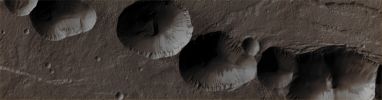
ESP_023597_2260_RED_abrowse-PCF-LXTT.jpgArtynia Catena (Absolute Natural Colors; credits for the additional process. and color.: Dr Paolo C. Fienga - Lunexit Team)274 visiteMars Local Time: 13:57 (Early Afternoon)
Coord. (centered): 45,8° North Lat. and 240,4° East Long.
Spacecraft altitude: 296,2 Km (such as about 185,1 miles)
Original image scale range: 59,3 cm/pixel (with 2 x 2 binning) so objects ~ 1 mt and 78 cm across are resolved
Map projected scale: 50 cm/pixel
Map projection: EQUIRECTANGULAR
Emission Angle: 0,4°
Phase Angle: 59,9°
Solar Incidence Angle: 60° (meaning that the Sun is about 30° above the Local Horizon)
Solar Longitude: 341,8° (Northern Winter)
Credits: NASA/JPL/University of Arizona
Additional process. and coloring: Dr Paolo C. Fienga - Lunar Explorer ItaliaMareKromiumOtt 29, 2011
|
|
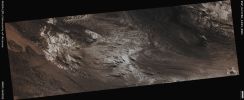
ESP_023780_1695_RED_abrowse.jpgPossible Sulphate-rich Terrain in Coprates Chasma (Absolute Natural Colors; credits for the additional process. and color.: Dr Gianluigi Barca - Lunexit Team) 153 visiteMars Local Time: 14:11 (Early Afternoon)
Coord. (centered): 10,4° South Lat. and 291,3° East Long.
Spacecraft altitude: 263,8 Km (such as about 164,9 miles)
Original image scale range: 52,8 cm/pixel (with 2 x 2 binning) so objects ~ 1 mt and 58 cm across are resolved
Map projected scale: 50 cm/pixel
Map projection: EQUIRECTANGULAR
Emission Angle: 5,1°
Phase Angle: 38,1°
Solar Incidence Angle: 33° (meaning that the Sun is about 57° above the Local Horizon)
Solar Longitude: 349,3° (Northern Winter)
Credits: NASA/JPL/University of Arizona
Additional process. and coloring: Dr Paolo C. Fienga - Lunar Explorer ItaliaMareKromiumOtt 29, 2011
|
|
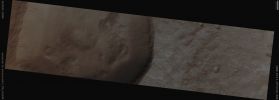
ESP_023770_1570_RED_abrowse.jpgUnnamed Southern Crater (Absolute Natural Colors; credits for the additional process. and color.: Dr Paolo C. Fienga - Lunexit Team)145 visiteMars Local Time: 14:14 (Early Afternoon)
Coord. (centered): 23,0° South Lat. and 206,0° East Long.
Spacecraft altitude: 258,5 Km (such as about 161,6 miles)
Original image scale range: 51,7 cm/pixel (with 2 x 2 binning) so objects ~ 1 mt and 55 cm across are resolved
Map projected scale: 50 cm/pixel
Map projection: EQUIRECTANGULAR
Emission Angle: 3,9°
Phase Angle: 40,7°
Solar Incidence Angle: 37° (meaning that the Sun is about 53° above the Local Horizon)
Solar Longitude: 348,9° (Northern Winter)
Credits: NASA/JPL/University of Arizona
Additional process. and coloring: Dr Paolo C. Fienga - Lunar Explorer ItaliaMareKromiumOtt 29, 2011
|
|
| 2237 immagini su 187 pagina(e) |
|
|
|
|
|
25 | |
|
|
|
|
|
|





