| |

| Ultimi arrivi - Mars Reconnaissance Orbiter (MRO) |

Q-U-Bosporus Planum (IR-VIS)-01.jpgBosporus Planum - detail mgnf (1)99 visiteCaption originale NASA, riferita al full-frame:"This is the first color image of Mars from the High Resolution Imaging Science Experiment on NASA's Mars Reconnaissance Orbiter. At the center portion of the camera's array of light detectors there are extra detectors to image in green and near-infrared color bandpasses, to be combined with the black-and-white images (from red-bandpass detectors) to create color images.
This is not natural color as seen by human eyes, but infrared color - shifted to longer wavelengths. This image also has been processed to enhance subtle color variations. The southern half of the scene is brighter and bluer than the northern half, perhaps due to early-morning fog in the atmosphere". Apr 10, 2006
|
|

Q-S-HalleyCrater-PIA08048_modest-2.jpgIn the vicinities of Halley Crater (2)55 visiteThis image was taken by the High Resolution Imaging Science Experiment (HiRISE) camera onboard NASA's Mars Reconnaissance Orbiter spacecraft on March 24, 2006. The image is centered at 47,14° South Latitude and 302,00° East Longitude. It is oriented such that north is 7° to the left of up. The range to the target was 1.699 Km (such as about 1.056 miles). At this distance the image scale is 1,70 mt (about 5,58 feet) per pixel in the center portion of the image, so objects as small as 5,1 meter (such as 16,7 feet) are resolved. In the side regions the pixels were binned 2x2 to a scale of 3,4 mt (such as 11,2 feet) per pixel. The camera has a total of 10 red-bandpass CCD detectors and in this image the first 4 CCDs on the left and the last 3 on the right were binned 2x2, while 3 in the middle returned data at full resolution. In total this image is 34,08 Km(21,18 miles) or 20.081 pixels wide and 8,50 Km (5,28 miles) or 5.164 pixels high. The image was taken at a MLT of 07:27 and the scene is illuminated from the upper right with a Solar Incidence Angle of 84,5° (this meaning that the Sun, at the time that the picture was taken, was about 5,5° above the local horizon).Apr 08, 2006
|
|
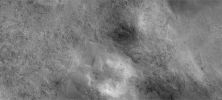
Q-S-HalleyCrater-PIA08048_modest-1.jpgIn the vicinities of Halley Crater (1)55 visiteThis image shows a landscape West of Mars' Argyre impact basin and North-East of Halley Crater. The large but faint circular feature near the center of the image is an unnamed impact crater about 7,5 Km (about 4,7 miles) in diameter. It has been all but erased by geological (and probably ice-related) processes. In fact, the majority of impact craters in this image have been modified from their original shapes, some undoubtedly beyond recognition. Only a few small craters remain pristine. The most prevalent surface type in this image is rough, dissected terrain, which is characterized by a complex pattern of knobs, pits, ridges and valleys. In places the rough terrain has been covered by a younger material that appears flat, smooth and nearly featureless. The smooth material may have been emplaced as muddy or icy debris. It filled low-lying areas (most notably craters) and surrounded higher features, preserving islands of rough terrain. Wind-formed dunes have formed atop some of the smooth material and diagonal streaks on the right side of the image may be due to the winds. Images such as this show the importance of water (liquid and/or ice), wind, and impacts in shaping the surface of Mars.Apr 08, 2006
|
|

Q-T-TerraCimmeria-PIA08052_modest.jpgTerra Cimmeria54 visiteThis scene in a Region of Mars named Terra Cimmeria shows a variety of ancient and recent geologic processes. In the upper portion of the image, a twisting ridge of raised ground may outline the location of a subsurface thrust fault. This type of fault results in the compression and crumpling of a Planet's surface. This crumpling of the Planet's surface has squeezed two originally circular craters on the ridge into oval-shaped craters. Valleys are also present throughout the image, suggesting that water flowed across this area a long time ago. Many valleys and craters in the image are now filled by deposits of dust or debris. This debris mantle is common over the middle latitudes of Mars and is a geologically recent deposit.
This image was taken by the High Resolution Imaging Science Experiment (HiRISE) camera onboard NASA's Mars Reconnaissance Orbiter spacecraft on March 25, 2006. The image is centered at 40,64° South latitude, 144,39° East Longitude. It is oriented such that North is 7° to the left of up. The range to the target was 2.038 Km (1.266 miles). At this distance the image scale is 2,04 meters (6,69 feet) per pixel, so objects as small as 6,1 mt (20 feet) are resolved. In total this image is 12,34 Km (such as about 7,67 miles) or 6.045 pixels wide and 34,68 Km (such as about 21,55 miles) or 17.003 pixels long. The image was taken at a Local Mars Time of 07:28 and the scene is illuminated from the upper right with a solar incidence angle of 82,0° (this meaning that the Sun was about 8,0° above the horizon).
Apr 08, 2006
|
|

Q-S-BosporusRupes-PIA08047_modest.jpgBosporos Rupes58 visiteThis image was taken in the mid-latitudes of Mars' Southern Hemisphere near the giant Argyre Impact Basin. It is located just to the West of a prominent scarp known as Bosporos Rupes. The left side of the image shows cratered plains. Some of the craters are heavily mantled and indistinct, whereas others exhibit sharp rims and dramatic topography. The largest crater in this half of the image is about 2,5 Km wide. Mounds and ridges, which may be remnants of an ice-rich deposit, are visible on its floor. Three sinuous valleys occupy the center of the image. Valleys such as these were first observed in data returned by the NASA Mariner 9 spacecraft, which reached Mars in 1971. The right side of the image shows part of an impact crater that is approx. 20 Km in diameter. The furrowed appearance of the crater's inner wall suggests that it has been extensively modified, perhaps by landslides and flowing water. Like other craters in the area, the floor of this crater has a rough and dissected texture that is often attributed to the loss of ice-rich material.
This image was taken by the High Resolution Imaging Science Experiment (HiRISE) camera onboard NASA's Mars Reconnaissance Orbiter spacecraft on March 24, 2006. The image is centered at 40,64° South Latitude, 303,49° East Longitude. The image is oriented such that North is 7° to the left of up. The range to the target was 2.044 Km (about 1.270 miles). At this distance the image scale is 2,04 mt (6,69 feet) per pixel, so objects as small as 6,1 mt (20 feet) are resolved. In total this image is 40,90 Km (about 25,41 miles) or 20.081 pixels wide and 11,22 Km (such as 6,97 miles) or 5.523 pixels high. The image was taken at a Local Mars Time of 07:30 and the scene is illuminated from the upper right with a solar incidence angle of 81,4° (this meaning that the Sun was about 8,6° above the horizon).
Apr 08, 2006
|
|

Q-T-ArgyrePlanitia-PIA08049_modest.jpgArgyre Basin, in the morning twilights...54 visiteThis image shows part of a low mountain belt that rings the Argyre Impact Basin in Mars' Southern Hemisphere. The mountains or hills seen here are located in the northwestern part of the Charitum Montes. Taken just minutes after the Sun had risen over the horizon, only the sun-facing slopes are well illuminated and much of the scene is in shadow, but the camera has nevertheless captured many details of the surface that are only dimly illuminated. There are terrains that are both smooth and rough at this scale (2,94 mt - or 9,65 feet per pixel). The rough terrain is littered with blocks roughly 10 mt (30 feet) across and the smooth material has a uniform appearance broken by subtle, undulating ridges. The rough terrains usually occur at relatively high elevations and smooth material occupies the lowest areas. In some locations it is evident that boulders from the rough terrain have tumbled downhill onto the smooth material. The smooth material is younger than the rough terrain, and some of it may have formed when water-rich or ice-rich debris flooded low-lying areas. In other areas the smooth material mantles the topography like deposits of airborne dust. Further upslope, the mountain flanks have a variety of rough textures. In places the terrain has been eroded into streamlined forms and striations, suggestive of glacial erosion. Gullies formed in one spot near bottom center. Perhaps the most striking aspect of this image is the dearth of fresh impact craters. The Argyre basin is thought to be billions of years old, but much more recent processes have greatly modified the surface.
This image was taken by the High Resolution Imaging Science Experiment (HiRISE) camera onboard NASA's Mars Reconnaissance Orbiter spacecraft on March 24, 2006. The image is centered at 52.20 degrees south latitude, 300.75 degrees east longitude. It is oriented such that north is 7 degrees to the left of up. The range to the target was 1,470 kilometers (913 miles). With 2x2 pixel binning, the scale of the image is 2.94 meters (9.65 feet) per pixel, so objects as small as 8.82 meters (28.94 feet) are resolved. In total this image is 29.47 kilometers (18.31 miles) or 10,040 pixels wide and 76.44 kilometers (47.50 miles) or 26,011 pixels long. The image was taken at a local Mars time of 07:24 and the scene is illuminated from the upper right with a solar incidence angle of 87.1 degrees, thus the sun was about 2.9 degrees above the horizon. At an Ls of 29 degrees (with Ls an indicator of Mars' position in its orbit around the sun), the season on Mars is southern autumn.
Apr 08, 2006
|
|

Q-Q-PIA08030.jpgThe Atmosphere of Mars67 visiteThe Mars Climate Sounder, an instrument on NASA's Mars Reconnaissance Orbiter designed to monitor daily changes in the global atmosphere of Mars, made its first observations of Mars on March 24, 2006.
These tests were conducted to demonstrate that the instrument could, if needed, support the mission's aerobraking maneuvers (dips into the atmosphere to change the shape of the orbit) by providing hemisphere-scale coverage of atmospheric activity. The instrument scanned nine arrays of detectors four times across the entire disc of the planet, including the north pole, from an altitude of about 45,000 kilometers (28,000 miles). This is about 150 times farther away than the spacecraft will be during its main science phase. At this great range, the planet appears only 40 pixels wide, as suggested by the pixilation of the images. However, this is sufficient to identify regional dust storms in the lower atmosphere. Regional dust storms could perturb atmospheric densities at the higher altitudes (about 100 kilometers or 60 miles) where the orbiter will conduct more than 500 aerobraking passes during the next six months. Such storms are rare in the current season on Mars, early northern spring, and no large storms are present as the orbiter prepares for the start of aerobraking.
Each of the Mars Climate Sounder's arrays looks in a different wavelength band, and three of the resulting images are shown here. The view on the left is from data collected in a broad spectral band (wavelengths of 0.3 microns to 3 microns) for reflected sunlight. The view in the center is from data collected in the 12-micron thermal-infrared band. This band was chosen to sense infrared radiation from the surface when the atmosphere is clear and from dust clouds when it is not. The view on the right is from data collected at 15 microns, a longer-wavelength band still in the thermal-infrared part of the spectrum. At this wavelength, carbon dioxide, the main ingredient in Mars' atmosphere, hides the surface emission, and the thermal-infrared radiation comes only from the atmosphere.
The visible-and-near-infrared image (left) is bright where surface ice and atmospheric hazes reflect sunlight back to space. The view is of the northern half of Mars, with the north polar cap visible as the bright semicircle at upper left. The night half of the planet (lower left) is dark. The "terminator" boundary between the day side and night side of the planet cuts from lower left to upper right, through the polar area. During the science phase of the mission, after the spacecraft has shrunk its orbit to a nearly circular loop approximately 300 kilometers (186 miles) above the surface, these visible-and-near-infrared readings by the Mars Climate Sounder will track how the amount of solar energy reflected from Mars varies from place-to-place and season-to-season, particularly in the polar regions where absorbed sunlight vaporizes the seasonal carbon-dioxide ice.
The 12-micron image (center) indicates that heat is being emitted from both the day side and the night side of the planet. The polar cap is dark in this image because it is cold (minus 190 degrees Fahrenheit) and emits less heat than surrounding areas. During the science phase of the mission, the thermal-infrared readings at this wavelength by Mars Climate Sounder will be used to track dust and clouds in the atmosphere. In the current season on Mars, the atmosphere is relatively clear except for an equatorial belt of thin water-ice clouds present in the visible-and-near-infrared image, and so the 12-micron image is dominated by the infrared radiation from the surface on the relatively hot dayside (upper right).
The 15-micron image (right) indicates the temperatures of the atmosphere at an altitude of about 25 kilometers (15 miles), where there is not much temperature difference even between the night side and the day side of the planet. The polar atmosphere is colder, so it appears darker.
Once deployed in a low-altitude, nearly circular orbit next fall, the Mars Climate Sounder will systematically alternate views of the surface with views of the atmosphere above the limb (horizon) of the planet from the surface to an altitude of 80 kilometers (50 miles), with a vertical resolution of 5 kilometers (3 miles). In this way it will monitor atmospheric and surface changes through a full annual cycle to characterize the present climate of Mars.
Mar 31, 2006
|
|

Q-pia08014-08-AEB1-full-reduced1.jpgMartian Southern Highlands (8) - HR110 visitenessun commentoMar 25, 2006
|
|

Q-pia08014-07-AEB1-full-reduced1.jpgMartian Southern Highlands (7) - HR57 visitenessun commentoMar 25, 2006
|
|

Q-pia08014-06-AEB1-full-reduced1.jpgMartian Southern Highlands (6) - HR59 visitenessun commentoMar 25, 2006
|
|

Q-pia08014-05-AEB1-full-reduced1.jpgMartian Southern Highlands (5) - HR60 visitenessun commentoMar 25, 2006
|
|

Q-pia08014-04-AEB1-full-reduced1.jpgMartian Southern Highlands (4) - HR69 visitenessun commentoMar 25, 2006
|
|
| 2237 immagini su 187 pagina(e) |
|
|
|
|
|
|
|
|
|
186 |
|
|
|





