| |

| Ultimi arrivi - Mars Reconnaissance Orbiter (MRO) |
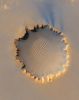
S-PIA08813_modest.jpgVictoria Crater, from MRO70 visitenessun commentoOtt 06, 2006
|
|

S-PIA08816.jpgCape Verde and Cabo Frio (2)58 visiteThis image from the High Resolution Imaging Science Experiment on NASA's Mars Reconnaissance Orbiter shows the Mars Exploration Rover Opportunity near the rim of "Victoria crater." Victoria is an impact crater about 800 meters (half a mile) in diameter at Meridiani Planum near the equator of Mars. Opportunity has been operating on Mars since January, 2004. Five days before this image was taken, Opportunity arrived at the rim of Victoria crater, after a drive of more than 9 kilometers (over 5 miles). It then drove to the position where it is seen in this image.
Shown in the image are "Duck Bay," the eroded segment of the crater rim where Opportunity first arrived at the crater; "Cabo Frio," a sharp promontory to the south of Duck Bay; and "Cape Verde," another promontory to the north. When viewed at the highest resolution, this image shows the rover itself, wheel tracks in the soil behind it, and the rover's shadow, including the shadow of the camera mast. Since this image was taken, Opportunity has moved to the very tip of Cape Verde to perform more imaging of the interior of the crater.
This view is a portion of an image taken by the High Resolution Imaging Science Experiment (HiRISE) camera onboard the Mars Reconnaissance Orbiter spacecraft on Oct. 3, 2006. The complete image is centered at minus7.8 degrees latitude, 279.5 degrees East longitude. The range to the target site was 297 kilometers (185.6 miles). At this distance the image scale is 29.7 centimeters (12 inches) per pixel (with 1 x 1 binning) so objects about 89 centimeters (35 inches) across are resolved. The image shown here has been map-projected to 25 centimeters (10 inches) per pixel and north is up. The image was taken at a local Mars time of 3:30 PM and the scene is illuminated from the west with a solar incidence angle of 59.7 degrees, thus the sun was about 30.3 degrees above the horizon. At a solar longitude of 113.6 degrees, the season on Mars is northern summer.
Images from the High Resolution Imaging Science Experiment and additional information about the Mars Reconnaissance Orbiter are available online at: http://www.nasa.gov/mro or http://HiRISE.lpl.arizona.edu.
Ott 06, 2006
|
|

S-PIA08812.jpgCape Verde and Cabo Frio (1)54 visiteThis image from the High Resolution Imaging Science Experiment on NASA's Mars Reconnaissance Orbiter shows the Mars Exploration Rover Opportunity near the rim of "Victoria Crater." Victoria is an impact crater about 800 meters (half a mile) in diameter at Meridiani Planum near the equator of Mars. Opportunity has been operating on Mars since January, 2004. Five days before this image was taken, Opportunity arrived at the rim of Victoria, after a drive of more than 9 kilometers (over 5 miles). It then drove to the position where it is seen in this image.
Shown in the image are "Duck Bay," the eroded segment of the crater rim where Opportunity first arrived at the crater; "Cabo Frio," a sharp promontory to the south of Duck Bay; and "Cape Verde," another promontory to the north. When viewed at the highest resolution, this image shows the rover itself, wheel tracks in the soil behind it, and the rover's shadow, including the shadow of the camera mast. After this image was taken, Opportunity moved to the very tip of Cape Verde to perform more imaging of the interior of the crater.
This view is a portion of an image taken by the High Resolution Imaging Science Experiment (HiRISE) camera onboard the Mars Reconnaissance Orbiter spacecraft on Oct. 3, 2006. The complete image is centered at minus7.8 degrees latitude, 279.5 degrees East longitude. The range to the target site was 297 kilometers (185.6 miles). At this distance the image scale is 29.7 centimeters (12 inches) per pixel (with 1 x 1 binning) so objects about 89 centimeters (35 inches) across are resolved. North is up. The image was taken at a local Mars time of 3:30 PM and the scene is illuminated from the west with a solar incidence angle of 59.7 degrees, thus the sun was about 30.3 degrees above the horizon. At a solar longitude of 113.6 degrees, the season on Mars is northern summer.
Images from the High Resolution Imaging Science Experiment and additional information about the Mars Reconnaissance Orbiter are available online at: http://www.nasa.gov/mro or http://HiRISE.lpl.arizona.edu.
Ott 06, 2006
|
|
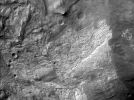
R-JusChasma-PIA08789.jpgJus Chasma55 visiteThe high resolution camera on NASA's Mars Reconnaissance Orbiter captured its first image of Mars in the mapping orbit, demonstrating the full resolution capability, on Sept. 29, 2006. The High Resolution Imaging Science Experiment (HiRISE) acquired this image at 8:16 AM (Pacific Time), and parts of the image became available to the HiRISE team at 1:30 PM. With the spacecraft at an altitude of 280 kilometers (174 miles), the image scale is 29.7 centimeters per pixel (about 12 inches per pixel).
This sub-image covers a small portion of the floor of Ius Chasma, one branch of the giant Valles Marineris system of canyons. The image illustrates a variety of processes that have shaped the Martian surface. There are bedrock exposures of layered materials, which could be sedimentary rocks deposited in water or from the air. Some of the bedrock has been faulted and folded, perhaps the result of large-scale forces in the crust or from a giant landslide. The darker unit of material at right includes many rocks. The image resolves rocks as small as small as 90 centimeters (3 feet) in diameter. At bottom right are a few dunes or ridges of windblown sand. If a person was located on this part of Mars, he or she would just barely be visible in this image.
Image TRA_000823_1720 was taken by the High Resolution Imaging Science Experiment (HiRISE) camera onboard the Mars Reconnaissance Orbiter spacecraft on September 29, 2006. Shown here is a small portion of the full image. The full image is centered at minus 7.8 degrees latitude, 279.5 degrees East longitude. The image is oriented such that north is to the top. The range to the target site was 297 kilometers (185.6 miles). At this distance the image scale is 29.7 centimeters per pixel (with one-by-one binning) so objects about 89 centimeters (35 inches) across are resolved. The image was taken at a local Mars time of 3:30 PM and the scene is illuminated from the west with a solar incidence angle of 59.7 degrees, thus the sun was about 30.3 degrees above the horizon. At an Ls of 113.6 degrees, the season on Mars is Northern Summer/Southern Winter.
Set 30, 2006
|
|

R-PIA08788-2.jpgOlympia Undae (2)55 visiteThis image shows three representations of the 72 colors. The left panel is a nearly true-color composite in which the blue, green, and red planes are 0.44, 0.53, and 0.60 micrometer light -- nearly as the human eye would see. The contrast between the bright ice and dark dunes is so large that the dunes are barely seen. The middle panel is false color constructed from infrared wavelengths just beyond the range of the human eye. The blue, green, and red planes cover 0.80, 0.95, and 1.06 micrometer light. In this rendering of the data the differences between ice- and soil-rich regions are not as apparent because the colors of ice and dust are similar in this wavelength region. The right panel uses 1.15, 1.8, and 2.25 micrometer light in the blue, green and red planes and provides a dramatically different view of the scene. The areas of highest ice content appear in blue, and those with a mix of dust and ice -- most of the scene -- appear yellowish. The dunes are now visible against the ice because of their higher brightness at longer infrared wavelengths, and appear ruddy brown.Set 30, 2006
|
|

R-PIA08788-1.jpgOlympia Undae (1)55 visiteThe Compact Reconnaissance Imaging Spectrometer for Mars, a mineral mapping instrument on NASA's Mars Reconnaissance Orbiter (CRISM), began observing Mars after its lens cover was opened on Sept. 27, 2006.
This image shows one of the first regions of Mars measured after CRISM's cover was opened.
CRISM takes images in two basic formats. The first format is a "targeted image" about 10 by 10 Km (about 6 by 6 miles), at about 18 mt (60 feet) per pixel, in 544 colors covering wavelengths of 0,36 to 3,92 micrometers. The second format is a lower-resolution strip 10 Km (about 6 miles) wide and thousands of kilometers long, at 200 mt (660 feet) per pixel, in 72 colors. Many thousands of these "multispectral survey" strips are used to build a global map.
The image is part of the second multispectral survey strip, taken at 22:36 UTC (6:36 p.m. EDT) on Sept. 27, 2006. Only minimal processing of the data has been done at this early point in the MRO's Mission.
The strip crosses part of the north polar region named Olympia Undae, and stretches between 76.7 north latitude, 141.9 east longitude and 85.5 north, 115.8 east. From the top, the northern end of the image crosses layers of dusty and clean ice in the north polar cap. Moving south the image covers dusty sedimentary deposits, dark sand dunes, and outlying polar ice deposits.Set 30, 2006
|
|
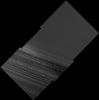
R-NorthPolarLayers-PIA08791_modest.jpgNorth Polar Layers (or "Bands")55 visiteThe HiRISE on NASA's MRO acquired this image during its first day of test imaging from the spacecraft's low-altitude mapping orbit, such as on Sept. 29, 2006.
This image of Mars' North Polar Layered Deposits was taken during the summer season (Solar Longitude of 113,6°), when CO2 frost had evaporated from the surface. The bright spots seen here are most likely patches of water frost, but the location of the frost patches does not appear to be controlled by topography. Layers are visible at the right side of the image, mostly due to difference in slope between them. The variations in slope are probably caused by differences in the physical properties of the layers. Thinner layers that have previously been observed in these deposits are visible, and may represent annual deposition of water ice and dust that is thought to form the polar layered deposits. These deposits are thought to record global climate variations on Mars, similar to ice ages on Earth. HiRISE images such as this should allow Mars' climate record to be inferred and compared with climate changes on Earth.
Image TRA_000825_2665 was taken by the High Resolution Imaging Science Experiment (HiRISE) camera onboard the Mars Reconnaissance Orbiter spacecraft on September 29, 2006. Shown here is the full image, centered at 86.5 degree latitude, 172.0 degrees east longitude. The image is oriented such that north is to the top. The range to the target site was 298.9 kilometers (186.8 miles). At this distance the image scale is 59.8 centimeters (23.5 inches) per pixel (with two-by-two binning} so objects about 1.79 meters (70 inches) across are resolved. In total the original image was 12.2 kilometers 7.58 mile; 10024 pixels) wide and 6.1 kilometers (3.79 miles; 5000 pixels) long. The image was taken at a local Mars time of 3:30 PM and the scene is illuminated from the southwest with a solar incidence angle of 63.5 degrees, thus the sun was about 26.5 degrees above the horizon. Set 30, 2006
|
|

Q-V-Argyre Basin-PIA08067.jpgArgyre Basin55 visiteThis picture (MARCI2-2b) shows a color composite made from the MARCI red, green, and blue bands.
It differs from the MOC wide angle color composite because, to create a color image with MOC data, we synthesize (fake) a green channel by adding the red and blue channels together and dividing by two. The slightly greenish tint of the MARCI image shows that the approximation used for MOC images underestimates the amount of green. Further calibration will be needed before a "true" color image — as it would appear to a human eye looking down from orbit — can be reconstructed from the MARCI data.Apr 14, 2006
|
|

Q-V-Atmosphere.jpgMars' Atmosphere63 visiteAs part of the checkout of the Mars Reconnaissance Orbiter (MRO) payload after the 10 March 2006 orbit insertion, the Mars Color Imager (MARCI) acquired a seven band color wide angle view of Mars on 24 March 2006. Illustrated here are some of these test images. Note that the linear banding seen in these images are artifacts resulting from incomplete removal of the detector pixel to pixel variations. Such deviations from ground testing calibration are an important reason for taking checkout images.
In the first figure (MARCI2-2a), three views acquired by MRO MARCI are compared to a color composite of two views acquired about 4 hours later by the Mars Global Surveyor (MGS) Mars Orbiter Camera (MOC). MRO imaging occurred during the early morning on Mars, while the MGS observations were made at around 2 PM local solar time. The region of Mars imaged by MRO on this day was south of the Valles Marineris and includes the large Argyre Basin, its interior plains, Argyre Planitia, and the mountains that comprise the basin rim, Nereidum Montes to the northwest (middle of images) and Charitum Montes to the southeast (bottom of images).
The ultraviolet (UV) image (260 nm in MARCI2-2a) shows how the planet appears in an ozone absorption band. Relatively darker areas in this band normally will indicate the presence of ozone, and relatively lighter areas will indicate the absence of ozone. Water vapor on Mars is anticorrelated with ozone, meaning that lighter areas can be used to track water vapor. The term "relatively" is used here because Mars itself is very dark in the UV owing to absorption of UV light by iron-bearing minerals, and sunlight is deficient in UV relative to visible light, so in general Mars will always look dark in the UV. A second UV band on MARCI (not shown in the figure above) at a longer wavelength allows these differences to be quantified. The MOC wide angle image shows wispy, light water-ice clouds to the northwest of Argyre in the afternoon, but we cannot as yet correlate these clouds with the UV information (especially because the times of day are different). When in its final mapping orbit, MRO will view the same area as MGS separated by only 1 hour, and such correlations will be much more direct.
Apr 14, 2006
|
|

Q-U-Bosporus Planum (IR-VIS)-04.jpgBosporus Planum - detail mgnf (4)57 visitenessun commentoApr 10, 2006
|
|

Q-U-Bosporus Planum (IR-VIS)-03.jpgBosporus Planum - detail mgnf (3)55 visiteCaption NASA originale, riferita al full-frame:"This image was taken by HiRISE on March 24, 2006.
The image is centered at 33,65° South Latitude and 305,07° East Longitude. It is oriented such that North is 7° to the left of up.
The range to the target was 2.493 Km (about 1.549 miles) and at this distance the image scale is 2,49 mt (such as approx. 8,17 feet) per pixel, so objects as small as 7,5 mt (about 24,6 feet) are resolved. In total this image is 49,92 Km (such as about 31,02 miles) or 20.081 pixels wide and 23,66 Km (about 14,70 miles) or 9.523 pixels long. The image was taken at a MLT of 07:33 and the scene is illuminated from the upper right with a solar incidence angle of 78° (this meaning that the Sun, at the time the picture was taken, was 12° above the local horizon).
At an Ls of 29° (with Ls an indicator of Mars' position in its orbit around the Sun), the season on Mars is Southern Autumn".Apr 10, 2006
|
|

Q-U-Bosporus Planum (IR-VIS)-02.jpgBosporus Planum - detail mgnf (2)55 visiteCaption originale NASA, riferita al full-frame:"Large-scale streaks in the northern half are due to the action of wind on surface materials. The blankets of material ejected from the many small fresh craters are generally brighter and redder than the surrounding surface, but a few are darker and less red. Two greenish spots in the middle right of the scene may have an unusual composition, and are good future targets for the Compact Reconnaissance Imaging Spectrometer for Mars, a mineral-identifying instrument on MRO (http://crism.jhuapl.edu/). In the bottom half of the image we see a redder color in the rough areas, where wind and sublimation of water or carbon dioxide ice have partially eroded patches of smooth-textured deposits".Apr 10, 2006
|
|
| 2237 immagini su 187 pagina(e) |
|
|
|
|
|
|
|
|
185 | |
|
|
|





