| |

| Ultimi arrivi - Mars Reconnaissance Orbiter (MRO) |
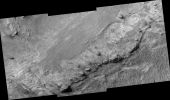
T-TRA_000849_1675_RED.jpgCoprates Labes55 visiteCoprates Labes is a Martian canyon, part of the huge Valles Marineris system. Valles Marineris most likely formed through tectonic processes, with extensional stresses leading to collapse of the terrain that now lies at the base of the canyons. Filling most of this image, we see a raised block on the canyon bottom, which is quite possibly a horst—a block bounded by faults that separate it from sunken blocks on each side. The raised block is heavily eroded, possibly by wind; this erosion has exposed its internal layering, especially at the southeast margin of the block. Here we see asymmetric erosion features with shallow slopes trailing off to the northwest, suggesting that southeasterly winds dominate the flow through this region. The arrangement of dunes and ripples in the lower right portion of the image confirms this prevailing wind direction. Finally, dark-toned material appears to have flowed from northeast to southwest along the block, possibly moving in a very fluid debris flow.Ott 08, 2006
|
|

Craters-Holden_Crater-TRA_000861_1530_RED_Holden_Delta_00.jpgThe beautiful Holden Crater57 visiteThis HiRISE image covers a portion of the floor of Holden Crater situated in southwest Margaritifer Terra. Holden crater has likely experienced extensive modification by running water, which is supported by observations of drainage and deposition into the crater from a large channel breaching Holden's rim and the alluvial fans that built out along the floor of the crater. The HiRISE sub-image shows relatively bright finely layered deposits that are capped by relatively darker materials. Unlike previous images, the HiRISE image shows that the thickness of some of the individual layers are on the order of a meter or even less in thickness and are laterally uniform and continuous over the extent of the imaged outcrop. Some of the layers in the outcrop display an orthogonal pattern or what may be fractures or joints. The "layer-cake" appearance of these layers suggests that they may have been deposited into a lake that once occupied the crater floor and have seen little in the way of deformation since that time. By contrast, the darker materials overlying the layers are younger and may have been sediments deposited off the nearby alluvial fans. Alternatively, they may represent wind-blown deposits lain down during a later much drier period similar to the conditions that currently exist at the surface today. In some locations, the darker materials have been stripped and expose the lighter finely layered sediments underneath, thereby implying the finely layered materials extend much farther than what is visible along the large outcrop.Ott 08, 2006
|
|
T-TRA_000853_1450_RED_AtlantisChaos_01.jpgAtlantis Chaos55 visiteThis HiRISE image covers a small area within a degraded crater adjacent to Atlantis Chaos in the Electris region of Mars. The crater and much of the surrounding region were once extensively mantled by a layer of material(s) of unknown origin and only small remnant outcrops of this material remain seen as flat topped mesas in the image sub-frame shown here. Intervening areas expose ancient uplands materials locally punctuated by narrow ridges that may represent more resistant material within the mantling deposit that were left in relief as the sediments were eroded away. Although the mesas do not appear to be comprised of finely layered materials, hints of some layering in a few locations can be seen. Large blocks of material are being shed from the mesas, but do not appear to accumulate on the mesa slopes as large talus aprons. Some wind blown dunes and ripples can be observed, but are not as widespread as in many other locations imaged with HiRISE. Collectively, these characteristics suggest that the material(s) forming the mantling deposit possess some limited strength, but are easily broken down and removed by wind over time. One possible Earth analog for these deposits may be the wind blown accumulations of very fine sediments, or silt known as loess.Ott 08, 2006
|
|

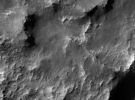
T-TRA_000862_1710_RED_CandorChasma_01.jpgCandor Chasma56 visiteThis HiRISE sub-image shows the steep slopes along wallrock in the eastern edge of West Candor Chasma. In general, the rocks in the upper part of the canyons are interpreted to be lava flows that cover the plains surrounding Valles Marineris, whereas the deeper material along the walls could be either more lava flows or megaregolith that resulted from numerous impact craters that disrupted the Martian surface during the first billion years after formation of the planet. Resistant material is visible in portions of the sub-image and HiRISE is able to resolve 1-2 meter size boulders shedding out of these resistant wallrock units. The bright and dark lineations seen in the right of the sub-image follow the slope of the wallrock (downslope is towards the top of the sub-image) and likely represent bright dust and dark sand that are sliding downslope. The large number of small impact craters visible along the slopes indicates that there isn't a large amount of material moving downslope recently because these craters would have been destroyed or buried.
Ott 08, 2006
|
|

T-TRA_000836_1740_RED_CandorChasma_01.jpgCandor Chasma57 visiteCandor Chasma is one of several large troughs that make up Valles Marineris, the largest canyon system in the Solar System. Much of Candor Chasma is filled with layered deposits, like those shown in this HiRISE sub-image. Layers only 1-2 meters thick can be resolved by HiRISE and provide details on the processes that emplaced and modified these sediments. The layered deposits could be volcanic, lacustrine, or eolian sediments that filled in some portions of the trough of Valles Marineris. The variations in brightness of the layers could represent compositional differences in the layers or the thickness of overlying debris, such as sand or dust. This area was targeted because minerals rich in sulfur were detected here by the OMEGA instrument on Mars Express. By using HiRISE images to look at specific geologic units that correspond to these locations of sulfate, it may be possible to determine the origin of the sediments, particularly those that contain the sulfates. The paucity of impact craters on the layered deposits suggests either a young age for the sediments or erosion has removed much of the upper layers to reveal a fresher-looking surface. Dark dunes and ripples indicate that wind has been, and still may be, moving debris across the sedimentary deposits.Ott 07, 2006
|
|
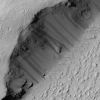
T-TRA_000853_1900_RED_MarteValles_01.jpgSeeps in Marte Vallis55 visiteMarte Vallis is a relatively young channel system on Mars that was carved by catastrophic floods of water. The HiRISE image samples just a small part of the valley system, but captures a variety of different landforms. The mesa in the eastern half of the image is a remnant of the pre-flood surface while the valley floor is covered by a surface with plates and ridges.
We highlight a piece from the southeastern portion of this HiRISE image, along the edge of the mesa. Some of the most striking features in this area are the dark streaks streaming down the cliff face. These mark locations where the layer of dust has been removed, exposing the darker surface underneath. The details of this cleaning process are not well-understood, but are thought to be driven by avalanches of dust. These avalanches appear to be more capricious than typical landslides or mudslides—they are sometimes able to surmount some large obstacles but in other cases are deflected by relatively small boulders. The darkness of the streaks vary, which suggests that they formed at different times. These streaks are expected to gradually fade as more dust will be deposited in the future. However, such fading has yet to be observed.
The role of dust is also clearly evident on the floor of the valley. The fluted mounds are characteristic of a thick dust deposit that is being gradually stripped away by wind. This extensive dust cover complicates any attempt to understand the details of the floods that carved the valley and the processes that formed the plates and ridges on the floor.
Ott 07, 2006
|
|

T-TRA_000866_1420_RED.jpgGorgonum Chaos54 visiteThis HiRISE image shows cratered plains along the edge of a large fracture to the south of Gorgonum Chaos. The wall of the fracture is in shadow and, at first glance, appears to reveal little detail about the geologic setting. In reality, the high quality of the HiRISE image, as shown in the stretched sub-image [below], demonstrates that considerable detail along the wall of the fracture can be discerned. A relatively dark layer extends along the upper wall of the fracture and approximately separates the exposed wall above from talus below. Some well defined talus chutes are also visible and are formed by the down slope movement of debris shed from higher along the fracture wall. The wind blown drifts of fine grained sediment accumulated along the base of the talus slope are relatively free of obvious talus. Hence, the wind likely accounts for much of the most recent modification of the scene in the sub image.
Ott 07, 2006
|
|
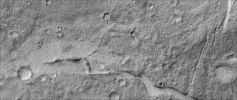
T-TRA_000834_1835_RED.jpgAram Chaos59 visiteAram Chaos is thought to be a degraded impact crater that was once filled with water and sedimentary units. The term "chaos" refers to the cracks and angled blocks formed perhaps by withdrawl of subsurface material. This sub-image covers only a small portion of Aram Chaos and illustrates the modification of the crater by fracturing, younger impact craters, and wind. A linear fracture cuts through the center of the image while a more sinuous depression filled with bright ripples or dunes is located towards the bottom of the image. Both depressions could have resulted from collapse associated with modification of the impact crater that created Aram Chaos or later disruption when water and sediment covered some of the crater floor. Impact craters of many shapes and sizes can be seen across the image, indicating a relatively older surface that has seen little modification since its formation. The bright ripples or dunes appear to cluster in low-lying topography, such as the sinuous depression and a larger impact crater in the lower right of the image, suggesting that wind has moved fine material along the surface until it becomes trapped in low spots where it collects to form ripples or dunes.
Ott 07, 2006
|
|
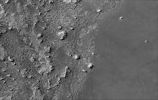
T-TRA_000833_1800_RED.jpgMeridiani Planum55 visiteThis HiRISE image shows geologic "contacts", or boundaries, between light-toned and dark-toned material in Meridiani Planum, near the equator of Mars. Merdiani Planum is where the Mars Exploration Rover Opportunity is located, although this image covers an area that is more than 600 km to the east of the Opportunity site. The central portion of the image shows very smooth, dark plains that are typical of much of the Meridiani region. These plains are flanked by more rugged lighter-toned materials. The light-toned materials have been eroded to form dramatic pits, buttes and mesas. Based on the lengths of the shadows that they cast, some of the buttes and mesas are up to about 30 meters (~100 feet) tall. The light-toned material shows distinctive layering, suggesting that it may be composed of sedimentary rock. Scattered across the scene, especially in the light-toned materials where they are prominent in low spots and around some of the larger buttes and mesas, are dunes and other similar landforms created by martian winds.
Ott 07, 2006
|
|
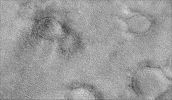
T-TRA_000828_2495_RED.jpgNorthern Plains55 visiteA network of shallow surface troughs and fissures coalesce into polygonal patterns that are ubiquitous throughout this image. Polygonal patterned ground of this nature is quite common in permafrost regions of Earth, where seasonal thermal contraction of ice-cemented soil produces a honeycomb network of subsurface cracks. Cracks of this nature can also be produced by desiccation (mud cracks) or lava cooling (columnar joints), though typically on a smaller scale. The diameter of these martian polygons are dominantly 10-20 meters, analogous to terrestrial permafrost. The individual troughs are frequently only a couple of meters or less wide, and easily resolved at HiRISE resolution. Other characteristics, such as small ridges on either side of the troughs and the distribution of rocks in and around each polygon is also readily apparent. Small rocks and occasional larger boulders are also seen scattered throughout the image. Rocks protruding above the surface soil can be seen to cast shadows (solar illumination is from the lower left), which can aid in the determination of the rock's size and height. This image is located near an area under consideration as a landing site for the Mars Scout mission, Phoenix, planned for 2008. Examination of many factors including surface texture (roughness and morphology) and the size distribution of rocks will aid in final landing site selection.
Ott 07, 2006
|
|
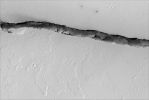
T-TRA_000827_1875_RED.jpgA long trough in Cerberus Fossae55 visiteThe prominent trough in this image is a segment of the Cerberus Fossae rift system. In geological terminology the trough is known as a graben, or down-dropped region bounded by faults. In this location the graben is about 300 m wide and 90 m deep. Bright, dust-covered, cratered plains surround the graben, and darker sediments blanket much of its floor. Dunes that vary in size and spacing occur within the darker sediments, and their shapes suggest that the wind typically blows from east to west. Light-toned, angular boulders pepper the darker sediments. They have broken away from the rocky walls of the graben and tumbled downhill. Over time this mass wasting has caused the cliffs to retreat, widening the trough. The somewhat lighter patches of cratered terrain on the graben floor were once level with the surrounding plains, but have since been lowered by faulting. Over time they may become obscured or buried by the darker sediments. High-standing ridges - remnants of the former surface - cast jagged shadows on the floor of the graben that reveal the rugged nature of the landscape in this region of Mars.
Ott 07, 2006
|
|

T-TRA_000828_1805_RED.jpgYardangs in Medusa Fosse57 visiteThis image covers a portion of an outcrop of the Medusae Fossae Formation, a series of light-toned terrains in the Martian mid-latitudes. The Medusae Fossae has been and remains one of the most enigmatic features on Mars. The unit is characterized by wind-sculpted landforms, most notably eroded ridges known as yardangs. The composition of the Medusae Fossae is not known, but candidates include indurated (hardened) volcanic ash or remnants of dust-ice mixtures that formed in a different Martian climate. This HiRISE image reveals new details of the Medusae Fossae.
Three prominent yardangs are seen, at upper right, lower center right, and partially at lower right. They are aligned with their long axes pointing NW-SE, with tapered ends on the NW, consistent with erosion from a southeasterly wind. One or more hard rocky layers within the yardangs are visible, with the layers commonly segregated into discreet boulders. Isolated rocks are seen on the slopes and at the base of the yardangs, indicating that some formed from breakup of the layers. The rocks may be similar in composition to the softer, non-rocky parts of the yardangs, but simply more indurated. Alternatively, they may be compositionally distinct, challenging current hypotheses for the origin of the Medusae Fossae.
Light-toned ridges at center left have a gross morphology similar to that of barchanoid dunes, formed from wind-blown sand. If these are dunes or ripples, their orientation is consistent with the presumed wind direction that carved the yardangs. However, zooming in to full resolution reveals flat tops, grooves, and smaller, darker ripple forms to the northwest of the ridges. Therefore if these are dunes, they seem indurated.
Ott 07, 2006
|
|
| 2237 immagini su 187 pagina(e) |
|
|
|
|
|
|
|
184 | |
|
|
|
|





