| Ultimi arrivi - Mars Reconnaissance Orbiter (MRO) |

Northern_Plains-Psp_001380_2520_red-01.jpgAnother "Frozen Lake" in the Northern Plains? (2 - EDM - False Colors; credits for the additional process. and color.: Dr Paolo C. Fienga - Lunexit Team)57 visitenessun commentoMareKromiumDic 21, 2006
|
|

Chasma_Boreale-PSP_001374_2650_RED.jpgChasma Boreale (False Colors)112 visitenessun commentoMareKromiumDic 21, 2006
|
|

Coprates_Labes_Canyon-Tra_000849_1675_red~1.jpgUnusual Landforms or...Something more?!?161 visiteUn ottimo lavoro di osservazione ed estrapolazione realizzato dal nostro caro Amico e Socio Lorenzo Leone ci riporta ad una (ormai) annosa e vexata questione: alcuni rilievi di Marte, nella loro "stranezza", restano rilievi naturali o si tratta di remnants di strutture artificiali?
Voi, cari Amici, la nostra posizione la conoscete; ma per questa volta - e diremmo con buona ragione - ci piace citare Lorenzo:"...Prendendo in esame una delle ultime immagini pubblicate, Coprates Labes, mi sono voluto divertire analizzandola nel tentativo di catturare le forme più strane (e sicuramente più fantasiose), ma di sicuro interesse.
Le immagini parlano da sole: abbiamo 2 possibili piramidi ed un "fortino".
Un gioco di luci ombre, aiutato da oggetti particolari, ma fantasticare e analizzare non nuoce certamente.
Ed è certo che Marte, almeno per me, riesce sempre a stupire...".
E noi condividiamo al 100%!MareKromiumDic 14, 2006
|
|

Elysium_Planitia-Tra_000867_1875_red-00.jpgElysium Planitia (CTX Frame - False Colors)55 visiteA low, sinuous tectonic ridge ("wrinkle ridge") can be seen in the South-East (lower left) and a rough-textured flow (lava?) fills the North-West (upper right) part of the image. Terraces that may have been carved by floodwaters are visible on the Southeastern side of the contact between the wrinkle ridge and the flow.
On the Northwestern side of this contact, the flow itself has a banded appearance reminiscent of contour lines or bathtub rings. It may be that long ago, when the flow was mobile, its surface level dropped, leaving these bands as indicators of how high it once stood. Alternatively, the bands could be buried terraces draped by the rough-textured flow. Relatively straight and narrow dunes (about 10 mt wide) have marched across the surface of the flow, and a thin layer of light-toned dust blankets the region. A dark spot about 100 mt in diameter on the left side of the image is probably where a cluster of small impacts blew away the dust, revealing the darker shade of the underlying surface.MareKromiumDic 12, 2006
|
|

Elysium_Planitia-Tra_000867_1875_red-01.jpgFresh Crater Cluster in Elysium Planitia (EDM - False Colors)54 visiteImage TRA_000867_1875 was taken by the High Resolution Imaging Science Experiment (HiRISE) camera onboard the Mars Reconnaissance Orbiter spacecraft on October 3, 2006. The complete image is centered at 7,4° North Latitude and 157,3 East longitude. The range to the target site was 274,6 Km (171,6 miles).
At this distance the image scale ranges from 54,9 cm/pixel (with 2 x 2 binning) to 109,9 cm/pixel (with 4 x 4 binning).
The image has been map-projected to 50 cm/pixel and north is to the right.
The image was taken at a Local Mars Time of 3:26 PM and the scene is illuminated from the West with a solar incidence angle of 52°, thus the Sun was about 38° above the horizon.
At a Solar Longitude of 115,1°, the season on Mars is Northern Summer.MareKromiumDic 12, 2006
|
|

Chasma_Boreale-Psp_001412_2650_red-01.jpgChasma Boreale: the Martian "Pentagon" and other unusual surface features (2)135 visiteMareKromiumDic 11, 2006
|
|
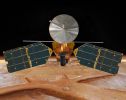
00-MRO-front-view_br~0.jpgHere is the "Mars Reconnaisance Orbiter"110 visiteThis artist's concept of the Mars Reconnaissance Orbiter features the spacecraft's main bus facing down, toward the red planet. The large silver circular feature above the spacecraft bus is the high-gain antenna, the spacecraft's main means of communicating with both Earth and other spacecraft. The long, thin pole behind the bus is the SHARAD antenna. Seeking liquid or frozen water, SHARAD will probe the subsurface using radar waves at a 15-25 MHz frequency band, "seeing" in the first few hundreds of feet (up to 1 kilometer) of Mars' crust. The large instrument (covered in black thermal blanketing) in the center is the HiRISE camera. This powerful camera will provide the highest-resolution images from orbit to date.
The other easily visible instruments are: the Electra telecommunications package which is the gold-colored instrument directly left of the HiRISE camera. It will act as a communications relay and navigation aid for Mars spacecraft. To the right of the HiRISE camera is the Context Imager (CTX). Nov 30, 2006
|
|

Hesperia_Planitia-TRA_000882_1595_RED-01.jpg"Fresh" Crater and unusual surface details in Hesperia Planitia (EDM - Extremely Enhanced and Saturated Natural Colors; credits for the additional process. and color.: Dr Paolo C. Fienga - Lunexit Team)55 visiteIl rilievo la cui albedo è tale da renderlo visibile anche in un'area ombreggiata (Sx del frame) non è risolvibile e, purtroppo, rimane inesplicabile; il rilievo posto a Dx, invece, lo risolviamo, applicando un ultra-detail mgnf, in un "boulder colonnare" (una surface feature spettacolare e molto rara, ma non necessariamente una Surface Anomaly in senso tecnico.
Semmai, ci domandiamo "da dove" possa provenire il boulder colonnare in oggetto e la nostra ipotesi è che potrebbe trattarsi di un ejecta.Nov 30, 2006
|
|

Craters-Holden_Crater-01.jpgThe beautiful "Holden Crater" (1)56 visitenessun commentoMareKromiumNov 11, 2006
|
|

Craters-Holden_Crater-02.jpgThe beautiful "Holden Crater" (2)56 visitenessun commentoMareKromiumNov 11, 2006
|
|

Craters-Holden_Crater-03.jpgThe beautiful "Holden Crater" (3)56 visitenessun commentoMareKromiumNov 11, 2006
|
|

Craters-Holden_Crater-04.jpgThe beautiful "Holden Crater" (4)57 visitenessun commentoMareKromiumNov 11, 2006
|
|
| 2237 immagini su 187 pagina(e) |
 |
|
|
|
|
180 | |
|
|
|
|





