| Ultimi arrivi - Mars Reconnaissance Orbiter (MRO) |

PSP_002244_1720_red.jpgWhite Rock (Enhanced Absolute Natural Colors; credits for the additional process. and color.: Dr Paolo C. Fienga - Lunexit Team)54 visiteThis image shows a portion of a relatively bright landform named "White Rock" on the floor of Pollack Crater in the Sinus Sabaeus Region of Mars.
Data from the Mars Global Surveyor Thermal Emission Spectrometer (TES) indicates that this landform is not anomalously bright, relative to other bright Martian Regions. Further, the apparent brightness seen here is due to contrast with other materials on the crater floor.
Dunes and ripples are visible in the dark material between the bright ridges. Their orientations appear to be influenced by wind directionally channeled by the ridges. Material appears to have been shed from the white landform and deposited on the darker bedforms indicating that the light-toned outcrops break down into fine materials.
Its high albedo and location in a topographic basin have led to suggestions that White Rock is an erosional remnant of an ancient lacustrine evaporate deposit.
Other interpretations include an eroded accumulation of compacted or weakly cemented aeolian sediment.
Apr 05, 2007
|
|

PSP_001948_1425_red.jpgGorgonum Chaos (Original NASA/JPL/University of Arizona b/w Frame)54 visitePSP_001948_1425 shows part of Gorgonum Chaos, a large cluster of chaotic terrain found in the Southern Hemisphere.
Many regions of chaotic terrain are found at the head of large outflow channels that were scoured by ancient floods. Gorgonum Chaos is one region that is not associated with an outflow channel. Chaotic terrain can form when subsurface volatiles (such as water) are catastrophically released and the overlying surface collapses. It is not known whether isolated chaotic terrain — such as that shown in this image — formed in the same way that the chaotic terrain near the outflow channels did. Wind erosion might play a role in their formation.
Gorgonum Chaos is an especially interesting area because gullies thought to have been eroded by liquid water are located on its mesas. The gullies have a wide range of orientations and many appear to emanate from a distinct layer in the mesas.
It is not known why gullies form on one slope rather than another, but insolation (amount of sunlight received), availability of water, and regional slope are possible contributing factors.
Mar 23, 2007
|
|

TRA_000878_1410_RGB.jpgTerra Sirenum56 visiteThis region receives very little sunlight in Southern Winter, and the bluish areas consist of frost. At the latitude of this image, frost is most likely composed of water because the temperature is not low enough for CO2 condensation. The reddish regions are locations where frost has been removed, most likely by sublimation. The dark, unfrosted regions (for example, in the channel of the gully on the far right) represent the most recent activity in the gullies and are possibly a result of seasonal melting. Mar 22, 2007
|
|

TRA_000825_2665_IRB.jpgNorth Polar Layered Deposits (full image & HR)56 visiteThis image of the north polar layered deposits was taken during the summer season (solar longitude of 113.6 degrees), when carbon dioxide frost had evaporated from the surface. The bright spots seen here are most likely patches of water frost, but the location of the frost patches does not appear to controlled by topography. Layers are visible at the bottom of the image, mostly due to difference in slope between them. The variations in slope are probably caused by differences in the physical properties of the layers. Thinner layers that have previously been observed in these deposits are visible, and may represent annual deposition of water ice and dust that is thought to form the polar layered deposits. These deposits are thought to record global climate variations on Mars, similar to ice ages on Earth. HiRISE images such as this should allow Mars' climate record to be inferred and compared with climate changes on Earth.Mar 21, 2007
|
|
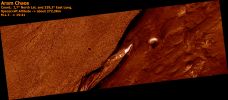
Psp_002839_1825_red.jpgAram Chaos' Sediments (False Colors)56 visiteAram Chaos appears to be a former impact crater. The terrain is disrupted, giving it a chaotic appearance (hence the name "chaos"). Scientists have postulated that a lake may have once existed inside the crater and sediments were laid down within the lake.
The mineral Hematite (rich in Iron) has been detected by orbiting spacecraft within Aram Chaos. Hematite has been identified in several other locations on Mars, including at the MER Landing Site in Meridiani Planum. The Hematite at both Meridiani and Aram Chaos most likely formed by precipitation in water.
This HiRISE image shows the light-toned sediments inside Aram Chaos that could have formed in a former lake. Unfortunately, dark debris now obscures much of this sediment, making it difficult to view and interpret the rocks. The light-toned layered deposit in the south (Dx) of the image is higher standing and has a pitted surface.
Circular structures with dark centers are likely to be impact craters that have been partly filled with dark debris, including sand. More irregular depressions appear to result from erosion of layered beds within the sediments. Wind could erode materials that are slightly weaker more quickly and produce the irregular topography seen along the surface of the deposit.
Mar 15, 2007
|
|

Psp_001691_1320_red~0.jpgGullied Trough in Noachis Terra (extra-detail mgnf - false colors)55 visiteThe majority of the gullies on both sides of the trough appear to originate at a boulder-rich layer seen in this subimage.
The layer appears dark on the sunlit slope because the boulders sticking out from the slopes cast shadows. If these gullies formed by water from the subsurface, then it is possible that this layer is a permeable layer that conducted water to the surface.
The layer is deteriorating and traveling down slope in the form of boulders.
These boulders can clearly be seen in the alcoves of the gullies on both sides of the trough.
Note that the alternating stripes on the lower right (Dx) side of the image are an artifact from camera noise. They are not real features.Mar 01, 2007
|
|

Psp_001691_1320_red.jpgGullied Trough in Noachis Terra(False Colors)55 visitePSP_001691_1320 shows gullies in a semi-circular trough in Noachis Terra. The gullies are observed to face all directions.
It is interesting to note that the gully morphology seen here depends on the orientation of the gullies. The morphology differences are most pronounced on the sunlit slope, with the gullies facing South (Dx) being more deeply incised than those facing the West. It is unknown what caused the different gully morphologies, but there are several possibilities.
Gullies are proposed to form at locations determined by the availability of a forming liquid (thought to be water) and/or the amount of insolation the slope receives, among other factors. It is possible that the deeper gullies experienced more erosional events or that their erosional events were more effective for undetermined reasons. It is also possible that the gullies formed at different times such that they did not have the same amount of water — either for an individual flow or total — available to them.
Also, the underlying topography could make the gullies appear relatively more incised without this actually being the case.
Mar 01, 2007
|
|

Psp_001481_2410_red-01.jpgEolian and Periglacial Activities in Vastitas Borealis (polygons)56 visiteThe polygons shown in this image's subset, which covers approximately 400 x 250 mt (350 x 225 yards), are in the order of 10 mt (0.9 yards) across; in some cases they are delimited by aligned rocks. Similar features in both shape and scale are found in Terrestrial Periglacial Regions such as Antarctica, where ice is present at or near the surface.
Antarctica's polygons and rock alignments are produced by repeated expansion and contraction of the soil-ice mixture due to seasonal temperature oscillations; dry soil falling into the cracks form sand wedges and amplify this effect. This results in polygonal networks of stress fractures and in the resurfacing and sorting of rocks along these fractures. Feb 23, 2007
|
|

Psp_002538_1720_red.jpgJust like Thaumasia: more "bright" dunes in Ius Chasma55 visiteIus Chasma is one of several canyons that make up Valles Marineris, the largest canyon system in the Solar System.
The canyons likely formed by extension in association with the development of the Tharsis plateau and volcanoes to the West. Wind and possibly water have modified the canyons after they formed.
This HiRISE image shows the floor of Ius Chasma. The floor is bounded to the North and South by higher standing wallrock, with a few exposures of wallrock seen in the North (Sx) of the picture. Much of the floor is covered by ripples that are oriented approximately North-South, indicating an East to West wind flow, parallel to the orientation of Ius Chasma.
Layered deposits and bright patches of material are also seen along portions of the Ius Chasma floor. The layered deposits appear distinct in morphology from the nearby wallrock. These layered deposits could be lava flows, sediments deposited in a former lake, or fines that settled out from the atmosphere over time, such as dust or volcanic ashes.
The bright outcrops visible further south in the image have been seen elsewhere in Valles Marineris as well as other locations on Mars and tend to have mineral signatures consistent with sulfates. Data from the CRISM instrument (also on Mars Reconnaissance Orbiter) of the composition of these bright patches in Ius Chasma could shed insight into their origin. MareKromiumFeb 23, 2007
|
|

Psp_001481_2410_red-00.jpgEolian and Periglacial Activities in Vastitas Borealis (DD Tracks and Polygons)57 visiteThis image shows a region of approximately 7 x 7 km (4.4-by-4.4 miles) located in Vastitas Borealis, part of the Northern Plains.
The surface imaged is relatively young, as indicated by the lack of recent impact craters.
Eolian and Periglacial activity seem to be the dominant geological processes at work, as shown by numerous crisscrossing DD Tracks and ubiquitous polygonal features, respectively.
Dust Devils form when the sun warms up the air near a flat, dry surface. Warm air then rises quickly through the cooler air above and starts spinning, causing a forward motion. The spinning, forward-moving cell may pick up dust and sand as it advances, thus leaving behind a "clean" track. We infer from this image that a thin veneer of light-colored particles of dust and/or fine-grained sand cover relatively darker materials, apparent in the dust devil tracks.
The tracks pictured in this image are in many cases more than 30 mt (27 yards) wide and over 4 Km (2,5 miles) long, surpassing the dimensions of average terrestrial DD tracks.MareKromiumFeb 23, 2007
|
|

Psp_002419_1675_red-02.jpgFrozen Waterfalls or just Layers and Dark Debris in Melas Chasma?55 visiteThis HiRISE sub-image shows layering in a light-toned deposit in Melas Chasma.
The layers are sedimentary in origin, but there are many processes that could have deposited them, such as volcanic airfall from explosive eruptions, dust-size particles settling out of the atmosphere due to cyclic changes and deposition in standing bodies of water.
By looking at the slopes in the layers and how the layers intersect each other, scientists can rule out various origins. A darker material can be seen covering much of the layered deposit. Some of this dark material is loose and can be seen accumulating as debris aprons at the base of steep slopes. Other dark material appears indurated and has been eroded by the wind to form etched edges with topographic expressions.
The lack of impact craters on the layered deposit indicates that it is a relatively young deposit, or the craters have been removed by the wind, or the deposit was quickly buried and is now being exhumed.MareKromiumFeb 16, 2007
|
|

PSP_002136_1920_cut_b.jpgPhotoartifacts?59 visiteThe image shows two portions of the Isidis Planitia image (PSP_002136_1920) with bright noise at top, and 6 examples of bright noise seen in the cruise images; all are from the original, unprocessed images.MareKromiumFeb 16, 2007
|
|
| 2237 immagini su 187 pagina(e) |
 |
|
|
|
|
177 | |
|
|
|
|





