| Ultimi arrivi - Mars Reconnaissance Orbiter (MRO) |
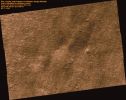
PSP_002202_2250_RED_browse-00.jpgPits, Cracks, and Polygons in Western Utopia Planitia (context image) - Elab. Lunexit54 visiteUtopia Planitia is part of the Great Northern Lowlands of Mars, where there may have been an ancient ocean.
The pits, cracks and polygons in Utopia have been interpreted as due to some combination of temperature variations in ice-rich ground, sublimation of ground ice, and collapse into subsurface voids.
This HiRISE image reveals many new details, including an abundance of boulders about 1 mt in diameter over the entire region (see the extr-detail mgnf).
The infrared color of HiRISE reveals two types of materials: the brighter and yellowish areas are probably dusty and the darker and bluer areas are probably coarser particles--sand and rocks.MareKromiumGiu 07, 2007
|
|
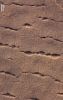
PSP_002202_2250_RED_browse-01.jpgPits, Cracks, and Polygons in Western Utopia Planitia (extra-detail mgnf) - elab. NASA54 visitenessun commentoMareKromiumGiu 07, 2007
|
|
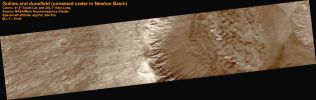
PSP_003464_1380_RED_browse-00.jpgGullies and Dunes in a Crater in Newton Basin (context image)54 visiteThis frame shows gullies associated with distinct layers located at multiple elevations along one crater wall as well as multiple generations of dunes that are eroding or covering a more coherent rock structure. The gullies in this crater appear to originate at the layers that cover a large extent of the slope. Gullies can be seen emanating from layers in two distinct sets, each at a different elevation. Gullies are often, but not always, form near layers.
Many of the gullies seen here have sinuous, or wavy, channels.
The bends are called meanders and, on Earth, meanders form in streams that have sustained and/or repeated flow. Not all of the gullies seen in this image extend the same distance downslope. This could result from differences in water supply, sediment supply, slope angle, and time of formation, among other factors.
Dunes are also visible in this image; they indicate the prevailing wind direction.
What is particularly interesting about this dune field is that there is exposed rock in the middle of it. This rock is either being exposed as the wind moves the dunes away from it or it is being covered. The dunes appear to outline the shape of the rock, which suggests that the rock has been uncovered long enough for dunes to form around it.
As the dunes shift over time, they will probably expose more of the underlying rock.MareKromiumMag 25, 2007
|
|
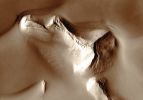
PSP_003464_1380_RED_browse-01.jpgGullies and Dunes in a Crater in Newton Basin (extra-detail mgnf)54 visiteThis extra-detail mgnf (~1 Km across) shows several generations of dunes interacting with the protruding rock.
MareKromiumMag 25, 2007
|
|

PSP_3647_1745_RED_browse-01.jpgCanditate Cavern Entrance (extra-detail mgnf)68 visitenessun commentoMareKromiumMag 25, 2007
|
|

PSP_003368_1755_RED_browse.jpgProposed MSL Site in Juventae Chasma (detail of the so-called "Martian Handwriting")109 visiteForse qualche Lettore avrà già riconosciuto il luogo e l'oggetto di questa ripresa e forse no.
Nel dubbio, Vi diciamo che si dovrebbe trattare (il condizionale è d'obbligo, poichè non abbiamo le coordinate esatte al centesimo di grado e quindi potremmo anche sbagliarci - ma di poco...) di una porzione della famosa - si fa per dire, naturalmente - "Scritta Marziana" di cui si è parlato sia nel Forum di SpazioUfo.com, sia nella nostra Rubrica TruePlanets.
Nostra opinione?
Se si tratta effettivamente di una porzione della "Scritta", allora pensiamo che adesso risulterà evidente a tutti come il parlare di artificialità del rilievo sia stato non solo azzardato e fuori luogo, ma addirittura ridicolo.
In caso contrario (e cioè qualora questo dettaglio fosse semplicemente relativo ad una zona promiscua alla "Scritta"), un simile e spettacolare frame MRO ci deve comunque essere di aiuto per capire, una volta che esso sia stato posto a confronto con il frame ESA-Mars Express relativo alla medesima zona, che l'operare congetture usando le orrende ed extra-piallate pseudo-immagini ESA è più che periglioso: è - semplicemente - assurdo.
E con questo, almeno per noi, la querelle sulla "Calligrafia Marziana"...è chiusa.MareKromiumMag 03, 2007
|
|

PSP_003222_1565_RED_browse.jpgProposed MSL Site in Eberswalde Crater57 visitenessun commentoMareKromiumMag 03, 2007
|
|

PSP_003193_0850_RED_browse_00.jpgMartian Spring: the "V" Fans (context image)57 visiteSouthern Spring sunshine is causing the seasonal Carbon Dioxide (CO2) Cap at the South Pole to evaporate.
This process happens fitfully, as small and large spots expose bare ground, which warms up, causing small spots to grow.
The defrosting areas are controlled by small scale differences in topography, which cause some areas of frost to be sheltered longer than others.
Once dust has accessed the surface it is blown in directions controlled by the local winds, making a distinctive fan. When the wind changes direction the fans broaden or may show multiple orientations.
It has also been proposed that dust is carried to the top of translucent seasonal carbon dioxide ice by release of gas held under pressure by the ice cap. When the pressure is released, like pulling the cork out of a champagne bottle, the gas escapes, carrying dust with it.MareKromiumApr 27, 2007
|
|

PSP_003193_0850_RED_browse_01.jpgMartian Spring: the "V" Fans (extra-detail mgnf)69 visitenessun commentoMareKromiumApr 27, 2007
|
|

PSP_002917_2175_RED_browse.jpgCrater Cluster in the Northern (Mid-Latitude) Plains54 visiteA Northern Mid-Latitude scene consisting of craters, intercrater plains and mantled material is seen in PSP_002917_2175. The mantled material seen here covers much of the Middle Latitudes in both Hemispheres of Mars; it has been visibly removed in some locations. It's called "mantled" because it looks as if it's just draped over, or mantling, the topography underneath. The mantled material is what causes the craters to have a muted, softened appearance. It's thought to be ice-rich material deposited in a climate different from that of today.
The mantled unit is dissected here, meaning that is not pristine and has likely undergone modification since it was originally laid down. The intercrater plains have a pitted texture that is thought to be caused by water ice sublimating and leaving depressions behind.
Unlike that of Earth, the obliquity (tilt of the planet's rotation axis) of Mars changes wildly.
Earth has the Moon to keep its axis stable, but Mars' satellites, Phobos and Deimos, are not massive enough to do the same.
Today Mars' obliquity (25.19°) is similar to that of Earth's (23.45°), but this has not always been the case. As the obliquity changes, the portions of Mars that receive the most sunlight shift. During periods of high obliquity, polar regions receive the most sunlight. This causes polar ices, including water ice and carbon dioxide ice, to sublimate (evaporate) into the atmosphere. They would then potentially be re-deposited in the mid-latitudes, similar to where this image is located. It is believed that this process is responsible for the mid-latitude mantled unit.
MareKromiumApr 20, 2007
|
|

PSP_003234_2210_red.jpgThe "Face" on Mars... (False Colors; credits: NASA/JPL)90 visiteImage PSP_003234_2210 was taken by the High Resolution Imaging Science Experiment (HiRISE) camera onboard the Mars Reconnaissance Orbiter spacecraft on 05-Apr-2007.
The complete image is centered at 40,7° latitude, 350,5° East Longitude. The range to the target site was 299,4 Km (187,1 miles). At this distance the image scale is 29,9 cm/pixel (with 1 x 1 binning) so objects ~90 cm across are resolved.
The image shown here has been map-projected to 25 cm/pixel and north is up.
The image was taken at a local Mars time of 03:28 PM and the scene is illuminated from the West with a solar incidence angle of 73°, thus the Sun was about 17° above the horizon.
At a Solar Longitude of 213,4°, the season on Mars is Northern Autumn. Apr 12, 2007
|
|
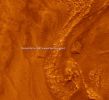
Psp_002098_2220_red-01.jpgMantles and Flows in Moreux Crater, with a "small" Surface Anomaly (EDM - False Colors)56 visiteSegnalataci dal Dr Barca (ottimo "occhio"!), la possibile Anomalìa di Superficie si sostanzia in una traccia di colore scuro che ci appare incongrua, nella sua direzione, rispetto alle altre fratture (anche modeste) della superficie ripresa, rispetto alla generale direzione assunta da dune e ripples e rispetto a tutte le altrei stratificazioni visibili.
Di che si tratta? Potrebbe essere un image-artifact (la definizione del frame, sebbene eccellente, non è tale da consentirci di escludere l'ipotesi del vizio fotografico), così come potrebbe trattarsi di una recente frattura del suolo (magari di origine sismica) o anche di uno "scalino" roccioso (un layer sedimentario parzialmente esumato).
Certo, se fossimo degli Eso-Archeologi illuminati ed immaginifici, ci saremmo già diretti verso l'ipotesi (decidete Voi se è "esotica" o meno) della "possibile evidenza di una struttura superficiale artificiale".
Ma noi non siamo Eso-Archeologi.
E, purtroppo, non siamo neppure illuminati ed immaginifici, però...però, se proprio dovessimo "azzardare"...diremmo che il rilievo scuro, in questo frame, potrebbe anche essere un'ombra. Di che cosa? Beh, questo "azzardatelo" Voi!...Apr 06, 2007
|
|
| 2237 immagini su 187 pagina(e) |
 |
|
|
|
|
176 | |
|
|
|
|





