| Ultimi arrivi - Mars Reconnaissance Orbiter (MRO) |

TRA_000827_1875_RED_browse-2.jpgCerberus' River (Extremely Saturated Natural Colors; credits for the additional process. and color.: Dr Gianluigi Barca - Lunexit Team)60 visitenessun commentoMareKromiumAgo 05, 2007
|
|
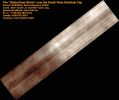
PSP_004353_0935_RED_browse.jpgThe "Global Dust Storm" over the South Polar Residual Cap55 visiteA dust storm has been raging on Mars, hampering the ability of the HiRISE team to carry out a seasonal monitoring campaign.
An area of the Southern Seasonal Polar Cap was selected in December 2006 for repeated imaging, to observe the sublimation (evaporation) of the seasonal Carbon Dioxide Polar Cap through Southern Spring.
Images collected as the season progressed show channels carved by escaping gas and fans of dust blown by the wind. This campaign has been stymied however by the arrival of a Martian dust storm. In this image the surface is completely obscured by the dust in the air.MareKromiumAgo 02, 2007
|
|

PSP_004000_1560_RED_browse.jpgLayers in Eberswalde Crater55 visiteThis image covers a portion of Eberswalde Crater, revealing a possible delta-lake transition. Water flowed into the crater through a series of tributary channels to the west of the crater and after the water entered, it formed a distributive network and partly filled the crater to form a lake (Eberswalde Crater is approx. 70 Km wide and 1,2 Km deep).
The bright layers are part of the terminal scarp at the eastern edge of the delta. Some of the steeper slopes visible at the edge of the fan may be coarser-grained resistant channel ridges. The CRISM instrument on board the Mars Reconnaissance Orbiter has detected phyllosilicates (clays) in the bright layers. One of the ways clays form on Earth is when water erodes rock and makes fine particles which settle out of water; this often occurs in river deltas and lake beds.
The delta in Eberswalde Crater and the detection of phyllosilicates provides evidence for possible persistent aqueous activity on Mars.MareKromiumAgo 02, 2007
|
|
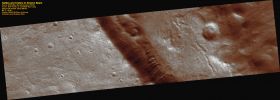
PSP_002620_1410_RED_browse-00.jpgGullies on the edge of Newton Basin (context image)54 visiteThis image shows a portion of two impact craters on the floor of Newton Basin where a smaller crater formed within a earlier larger one.
The larger crater's North rim can be seen diagonally (South-West/North-East) across the image and the smaller crater's north rim is near the right-side of the image.
Along the interior wall of the larger crater, several gullies have incised into the wall of the Crater. MareKromiumLug 06, 2007
|
|
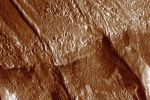
PSP_002620_1410_RED_browse-01.jpgGullies on the edge of Newton Basin (extra-detail mgnf)54 visiteThe gullies start near the top of the wall and can be traced across a break in slope partway down the wall (see here, 750 mt across). This break in slope occurs along the entire portion of the Crater wall in this image. The gullies appear shallower just above the break in slope, and deeper below the slope break.
This suggests that the fluid which eroded and carved out the wall materials forming the gullies, increased in velocity after the slope break, creating a deeper section of the gully.MareKromiumLug 06, 2007
|
|
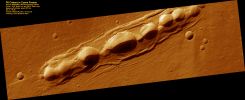
PSP_003370_2140_RED_browse.jpgPit Craters (or Collapse Pits) in Cyane Fossae63 visiteThis image shows several pits along the floor of Cyane Fossae, a set of fissures between the giant volcanoes of Olympus Mons and Alba Patera (North-East of Olympus Mons).
The fissures probably formed when the surface of the Planet was actively being stretched from the stresses of volcanic activity, causing the surface to split open along faults. There is no material piled up around the edges of the pits, as would be expected if these were impact craters or volcanic vents. Instead, parts of the Fossae floor likely collapsed into the void underlying Cyane Fossae, forming the pits.
This type of process, in which the crust is split open, has occurred here on Earth, and it created the geologic "basin and range" province of the western United States.
The walls of the pits are likely covered in dust and the few dark streaks along the walls are likely formed by avalanches of dust. Striations along the slope may be produced by the passage of DDs.
Dust also appears on the floors of the collapse pits and covered most of the plains nearby. Despite the presence of this layer of dust, bouldery outcrops occur in places along the wall, suggesting that the underlying material is hard and rocky.
MareKromiumLug 06, 2007
|
|
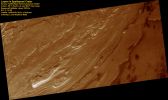
PSP_003442_1215_RED_browse-00.jpgLayers in Spallanzani Crater (context image)54 visiteThis image shows light-toned layered deposits along the floor of Spallanzani crater, a 72 Km (about 45 mile) diameter crater located just South-East of Hellas Planitia.
These layered deposits may be remnant sediments once deposited within the crater. Mechanisms for sediment deposition include windblown debris, airfall volcanic ash, or sediments that accumulated in a lake on the crater floor.
The slopes are covered in debris, and not fallen plates or blocks from the plateau edge.
This suggests that the layers are composed of weak materials that are protected by a stronger, more coherent surface.
The crater is named after the 18th Century Italian biologist, Lazzaro Spallanzani (1729-1799).
MareKromiumLug 06, 2007
|
|
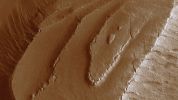
PSP_003442_1215_RED_browse-01.jpgLayers in Spallanzani Crater (extra-detail mgnf)100 visiteThe layers within Spallanzani Crater are eroding in a stair-stepped pattern.
Each layer appears as a sequence of a broad flat area or plateau, which drops off abruptly down to the next flat surface (see this extra-detail mgnf).
This stair-stepped pattern suggests that the layers have discreet boundaries that may be the result of differing compositions, time of deposition, or both. Near, but not at the edge of each plateau, the material is fracturing into polygonal plates or blocks that tilt downward away from the plateau center. MareKromiumLug 06, 2007
|
|
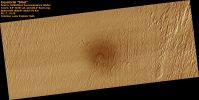
PSP_004030_1855_RED_browse.jpgBlast from the (Very Recent) Past54 visiteIn the center of this image is a very sharp-rimmed impact crater just 35 mt wide.
It lies in a bright, dust-covered region, but is surrounded by a slightly darker spot about 3 Km wide. The impact event created a blast of high winds that disturbed the dust and darkened the spot.
Since dust is constantly settling over the Region, the fact that we can still see the dark region means the impact event occurred of late, perhaps in recent decades. There are many dark streaks on topographic slopes over an even wider region surrounding the dark spot - these could be due to dust avalanches triggered by the impact, either from the air blast or from seismic shaking of the ground.
There are also rays of very small (approx. 1 mt in diameter) secondary craters extending radially outward from the 35-mt crater, created by the impact of rocks ejected from the main crater.
Thus a small impact crater has modified the surface over an area more then 10.000 times greater than that of the crater's interior.MareKromiumGiu 28, 2007
|
|
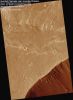
PSP_003223_1755_RED_browse.jpgInverted Channels Near Juventae Chasma55 visiteThis image shows several long, sinuous features on the plains near Juventae Chasma. These features have been explained as former stream channels now preserved in inverted relief.
Inverted relief occurs when a formerly low-lying area becomes high-standing. For instance, depressions may become filled with lava that is more resistant to erosion. In the case of stream channels, there are several possible reasons why the channel might stand out in inverted relief. The streambed may contain larger rocks, which remain while fine material is blown away by the wind, or it could be cemented by some chemical precipitating from flowing water.
These features are old, since several impact craters cut the ridges. They provide important information about past processes on Mars. Understanding how streams could have formed is an important issue in understanding the history of water on Mars.MareKromiumGiu 28, 2007
|
|
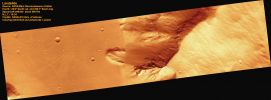
PSP_003516_1540_RED_browse.jpgLarge (and VERY Old) Landslide Deposit54 visiteThis HiRISE image is centered on a large landslide which formed the large lobe at the base of the steep slope. This is material which was transported in a massive rock-slide.
The landslide has several ridge-and-trough lineations in the direction of the flow. These occur in similar landslides on Earth as well. Comparing these features on Mars with similar examples on Earth helps geologists better understand how they work on both Planets.
In this case, the slide is relatively old.
The material has many impact craters superimposed. The steep slope, which was the source of the landslide, has undergone further erosion, so the landslide source area is no longer clear. MareKromiumGiu 14, 2007
|
|

PSP_003595_2115_RED_browse.jpgOlympus' Aureole (False Colors; credits for the additional process. and color.: Dr Paolo C. Fienga - Lunexit Team) 111 visiteThis image samples the rugged central portion of the mysterious "aureole" that extends to the West and North of Olympus Mons.
While many ideas for its formation have been advanced over the decades, these days it is generally thought to be a giant landslide deposit. The scene here fits that model with kilometer-scale (mile-sized) rocky hummocks and blocks strewn about. The blocks themselves are now covered with dust that is slumping off in small landslides or avalanches. These leave dark streaks on the sides of the blocks.MareKromiumGiu 07, 2007
|
|
| 2237 immagini su 187 pagina(e) |
 |
|
|
|
|
175 | |
|
|
|
|





