| |

| Ultimi arrivi - Mars Reconnaissance Orbiter (MRO) |

PSP_004847_1745-WFull2.jpgThe "Martian Black Hole" (general context frame - False Colors; elab. Lunexit)59 visiteCon questa ricostruzione in colori "naturali" della Regione su cui si trova il nostro "Black Hole", forse riusciamo a rispondere (finalmente con chiarezza) a qualche Lettore il quale ci chiedeva come mai, a fronte di frames che inquadrano la stessa Regione Marziana, spesso le colorizzazioni che facciamo sono diverse. Ebbene la risposta è in questo frame-composite: la nostra colorizzazione RISENTE SEMPRE e COMUNQUE del tipo di filtro adottato dalla Sonda per effettuare la ripresa (nonchè delle effettive condizioni di illuminazione "locali")! Questo caso è eclatante e chiarificatore: diverse stripes, ottenute con diversi filtri, producono - anche a fronte dell'uso di un processo di colorizzazione omogeneo ed unitario - dei risultati MOLTO diversi (provate con JASC Paint Shop Pro, se volete - funziona egregiamente per le colorizzazioni, e verificate Voi stessi).MareKromiumSet 01, 2007
|
|
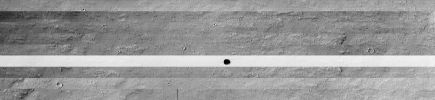
PSP_004847_1745-WFull.JPGThe "Martian Black Hole" (general context frame)55 visiteRingraziamo il Dr Gianluigi Barca per il lavoro svolto e per la pazienza avuta. Di che si tratta? Si tratta della ricostruzione, strip-by-strip, della Regione situata nei pressi del Grande Vulcano Arsia Mons laddove, come vedete bene, si trova il nostro "Martian Black Hole".
Come è facile notare, la striscia che comprende la voragine è stata processata (o ripresa?) in maniera tale da risultare, rispetto alle altre stripes che vanno a comporre l'interezza della Regione, completamente piallata e palesemente sovraesposta.
Il motivo (l'unico che ci viene in mente) potrebbe essere trovato nel tentativo di contrastare meglio quello che si vedeva "dentro" la voragine. Tuttavia, considerati i mezzi dei quali la NASA dispone, ci sentiamo pure di dire che quanto fatto NON è esattamente un "gran bel lavoro".
E allora?
E allora ribadiamo ed esplichiamo meglio quanto scritto in "Velvet Underground": o la NASA è in perfetta Buona Fede (però lavora - spesso - "in qualche modo"...), oppure la porzione di terreno che circonda la "voragine" è stata VOLUTAMENTE piallata, per motivi ignoti.
La Verità? Noi non la sappiamo, ma la nostra Coscienza e Professione ci spingono a proporre TUTTE le ipotesi che ci vengono in mente e che trovano una certa sostanza. Per il resto...dovete decidere Voi.MareKromiumSet 01, 2007
|
|
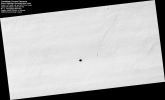
PSP_004847_1745_RED_browse-00.jpgThe "Martian Black Hole"...Again! (context frame)54 visiteVi invitiamo a leggere l'ultimo articolo sull'argomento (pubblicato su TruePlanets) dal titolo "Velvet Underground".MareKromiumSet 01, 2007
|
|

PSP_004847_1745_RED_browse-02.jpgThe "Martian Black Hole"...Again! (EDM - False Colors)142 visiteVi invitiamo a leggere l'ultimo articolo sull'argomento (pubblicato su TruePlanets) dal titolo "Velvet Underground".MareKromiumSet 01, 2007
|
|

PSP_004989_0945_RED_browse.jpgSwiss Cheese Terrain in the South Polar Region54 visiteSince Mars is colder than Earth, there is not just water ice at the Poles, but also a concentration of Carbon Dioxide (CO2) ice. Some of the Carbon Dioxide ice at the South Pole is there all year long and called the "Residual Cap".
This image was taken near the South Pole of Mars and shows a characteristic "Swiss cheese" pattern.
This pattern is created when there is relatively high, smooth material that is broken up into these circular-shaped depressions forming the "Swiss cheese" terrain.
The depressions are thought to be caused by sublimation, which is when a material goes directly from a solid to a gas phase.
Repeated images are taken of areas like this so the changes in depression size and where they form can be monitored through the seasons.MareKromiumAgo 30, 2007
|
|
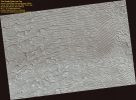
PSP_004820_0940_RED_browse.jpgFingerprint Terrain with Sawtooth Patterns in the South Polar Ice Cap (Natural Colors; credits for the additional process. and color.: Dr Paolo C. Fienga - Lunexit Team)54 visiteThis image shows a portion of the South Polar Ice Cap. The ice you see here is frozen CO2 rather than the frozen water you are used to here on Earth.
Even on Mars, where the temperatures are much lower than on Earth, CO2 ice is a volatile substance. As it is so unstable, large amounts can sublimate very quickly when heated. In this ice cap we can see icy features shrink in size by several meters per year as the ice that makes them up is removed by solar heating. Usually these icy features are almost circular as you get equal amounts of Sunlight from every direction when you are at the Pole.
However, in this location something strange has happened. Instead of the usual circular features we see features that are decidedly linear in shape. These sets of linear features have been dubbed "fingerprint terrain" by Planetary Scientists. They are seen in several locations in this ice cap and usually have a wavelength close to 90 mt (295 feet). It's hard to understand why linear features would form in this sort of environment by sublimation of ice alone.
It is possible that these features are formed instead by atmospheric processes. Either the features are sand dunes covered by a thin covering of frost or they might be made up of loose ice crystals that saltate like sand grains and have collected into ripples.
It would be a huge surprise to find sand dunes in this location, just as you wouldn't expect to see sand dunes on top of the Greenland ice sheet on Earth. To confirm that they are made of CO2 ice, HiRISE will image this location again at the end of the year and compare it to this image to look for changes.
Icy features should show large changes, but sand dunes move much more slowly. MareKromiumAgo 23, 2007
|
|

PSP_003252_1425_RED_browse-01.jpgBright Gully Deposit in Terra Sirenum (the "crater" - close-up; false colors)57 visiteAs seen in the context image and here, the appearance of the crater wall differs between the Northern and Southern Sides. On the Northern Pole-Facing Side Walls, prominent gullies with channels and aprons are apparent, with many of these having valley-like alcoves near their tops. The morphology of the gullies is consistent with formation by a fluid, most likely water.
On the pole-facing slopes, ground ice or aquifers may be more stable, being subjected to less heating from sunlight compared to equator-facing slopes.
In contrast, the Southern, Equator-Facing Walls are dominated by rocky debris flows that lack prominent channels.MareKromiumAgo 16, 2007
|
|

PSP_003252_1425_RED_browse-02.jpgBright Gully Deposit in Terra Sirenum (the "gully" - close-up; false colors)54 visiteThe bright gully deposit has a very fluid-like appearance, and has not been covered by other gullies or debris flows, indicating a young age. The brightness is a mystery; it could be due to minerals formed from water or ice.
Alternatively, the flow that made the gully may have removed a thin coating of relatively darker dust and soil, revealing a brighter substrate.
In any case, this feature is probably indicative of recent flow of water or water-rich material on Mars.MareKromiumAgo 16, 2007
|
|
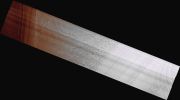
PSP_004664_0955_RED_browse.jpgOutcrops of Layers in the South Polar Layered Deposits54 visiteThis image spans a section of the South Polar Layered Deposits (SPLD). The SPLD are composed of layers of water ice mixed with impurities (probably mostly dust). The most similar terrestrial analog to the SPLD are ice sheets, like those covering most of Greenland and Antarctica.
The materials of ice sheets are deposited by freezing of atmospheric water vapor on dust particles and precipitation of those water/dust particles (snow), by direct condensation (freezing) of atmospheric water vapor onto the surface, and by fallout of dust. Together, these processes cause an ice sheet to undergo accumulation (build-up). Ablation (removal of material, also called erosion) of an ice sheet can also occur. If more accumulation happens than ablation, the ice sheet grows; if reversed, the ice sheet shrinks, as is the case for many of Earth’s glaciers due to global warming. Each year, the amount of accumulation and ablation varies, so layers of different thicknesses and different amounts of impurities (dust) will be deposited onto the ice sheet.
Volcanic eruptions anywhere on the planet can also potentially spew ash high into the atmosphere, where it can travel great distances and fall onto an ice sheet surface. Later accumulations of water ice can then trap this volcanic ash as a layer within the ice sheet. Thus, layers in an ice sheet can originate through a variety of means and occur at a variety of scales (thicknesses).
This particular image is interesting because many layers are exposed and because more than one outcrop (exposure of layering) is visible—at the top of the image and at the bottom. You can imagine the outcrops at the top and bottom of the image as if you are looking down on a staircase. The approximately horizontal lines are the edges of the layers (the risers), and the flat areas between them are the layer surfaces (the flat parts of the steps). The middle of the image is the top of the staircase. At the bottom, the staircase of layers goes down again.
The layers in this image are on the scale of meters (several to tens of feet) in thickness and are much thicker than one might expect from annual accumulation (which might be about 0.5 millimeters per year, or 0.02 inch per year). So the layers we see in this image may be packages of thinner, annual layers. The reason that we can distinguish between different packages of annual layers (in other words, the reason that we can see layering at this scale) is because the rates of accumulation and ablation change not only yearly, but also on much longer time scales. Imagine drilling into the SPLD and looking at the walls of the hole with a microscope. Within the large-scale layering we see in this image, we might see annual accumulation layers, dusty layers created during large dust storms, and maybe even volcanic ash layers.MareKromiumAgo 10, 2007
|
|
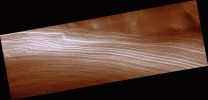
PSP_004708_1000_RED_browse-00.jpgFault in the South Polar Layered Deposits (CTX Frame - Extremely Enhanced Natural Colors; credits for the additional process. and color.: Dr Paolo C. Fienga - Lunexit Team)54 visiteThis image spans a section of the south polar layered deposits (SPLD). The SPLD are composed of layers of water ice mixed with impurities (mostly dust). The most similar terrestrial analog to the SPLD are ice sheets, like those covering most of Greenland and Antarctica.
Faults are created when rock (or, in this case, water ice) breaks due to some outside force and rocks (or ice) along either side of that break move in opposite directions. One of the most famous faults on Earth is the San Andreas Fault in California. There is a crack between the floor of the Pacific Ocean, plus a little bit of the California and Mexico coastline, and the rest of North America; the Pacific Ocean floor is moving northward along that crack, but North America is moving southward. Because the two sides are grinding against each other, they sometime stick together and then move again in jerky fashion, much like the way if you try to rub pieces of rough sand paper together. When movement along the fault occurs after a period of sticking together, this creates an earthquake.
For the case of this fault on Mars, it is unlikely that a "Marsquake" occurred when movement happened along this fault, because it is so small (over 1000 times shorter than the San Andreas Fault). This is interesting because faults are rare in the Martian polar layered deposits. The fault may have been created during widespread flow of the SPLD. Some of the stiffer ice could not flow and broke instead. Ice can only flow fast enough to create faults when it is relatively warm. Similarly, if you cool molasses enough, it becomes hard and doesn't flow. But the temperatures on Mars today are probably not warm enough to allow the creation of faults. This is why faults are so rare in the Martian ice. When were temperatures warm enough? This is still a mystery.
MareKromiumAgo 10, 2007
|
|
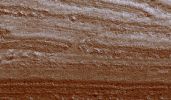
PSP_004708_1000_RED_browse-01.jpgFault in the South Polar Layered Deposits (EDM - Extremely Enhanced Natural Colors; credits for the additional process. and color.: Dr Paolo C. Fienga - Lunexit Team)54 visiteThe figure shown here is a cutout of the previous frame (1,8 Km across, or about 1,1 mile) showing a very interesting and smewhat rare feature: a fault. The fault is the thin, diagonal line that cuts through most of the image, from near the lower left corner to near the upper right corner. On each side of the fault, the layers that cross the fault are slightly off-set from one other; in other words, the layers don't line-up with each other anymore. The relationship between the angles at which the layers and fault are exposed and the movement along the fault is complex, but, in general, the layers on the left side of the fault are slightly lower than those on the right.MareKromiumAgo 10, 2007
|
|

PSP_004324_1060_RED_browse.jpgPolygons on South Polar Layered Deposits55 visiteThis image shows an exposure of south polar layered deposits, thought to record recent global climate changes on Mars.
The layers were probably laid down over the past few million years over a large area near the south pole, then eroded to show the layering visible in this image.
The layers appear brighter where their slopes are steeper and facing the Sun.
Within the brighter, steeper part of the layered deposits, a network of polygonal fractures is visible. The polygons outlined by the fractures are typically a few hundred meters (approx. 1000 feet) across, and traverse layer boundaries. Such polygonal fractures are seen on Earth in places where ground ice is present, and previous Mars orbiters have found evidence for abundant ground ice in the south polar region of Mars. So it is not surprising to see polygonal fractures here; what is unusual is that they cross layer boundaries, apparently unaffected by the changes in slope across them.
This suggests that the polygonal fractures formed after the scarp exposing the south polar layered deposits was formed by erosion. This indicates, possibly, that the scarp has been stable for some time, allowing the polygonal fractures to form.
MareKromiumAgo 10, 2007
|
|
| 2237 immagini su 187 pagina(e) |
|
|
|
|
|
174 | |
|
|
|
|
|
|





