| Ultimi arrivi - Mars Reconnaissance Orbiter (MRO) |

PSP_005571_0950_RED_abrowse-01.jpgSouth Polar Residual Cap Margin (extra-detail mgnf; MULTISPECTRUM - elab. Lunexit)56 visiteIn this extra-detail mgnf one can see fractures in the Residual Cap ice near the margin and, farther in, circular depressions that, in some places, appear to have coalesced.
These depressions constitute what is called "Swiss Cheese Terrain" and it's fairly easy to see why. The Swiss cheese terrain is created when the CO2 goes directly from the solid state (ice) to a gaseous state (the more familiar CO2 gas) as temperatures warm during South Polar Summer.
Swiss Cheese Formation may also be linked in a complicated way to the behavior of major Martian Dust Storms.
Images like these, taken before and after dust storm events, can aid our understanding of that complicated relationship.MareKromiumNov 29, 2007
|
|

PSP_005456_1650_RED_abrowse-01.jpgHome Plate from Orbit (EDM; Natural Colors - elab. Lunexit)62 visiteIl MER Spirit è indicato da una Freccia Rossa (Red Arrow), ad approx. ore 05:30 di Home Plate (la struttura più chiara, posta sul lato Dx del frame ed in posizione mediana).MareKromiumNov 22, 2007
|
|
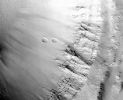
PSP_005343_2170_RED_abrowse-01.jpgScarp with Landslides and Boulder Tracks (extra-detail mgnf)54 visiteThis subimage - or extra-detail mgnf - (approx. 480 meters across) shows boulder tracks from the landslide scar on the left side of the image.
Some boulders can be seen forming trails along the slope at the top part of the subimage, while others can be seen at the end of their trails (...).MareKromiumNov 22, 2007
|
|
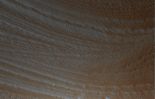
PSP_005682_1035_RED_abrowse-01.jpgBasal Exposure of South Polar Layered Deposits (extra-detail mgnf; possible natural colors - elab. Lunexit)55 visiteSome layers have an irregular wavy appearance that may have been caused by flow of the ice in the past when the now-exposed ice was still buried.
It is currently too cold at the surface in the South Polar Region of Mars for significant flow to be occurring today.
Other layers appear to be converging and some are truncated and may represent the so-called "unconformities" (see here).
Unconformities form when a previous episode of erosion removes all or part of a layer and is later followed by more deposition.MareKromiumNov 09, 2007
|
|

PSP_005381_0870_RED_abrowse.jpgSouth Polar Layered Deposits with Surface Modification (possible natural colors - elab. Lunexit)54 visiteThis image shows a scarp exposing the south polar layered deposits (SPLD). The polar layered deposits are thought to record recent climate variations on Mars, similar to ice ages on Earth.
Radar data indicate that the SPLD are ice-rich, with variations in dust contamination likely causing the layering visible here. HiRISE images of the SPLD will help to unravel Mars' climate history, but this image illustrates how this effort is complicated.
The development of surface features, by erosion, deposition, or modification of the surface, makes it difficult to determine the characteristics of the layers themselves. Some of the layers appear wavy, perhaps due to folding, flow, or uneven erosion since they were laid down. Short, branching, often radial channel systems are cut into the surface of the layers in places. These may be related to "spiders," thought to be formed as carbon dioxide gas flows along the surface when the seasonal polar cap sublimates in the spring. Pits and polygonal fractures are visible on the layers as well.
Apparently this exposure of SPLD is relatively old, as these features probably take many years to form. While these features are interesting in their own right, they disturb the SPLD outcrops and make it more difficult to measure the thickness of layers and compare them to other outcrops of SPLD.
MareKromiumOtt 26, 2007
|
|

PSP_005680_1525_RED_abrowse-00.jpgPossible ancient Salt Deposits in Terra Cimmeria (Extremely Saturated and ENhanced Natural Colors - credits for the additional process. and color.: Dr Paolo C. Fienga - Lunexit Team)54 visiteThe ancient cratered highlands of the Southern Hemisphere of Mars has an intriguing and complex history as it has been riddled with impact craters and modified by volcanic processes and by the wind.
Additionally, it is one of the most heavily dissected terrains on Mars exhibiting the densest population of Valley Networks: old dried up channels and valleys that may have been formed by surface runoff, the seepage of ground water, or both.
Recently, the Thermal Emission Imaging System (THEMIS) aboard Mars Odyssey, in conjunction with spectral data from the Thermal Emission Spectrometer (TES) aboard the Mars Global Surveyor (MGS) have revealed the presence of a unique surface deposit that may be rich in chloride salts formed from the presence of liquid water. Three separate missions (MGS, MO and MRO) have come to reveal the composition and nature of these unique deposits, which, although they occur as relatively small deposits (less than 25 square Km) are widely distributed in Noachian (most ancient) terrains with fewer occurrences in the Hesperian (middle geologic time) terrains.
The deposit appears to be relatively thin and occurs in low-lying areas. It is also heavily pockmarked and discontinuous, possibly from removal of the material by erosion. Both of these aspects suggest that the deposit is indeed very old.
The presence of such salts is intriguing, and strongly suggests that conditions were favorable for water near or at the surface in the geologic past.
Polygonal cracks can be observed in this image and other images of these deposits elsewhere on Mars (see PSP_003160_1410) and are similar to desiccation cracks (formed from the rapid evaporation and drying of a wet surface) and indicate that these may were more likely deposited at the surface.
However, the volume and duration the water required for these deposits is still being investigated. MareKromiumOtt 26, 2007
|
|

PSP_005346_1755_RED_abrowse-00.jpgLow-Order Inverted Streams near Juventae Chasma (context frame - elab. Lunexit)54 visiteThis image shows plains North-West of Juventae Chasma, one of the Martian canyons that are part of the equatorial Valles Marineris System. The two most noticeable features in this scene are craters on mesas (plateaux) and raised, winding ridges. The raised ridges are "Inverted Channels". It is likely that liquid water, either pure or salt water, flowed through these channels. The channels are raised because streams transport sediment as they flow, deposit the heavier sediment on the stream floor, and, eventually fill in once their water supply dwindles. Over time, wind erosion modifies a landscape, and this has played an important role on these plains. It eroded the land around the channels leaving the remnant channels exposed and standing high. The channels did not erode as much since they were more resistant, possibly because the deposited sediment had cemented together.
The craters on mesas are also evidence of active wind erosion: when craters form, they eject material out onto the surrounding landscape.
It appears that several of the craters’ ejecta visible here cemented, making the ejecta more resistant to erosion and leaving them standing high as craters on plateaux.MareKromiumOtt 25, 2007
|
|

PSP_005346_1755_RED_abrowse-01.jpgLow-Order Inverted Streams near Juventae Chasma (extra-detail mgnf)54 visiteThis subimage (approx. 1120 meters across) shows a juncture of 2 of the "Inverted Channels".
It is likely that the water flowed from the left to the right of the scene, because channels usually join rather than divert unless there is an obvious obstacle in the way.
No such obstacle is seen here, but one might have been present when the stream originally flowed.
However, there is no way of knowing this.MareKromiumOtt 25, 2007
|
|

PSP_005419_1380_RED_browse-00.jpgFlow-like Features in Promethei Terra (context frame)54 visiteThis image, part of the south-facing slopes of a massif in Promethei Terra in the Southern Highlands, shows flow-like features (tongue-shaped lobes, parallel ridges) that indicate movement of surface materials downhill and towards the South-West, following the regional slope.
The difference in elevation between the ridge (near the top or northern-most portion of the image) and the valley (to the South) is over 2200 meters (7,200 feet).
These flow-like features are reminiscent of those observed in terrestrial landslides and rock glaciers , in which the downhill movement of rocks and soils is facilitated by an agent (most commonly water in landslides, ice in glaciers) that acts as a lubricant and provides cohesion. Theoretical calculations predict that under current and recent Martian climate conditions, neither water nor ice would be stable near the surface for extended periods of time in this Region.
The temperatures are so low that water would freeze, and then quickly sublime, because the air is very thin and dry. Ice could, though, be stable at present approximately 1 meter (3 feet) or more below the surface.
MareKromiumOtt 05, 2007
|
|
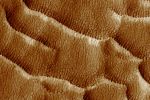
PSP_005419_1380_RED_browse-01.jpgFlow-like Features in Promethei Terra (extra-detail mgnf)54 visiteThe subimage (approx. 390 x 260 meters) shows in detail some of the ridges developed in the slope deposits. Numerous fissures cut through the surface, forming polygons 5 to 10 mt (5,5 to 11 yards) across.
Such well-preserved polygons indicate that the downhill flow had stopped before they formed. Polygonal features similar to these are common in terrestrial periglacial regions such as Antarctica, where ice is present at or near the surface. Antarctica's polygons formed by repeated expansion and contraction of the soil-ice mixture due to seasonal temperature oscillations.MareKromiumOtt 05, 2007
|
|
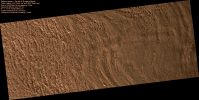
PSP_003639_1345_RED_browse-00.jpgDebris Apron South of Euripus Mons (context image - possible natural colors; elab. Lunexit)56 visiteEuripus Mons is located to the east of Hellas impact basin in the southern mid-latitudes of Mars.
The overall wavy, curved surface pattern of this debris apron suggests that material flowed out from the isolated flat-top ridge. This mass movement of debris probably involved ice flow (possibly forming rock glaciers) and potentially liquid water.MareKromiumSet 27, 2007
|
|
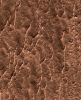
PSP_003639_1345_RED_browse-01.jpgDebris Apron South of Euripus Mons (extra-detail mgnf - possible natural colors; elab. Lunexit)56 visiteA closer view of the upper portion of the image (see here), reveals that rough sharp scalloped ridges are particularly prominent.
This scalloping may have resulted from sublimation of ice below the surface.MareKromiumSet 27, 2007
|
|
| 2237 immagini su 187 pagina(e) |
 |
|
|
|
|
172 | |
|
|
|
|





