| Ultimi arrivi - Mars Reconnaissance Orbiter (MRO) |
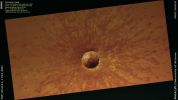
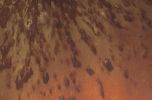
PSP_004313_1760_RED_abrowse-00.jpgWinslow Crater - context frame n. 1 (MULTISPECTRUM; credits: Lunexit)62 visiteIn this first HiRISE image of Winslow Crater (PSP_004313_1760), distinct dark rays surrounding the crater and are consistent with the THEMIS data’s suggestion of rockier materials. V-shaped patterns in the rays — referred to as a “herringbone” pattern — are identical to those around fresh Lunar Craters.
These form when materials are ejected from the crater at a very low angle, which form clusters of secondary craters that preferentially eject materials down-range in a V-shaped pattern. (It‘s the same pattern that you would get when shooting a water pistol nearly parallel to a sidewalk.)
Also noteworthy are the large meter-to-decimeter-sized boulders on the steep rim that have not been buried or physically weathered to smaller sizes in this windy region, indicating that they have not been exposed long.
This is also reminiscent of Meteor Crater and examples of fresh simple craters on the Moon.
The ring of rocky, cliff-forming materials in the inner wall of the Crater represents original bedrock that was uplifted and exposed by the impact. The characteristic morphology is called “spur and gully” consisting of both the protruding bedrock inter-fingered with debris shoots feeding fans of sandy materials that extend down to the crater floor.
Throughout this Region, the present-day surface consists of a mix of global dust and volcanic sands from the Syrtis Major complex that typically cover the local bedrock. Winslow Crater is an excellent example of how craters can provide a window into the subsurface by exposing the local bedrock within the ejecta and crater wall.MareKromiumGen 12, 2008
|
|
PSP_004313_1760_RED_abrowse-01.jpgWinslow Crater - extra-detail mgnf from frame n. 1: the "Herringbone Pattern" (MULTISPECTRUM; credits: Lunexit)56 visitenessun commentoMareKromiumGen 12, 2008
|
|

PSP_005418_1075_RED_abrowse-01.jpgDistorted Layers in the SPLD (extra-detail mgnf - MULTISPECTRUM; credits: Lunexit)56 visiteThis enhanced image (1,2 Km or 0.7 miles across) shows a section of the South Polar Layered Deposits, which are an accumulation of layers consisting mostly of water ice and dust. Perhaps their closest analog on Earth would be the Ice Caps of Greenland and Antarctica.
This image is particularly interesting because the layers are not flat-lying but rather appear "wavy" (---> ondeggianti).
This appearance could partly be an “illusion” due to erosion after the flat-lying layers were deposited. In that case, the wavy appearance is due to the fact that the layer edges are wavy, going into and out of the plane of the outcrop exposing the layers.
Alternatively, this waviness could be due to deformation of the layers folding caused by flow of the ice.
Here, the flow probably occurred long ago since current temperatures are too low to allow the ice to flow at a significant rate.MareKromiumDic 28, 2007
|
|

PSP_004965_0980_RED_abrowse-01.jpgSouth Polar Layered Deposits (SPLD; extra-detail mgnf - MULTISPECTRUM; credits: Lunexit)56 visiteThe exposure of South Polar Layered Deposits shown here also appears to be partly covered by additional debris.
The layers appear to have been offset by a fault near the upper right corner.
The faulting and burial visible here complicates the interpretation of the climate history of Mars based on observations of layering.MareKromiumDic 28, 2007
|
|

PSP_005788_1035_RED_abrowse.jpgRepeated Erosion and Deposition in the SPLD (MULTISPECTRUM; credits: Lunexit)54 visiteThis image of the SPLD shows evidence of multiple episodes of deposition and erosion near their base.
The SPLD, like the North Polar Layered Deposits (NPLD), are thought to contain a record of global climate changes on Mars. The surface of the outcrop shown here slopes generally toward the right. The layering is cut off by deposits that partly fill two broad valleys that were previously cut into the SPLD, probably by wind erosion. These more recent deposits appear to cover the flatter, upper part of the SPLD, and have also been eroded to expose layering with them.MareKromiumDic 28, 2007
|
|

PSP_005388_1975_RED_abrowse-01.jpgPang Boche Crater (EDM; False Colors; credits for the additional process.: Dr Paolo C. Fienga - Lunexit Team)55 visiteThe interior of Pang Boche Crater contains material that likely slumped off the walls during late stages of its formation. The north wall of the crater has material that has not slumped to the floor, instead forming a terrace.
Also noteworthy is the abundance of small craters that surround, but do not occur within, Pang Boche. These are mostly Secondary Craters that formed when ejecta from an impact hit the surface. If the small craters were Primary Craters (formed from an impactor from space), then they would be expected to be within Pang Boche as well. Secondaries commonly occur in clumps as seen in this extra-detail mgnf (which is approx. 2 km across).
The strong clustering indicates that these craters are Secondaries.MareKromiumDic 20, 2007
|
|
PSP_003292_2025.jpgCollapse Pits (natural colors + MULTISPECTRUM; credits: Dr M. Faccin e Lunexit)67 visitenessun commentoMareKromiumDic 14, 2007
|
|

PSP_001474_2520_RED-new_lake-00~0.jpgThe Northern Lakes: Lake "Lunexit" (context image; MULTISPECTRUM - Credits: Lunexit)67 visitenessun commentoMareKromiumDic 13, 2007
|
|

PSP_001374_1805_RED_browse-00~0.jpgLayering in Exhumed Crater at Meridiani Planum Region (context image - MULTISPECTRUM; credits: Lunexit)55 visite...Noi, detto senza falsa modestia, sfidiamo la NASA a fare di meglio...MareKromiumDic 12, 2007
|
|

PSP_005946_0975_RED_abrowse-01.jpgUnconformity in the South Polar Layered Deposits (SPLD) - (extra-detail mgmf - natural colors; elab. Lunexit)75 visiteThe layers in the upper center/right end abruptly (truncate) at a curve in the layers that extend along the left side of the image.
This type of truncation (termed "unconformity" in Geology) is usually due to erosion, wherein the layers in the lower right were eroded, followed by later deposition of the rest of the layers on top of the older layers (layer age likely increases from left to right). It is also possible that flow of these icy layers played a part in the complicated layer geometry exhibited in this extra-detail mgnf".MareKromiumDic 06, 2007
|
|

Phobos_Deimos-PIA10117.jpgCRISM Views Phobos and Deimos57 visiteThese 2 images taken by the Compact Reconnaissance Imaging Spectrometer for Mars (CRISM) show Mars' 2 small moons, Phobos and Deimos, as seen from the MRO's low orbit around Mars. Both images were taken while the spacecraft was over Mars' night side, with the spacecraft turned off its normal nadir-viewing geometry to glimpse the moons. The image of Phobos, shown at the top, was taken at 01:19 UTC on October 23, 2007 (19:19 EDT on Oct. 22), and shows features as small as 400 mt (1320 feet) across. The image of Deimos, shown at the bottom, was taken at 20:16 UTC (00:16 EDT) on June 7, 2007, and shows features as small as 1,3 Km (0,8 miles) across.
Both CRISM images were taken in 544 colors covering 0.36-3.92 micrometers and are displayed at twice the size in the original data for viewing purposes.
Phobos and Deimos are about 21 and 12 Km (13,0 and 7,5 miles) in diameter and orbit Mars with periods of 7 hours, 39,2 minutes and 1 day, 6 hours, 17,9 minutes respectively. Because Phobos orbits Mars in a shorter time than Mars' 24 hour, 37.4-minute rotational period, to an observer on Mars' surface it would appear to rise in the West and set in the East. From Mars' surface, Phobos appears about one-third the diameter of the Moon from Earth, whereas Deimos appears as a bright star. The moons were discovered in 1877 by the astronomer Asaph Hall, and as satellites of a planet named for the Roman God of War, they were named for Greek mythological figures that personify fear and terror.
The first spacecraft measurements of Phobos and Deimos, from the Mariner 9 and Viking Orbiter spacecraft, showed that both moons have dark surfaces reflecting only 5 to 7% of the sunlight that falls on them. The first reconstruction of the moons' spectrum of reflected sunlight was a difficult compilation from 3 different instruments, and appeared to show a flat, grayish spectrum resembling carbonaceous chondrite meteorites. Carbonaceous chondrites are primitive carbon-containing materials thought to originate in the outer part of the Asteroid Belt. This led to a commonly held view among planetary scientists that Mars' moons are primitive asteroids captured into Martian orbit early in the Planet's history. More recent measurements have shown that the moons are in fact relatively red in their color, and resemble even more primitive D-type asteroids in the outer Solar System.
Those ultra-primitive bodies are also thought to contain carbon as well as water ice, but to have experienced even less geochemical processing than many carbonaceous chondrites.
The version of the CRISM images shown here were constructed by displaying 0.90, 0.70, and 0.50 micrometer wavelengths in the red, green, and blue image planes. This is a broader range of colors than is visible to the human eye, but it accentuates color differences. Both moons are shown with colors scaled in the same way.
Deimos is red-colored like most of Phobos. However, Phobos' surface contains a second material, grayer-colored ejecta from a 9-Km (5,6-mile) diameter crater.
This crater, called Stickney, is located at the upper left limb of Phobos and the grayer-colored ejecta extends toward the lower right.
These CRISM measurements are the first spectral measurements to resolve the disk of Deimos, and the first of this part of Phobos to cover the full wavelength range needed to assess the presence of iron-, water-, and carbon-containing minerals.MareKromiumDic 03, 2007
|
|

PSP_005813_2150_RED_abrowse.jpgUnusual Depression near Elysium Mons (MULTISPECTRUM; elab. Lunexit)55 visiteThis unusual depression and the associated concentric rings are situated within an area thought to have been deposited as a mud flow. Due to the lack of a distinctive, raised rim or other impact-related features, this crater is thought to have formed by the loss of material below the surface and subsequent collapse, rather than by an impact from space.
The exact mechanism for the loss of material is not fully understood, although the missing material was likely water in some form. This feature is near a large volcano, so perhaps there were explosive magma-water interactions that violently removed the water and some magma, followed by surface collapse. Or, less violently, there could have been simple melting of subsurface ice and then collapse of the surface into the resulting void. The rays emanating from the depression suggest some amount of violence before the surface collapse that sprayed material far from the depression.
Some aspects of this and other, nearby features are similar to the collapse pits associated with Grímsvötn volcano in Iceland, which erupts beneath an ice-cap. However, there are no rays formed during the eruptions at Grímsvötn.
MareKromiumNov 29, 2007
|
|
| 2237 immagini su 187 pagina(e) |
 |
|
|
|
|
171 | |
|
|
|
|





