| Ultimi arrivi - Mars Reconnaissance Orbiter (MRO) |
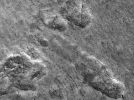
PSP_006690_2280_RED_abrowse-02.jpgFeatures of Acidalia Planitia (extra-detail mgnf)54 visiteThis HiRISE extra-detail mgnf (358 x 266 mt or 392 x 291 yards) shows incipient scalloped terrain in the Southern Slopes of the Crater.
Scalloped terrain — depressions with scalloped edges and polygonal fractures — has been interpreted as a sign of surface caving, perhaps due to sublimation (evaporation) of underlying ice.MareKromiumFeb 15, 2008
|
|
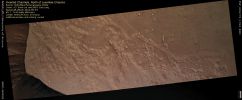
PSP_006770_1760_RED_abrowse-00.jpgInverted Channels, North of Juventae Chasma (context frame - MULTISPECTRUM; credits: Lunexit)56 visiteThis image shows raised ridges on a plain to the North of Juventae Chasma. Juventae Chasma, a canyon that is part of the Valles Marineris Canyon System, stretches for about 180 Km (approx. 110 miles) from East to West and about 250 Km (approx. 155 mi) from North to South.
Several examples of raised features have been identified on the plains near this canyon.
In this location, it is most likely that water - either pure or salt water - once flowed through these channels and deposited sediments that eventually filled the channels and became cemented by some chemical precipitating from the flowing water.
Over time, wind eroded the surrounding surface leaving the remnant channels exposed as raised ridges.MareKromiumFeb 15, 2008
|
|
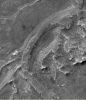
PSP_006770_1760_RED_abrowse-01.jpgInverted Channels, North of Juventae Chasma (extra-detail mgnf)56 visiteThe raised ridges in this image have been explained as former stream channels that are now preserved in inverted relief.
On Earth, inverted relief occurs when former depressions become elevated because materials that fill the depressions are more resistant to erosion than the surrounding terrain.
For example: a depression may become filled with lava that is more resistant to erosion than the surrounding surface; gravel or boulders transported in a high energy flow protect underlying material from erosion, or sediments deposited by a flowing stream become cemented.MareKromiumFeb 15, 2008
|
|
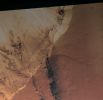
PSP_003545_2025_RED_abrowse-PCF-LXTT-01.jpgIntersection between Hyblaeus and Elysium Chasmata (EDM n.1 - Saturated Natural Colors; credits for the additional process. and color.: Dr Paolo C. Fienga - Lunexit Team)55 visiteA cross-section of Hyblaeus Chasma is visible in this first extra-detail mgnf).
The chasm seems to be filled with a resistant light-toned layer, about 200 mt thick (likely consisting of cemented windblown sand and dust) forming a mantling unit and overlying more resistant boulder-rich layers. The sand and dust was likely blown into Hyblaeus Chasma after it was formed by tectonic processes, possibly in combination with fluvial processes.
The chasmata were subsequently broadened by hillslope erosion: boulders are strewn along the top of this dusty mantling unit. Slumping, possibly caused by faulting, along the Southern Wall of Hyblaeus is visible at the intersection with Elysium Chasma.
This image also shows a number of dark streaks along the walls of Elysium Chasma, further to the south.MareKromiumFeb 08, 2008
|
|

PSP_003545_2025_RED_abrowse-PCF-LXTT-02.jpgIntersection between Hyblaeus and Elysium Chasmata (EDM n.2 - Saturated Natural Colors; credits for the additional process. and color.: Dr Paolo C. Fienga - Lunexit Team)60 visiteOne fresh-appearing streak divides around a slight ridge in this extra-detail mgnf n. 2 (about 1 Km across). Other smaller, fainter, possibly older streaks have formed on either side of this ridge, producing a herringbone-like pattern.
A number of explanations have been suggested for these streaks, including the idea that they are formed by dry avalanches of dust.MareKromiumFeb 08, 2008
|
|

PSP_006567_2220_RED_abrowse-01.jpgFlooded terrain in Terra Sabaea (extra-detail mgnf - MULTISPECTRUM; credits: Lunexit)68 visiteThe smooth surfaces of the flows are punctuated by curved, subparallel fractures oriented transverse to the flow direction.
These cracks resemble crevasses in terrestrial glaciers and were formed when the brittle solid crust of the flow fractured as it was dragged downstream. Detailed images such as this will help determine the role ice may have played in these flows.MareKromiumFeb 02, 2008
|
|

PSP_006528_1120_RED_abrowse-01.jpgSources of Basaltic Sand (extra-detail mgnf n. 1; MULTISPECTRUM - credits: Lunexit)64 visiteThis image was targeted at a point in Mitchell Crater in the Southern Highlands of Mars where sands abruptly appear and spread North.
The sands seem to derive from the edge of an eroding mesa (shown here with an arrow; 8,66 Km, or about 5,4 miles across).
A close-up view of the terrain nearby (see the extra-detail mgnf n. 2) suggests that boulders and sand have been excavated by erosion from beneath brighter, polygonally fractured ground (1,45 Km, or about 0,9 mi across). MareKromiumFeb 02, 2008
|
|

PSP_006528_1120_RED_abrowse-02.jpgSources of Basaltic Sand (extra-detail mgnf n. 2; MULTISPECTRUM - credits: Lunexit)56 visiteThis rocky layer may originally have been a lava flow; Martian lava flows are predominantly composed of basalt, which would account for the dark color of the sand.
The polygonal pattern of the bright upper layer may be due to repeated freezing and thawing of the soil that buries the lava flow. The tracks of Dust-Devils are clearly visible on the smooth, sandy surface but largely vanish when they cross into the polygonally fractured terrain.MareKromiumFeb 02, 2008
|
|
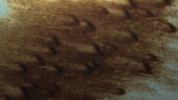
PSP_006538_1035_RED_abrowse-01.jpgSouthern Dunes and Spiders (extra-detail mgnf - MULTISPECTRUM; credits: Lunexit)55 visitenessun commentoMareKromiumGen 26, 2008
|
|
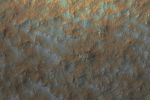
PSP_006538_1035_RED_abrowse-02.jpgSouthern Dunes and Spiders (extra-detail mgnf - MULTISPECTRUM; credits: Lunexit)55 visitenessun commentoMareKromiumGen 26, 2008
|
|
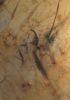
PSP_006477_1745_RED_abrowse-01.jpgDD Tracks in Southern Schiaparelli Basin (extra-detail mgnf - False Colors; credits: Lunexit)54 visiteThis observation shows a Region near the Martian Equator that is a perfect tablet for the scribblings of Dust-Devils. This Region is made up of dark bedrock that is thinly blanketed by bright dust.
Dark tracks form when Dust-Devils scour the surface, exposing the darker substrate. The tracks tend to cluster together, as Dust-Devils repeatedly form over terrain that has been previously scoured and is consequently darker and warmer than the surrounding surface.
Once lofted by a Dust-Devil, the fine dust can be transported great distances before it settles again onto the surface.MareKromiumGen 17, 2008
|
|
PSP_004313_1760_RED_abrowse-02.gifWinslow Crater's Changing (GIF-Movie; credits: NASA)69 visitenessun commentoMareKromiumGen 12, 2008
|
|
| 2237 immagini su 187 pagina(e) |
 |
|
|
|
|
170 | |
|
|
|
|





