| Ultimi arrivi - Mars Reconnaissance Orbiter (MRO) |

PSP_006284_1145_RED_abrowse-03.jpgMedium-sized Boulders inside Smith Crater (MULTISPECTRUM; credits: Lunexit)60 visitenessun commentoMareKromiumApr 18, 2008
|
|
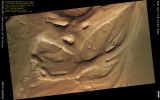
PSP_007738_2145_RED_abrowse.jpgStreamlined Islands in Hrad Vallis (possible natural colors; credits: Lunexit)55 visiteThis image shows a portion of Hrad Vallis, an approx. 400 mt (1300 feet) deep and about 800 Km (approx. 500 mile) long depression located in the Elysium Planitia.
Hrad Vallis is one of several channel systems that are found just West of the Elysium volcanoes. The scoured floor of Hrad Vallis shows the effects of erosion, presumably by water.
Flowing water in the past has carved and sculpted rocky masses into streamlined shapes or islands. The streamlined islands often have sharp edges and are narrower at the downstream end and wider at the upstream end. The streamlined islands visible here are located in an area where the flow condensed from the fractured terrain of the Hrad Valles headwaters (to the South-East) to a more regular channel (to the North-West).MareKromiumApr 11, 2008
|
|
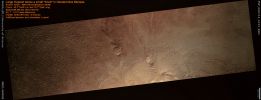
PSP_006714_2255_RED_abrowse.jpgLandslide Deposit below a small Knob in Deuteronilus Mensae (MULTISPECTRUM; credits: Lunexit)54 visiteThis image shows a possible Landslide Deposit originating from a mesa just East of the center of the scene in Deuteronilus Mensae.
The deposit is the lobe-shaped feature extending across the center of the image. Located at approx. 45° North, where ground ice is thought to be stable, it is possible that the deposit formed from "Mass Wasting" of ice-rich material.
Mass Wasting is a process driven by gravity that moves material downslope; the ice enhances the process.
The lobe has distinct textures. It is bouldery at some locations and pitted or wrinkled at others. The pitted texture may be due to desiccation (drying) of soil that can occur when ice from beneath the surface sublimates and leaves empty spaces into which the surface collapses.MareKromiumApr 10, 2008
|
|

PSP_007769_9010_15.jpgPhobos in 3D (credits: NASA)55 visitenessun commentoMareKromiumApr 10, 2008
|
|

PSP_007653_2010_RED_abrowse-00.jpgBright on Dark (MULTISPECTRUM; credits: Lunexit)57 visiteThis image reveals bright Slope Streaks in Bahram Vallis, a long sinuous valley that winds across North-Eastern Lunae Planum and Xanthe Terra to the circum-Chyrse basin.
Typically, dark and light-toned Slope Streaks appear together on light-toned slopes. This scene is a rare case in which only bright streaks are visible on a dark surface. Slope Streaks generally start at a point source and widen downslope as a single streak or branch into multiple streaks. Some of the Slope Streaks show evidence that downslope movement is being diverted around obstacles, such as large boulders, and a few appear to originate at boulders or clumps of rocky material.
Many hypotheses have been proposed for the formation of slope streaks including dry avalanching, geochemical weathering, liquid stains or flows, and moisture wickering. Recent observations from HiRISE images have revealed that the interior of Slope Streaks is lower in elevation than the surroundings indicating that material must have been removed and then deposited in the formation of the streak.
Slope Streak formation is among the few known processes currently active on Mars. Where they appear together, dark Slope Streaks cross cut and lie on top of the older and lighter-toned streaks leading to the belief that lighter-toned streaks are dark streaks that have lightened with time as new dust settled on their surface. Over the course of several years, MOC images from this Region did not reveal any new dark or light-toned Slope Streaks suggesting that streak formation is not currently active here.
HiRISE will continue to monitor this Region for new slope streaks and changes in tone of old streaks.MareKromiumApr 03, 2008
|
|

PSP_007547_1895_RED_abrowse-01.jpgRolling Rocks inside Shalbatana Vallis (EDM - False Colors; credits: Dr Paolo C. Fienga - Lunexit Team)57 visiteIn this extra-detail mgnf, the left frame shows boulders moving in two directions, indicating that they had different sources.
The right frame shows a boulder about 4 meters in diameter in the bottom left, having left a track that begins in the upper right. This boulder rolled down the hill, appears to have jumped the crater, bounced a few times, and then rolled to a halt.MareKromiumApr 03, 2008
|
|

PSP_005574_1720_RED_abrowse-01.jpgLayers and Slope-Streaks within Valleys along the Highland-Lowland Boundary (extra-detail mgnf - MULTISPECTRUM; credits: Lunexit)58 visiteSlope Streak formation is among the few known processes currently active on Mars. Since the Slope Streaks in this image appear to superpose (lie on top of) the surfaces between individual dunes, the Streaks most likely formed more recently and are younger than the dunes.
Many hypotheses have been proposed for the formation of Slope Streaks including dry avalanching, geochemical weathering, liquid stains or flows, and moisture wickering.
Recent observations from HiRISE images have revealed that the dark interior of Slope Streaks is lower in elevation than the surroundings, suggesting that material must have been removed in the formation of the streak.MareKromiumMar 25, 2008
|
|
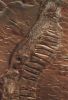
PSP_007219_1720_RED_abrowse-01.jpgFinely-Layered Rocks in Ius Chasma (extra-detail mgnf - MULTISPECTRUM; credits: Lunexit)55 visiteMuch of this Region has been covered by dust and sand, which appears brownish-red. This material is eroded by wind over time and allows us to see the light-toned rock underneath the surface.
There are also dunes that obscure portions of the outcrop.
Many outcrops within Ius Chasma and elsewhere on Mars are covered by such dunes and dust, but the high spatial resolution of instruments such as HiRISE and CRISM allow us to see the Geology and Mineralogy of regions between these dunes to help unravel the Geologic History of Mars.MareKromiumMar 24, 2008
|
|

PSP_007162_1915_RED_abrowse.jpgBright and Dark "Slope Streaks" in Arabia Terra (MULTISPECTRUM; credits: Lunexit)84 visiteThis observation is of region between large craters in Arabia Terra, which is a large swath of bright (high albedo) terrain in the Martian Cratered Uplands. At the center of this image is a channel with a sinuous, fluvial-like (such as "river-like") morphology, although it has long since been dry.
The floor of the channel is covered with an array of linear dunes, which are accumulations of windblown sediment.
Of special interest in this scene is a series of dark (low albedo) and brighter (higher albedo) discolorations along the channel walls, also known as slope streaks. Most slope streaks are initially dark, gradually brighten with time, and are thought to be due to dust avalanches that remove a thin layer of bright dust to reveal darker material. Here, many streaks appear brighter than the surrounding undisturbed slope surface, and the origin of these bright streaks is not entirely clear.MareKromiumMar 21, 2008
|
|

PSP_006673_1600_RED_abrowse.jpgBright Material on the Floor of an Unnamed Crater (natural colors; credits: Lunexit)57 visiteThis image shows part of a crater wall and floor, where the floor is covered by dunes and distinct regions of bright material. The bright material stands higher than the rest of the floor suggesting that it is more resistant to erosion than surrounding materials.
It is possible that more and more bright material will be exposed over time; why the material is bright is unknown.
The material might be evaporites, that form when salt water dries up and leaves behind salt deposits (the evaporites).
Also in this scene is a crater with a ridge running up to its west (left) side. The ridge is lighter and might be evidence that water flowed through it, bleaching the rocks as it went. The water might have cemented the soil, causing it to be more resistant to erosion and high standing as seen today.MareKromiumMar 21, 2008
|
|
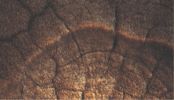
PSP_007173_2245_RED_abrowse-01.jpgScallops and Polygons in the Utopia Planitia Region (extra-detail mgnf - MULTISPECTRUM; credits: Lunexit)56 visiteSeveral cracks cut through the side of the scallops suggesting that they must be at least as deep as the scallops. The polygons may have been present previous to the erosion of the mantle.
The landforms we observe here most likely show that ice-rich permafrost is present or has been present geologically recently. At this latitude on Mars, the conditions of pressure and temperature allow water ice within the ground to sublime.
The disappearance of the ice component of the ground probably leads to the formation of the depressions, a process that may still be active today.MareKromiumMar 16, 2008
|
|

PSP_007151_1445_RED_abrowse-00.jpgColorful Layers in the Walls of an Unnamed Southern Crater (context frame - MULTISPECTRUM; credits: Lunexit)58 visiteThis image shows an unnamed, bowl-shaped impact crater located in the Southern Highlands. The crater is approximately 4 Km (about 2,5 miles) in diameter and 600 meters (approx. 2000 feet) deep.MareKromiumMar 16, 2008
|
|
| 2237 immagini su 187 pagina(e) |
 |
|
|
|
|
168 | |
|
|
|
|





