| |

| Ultimi arrivi - Mars Reconnaissance Orbiter (MRO) |

PSP_008060_1770_RED_abrowse.jpgLayers and Phyllosilicates in Miyamoto Crater (MULTISPECTRUM; credits: Lunexit)85 visiteThis observation was taken in Miyamoto Crater in South-West Meridiani, an area near the Equator of Mars. This image is located to the East of one of the potential Mars Science Laboratory Landing Sites and is near the contact between the Hematite-bearing plains unit to the North-East (where the MER Opportunity is exploring) and the phyllosilicate-bearing unit to the South-West.
Aeolian (meaning "wind deposited") processes are active here, which are visible in dunes and ripples, most likely made of basaltic sand. The bedrock contains Phyllosilicates (such as Clay Minerals), which form in the presence of water. Phyllosilicates have been detected in higher concentrations in other areas of Mars such as Mawrth Vallis and Nili Fossae, but detections of lesser abundance have been noticed in Meridiani as well.MareKromiumMag 22, 2008
|
|

PSP_001750_1425.jpgSouthern Crater (side-view; credits: Dr M. Faccin)106 visitenessun commentoMareKromiumMag 13, 2008
|
|
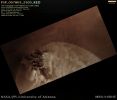
PSP_007805_2505_RED_abrowse-00.jpgThe "Frozen Lake" of Vastitas Borealis, alias Louth Crater (context frame - MULTISPECTRUM; credits: Lunexit)85 visiteThis image shows the changing seasonal frost patterns on Louth Crater, located at latitude 70° North. This crater contains a mound covered by water frost that persists throughout the year, which is unusual for this latitude.
The seasonal Carbon Dioxide frost deposited during Northern Winter can also reach this Latitude. At the time this image was acquired in Northern Spring, the CO2 frost is in the process of sublimating back into the atmosphere.
There are sand dunes near the edge of the mound, which become clear of frost in the Summer.
Per avere qualche Informazione in più...
Geophysical Research Abstracts,
Vol. 10, EGU2008-A-10434, 2008
SRef-ID: 1607-7962/gra/EGU2008-A-10434
EGU General Assembly 2008
© Author(s) 2008
Louth crater: Water vapour distribution as seen by CRISM/MRO
R. Melchiorri (1); T.L. Roush (1); R.M. Haberle (1); A. J. Brown (2) ; T. Encrenaz
(3); CRISM team
1) NASA AMES Research Center, Moffet Field, CA, 94035, USA
2) SETI Institute, 515N. Whisman Rd, Mountain View, CA 94043, USA
3) LESIA Observatoire de Meudon 5, place Jules Janssen, 92195 Meudon, France
“Louth” crater (70.5°N, 103.2°E, name submitted to IAU for consideration) has been identified to have a greater resemblance to the polar cap than previously expected [1 and 2]. This crater is a conveniently small and contains a central water ice deposit that is suitable for testing models of volatile stability in the Martian north polar region. A sensitive detector for water stability is the study of water vapour distribution, which could reveal the presence of interactions between the surface and atmosphere by identifying possible sources and sinks. By adapting the water vapour analysis already developed and tested for the
OMEGA/Mars Express data [3 and 4] we have been able to retrieve the total amount of water vapour from the CRISM/MRO data. This retrieval was performed on two independent high spectral-spatial resolution observations of Louth crater.
For the first time a water vapour distribution at the 1/1000 of a degree scale is presented. Opening the possibility of studying atmospheric water dynamics at very high spatial resolution, like on the boundary of the ice mound, and thus providing hints
regarding the presence and extent of the ice under the close dusty regions.
We present the method and some preliminary results of the analysis, showing in detail the distribution of water vapour on and near the ice mound and near the northern crater rim.
References:
[1] A.J. Brown et al; ICARUS (in press) 2008
[2] A.J. Brown et al; LPCI 2008
[3] R. Melchiorri et al ; Plan and Space Sci. 55 (2007) 333–342
[4] T. Encrenaz et al A&A 441, L9–L12 (2005)MareKromiumMag 11, 2008
|
|

PSP_007805_2505_RED_abrowse-01.jpgThe "Frozen Lake" of Vastitas Borealis, alias Louth Crater (extra-detail mgnf - MULTISPECTRUM; credits: Lunexit)66 visiteThis extra-detail mgnf shows a comparison of these dunes acquired in late Northern Summer (see PSP_001700_2505, top) with the newer image. It is hard to believe this is the same piece of ground because the brightness patterns are so different due to the large temperature changes throughout the year.
Nota Lunexit: dunque il famoso "Lago di Ghiaccio" - situato all'interno di un cratere senza nome il quale venne individuato nella Regione Nordica di Vastitas Borealis dalla Sonda ESA "Mars Express" - non è un lago, ed il cratere "senza nome" è, in realtà, il Cratere "Louth". Ora, se ci consentite una piccolissima ironia (naturalmente corredata da elementi fattuali), vorremmo dire che il modo in cui ESA e NASA si comportano, alle volte, è davvero "bizzarro" (tanto per usare un eufemismo...).
Andate a leggerVi (o a "rileggerVi", se volete) quello che l'ESA scrisse riguardo questo Cratere. Noi, tanto per semplificare, Vi riportiamo il tutto qui di seguito e Voi, se non vi fidate (un Vostro sacrosanto Diritto) e volete verificare di persona, andate qui: http://www.esa.int/SPECIALS/Mars_Express/SEMGKA808BE_1.html
Caption ESA:"The HRSC on ESA's Mars Express obtained this perspective view on 2 February 2005 during orbit 1343 with a ground resolution of approximately 15 metres per pixel. It shows an unnamed impact crater located on Vastitas Borealis, a broad plain that covers much of Mars's far Northern Latitudes, at approximately 70,5° North and 103° East.
The crater is 35 Km wide and has a maximum depth of approximately 2 Km beneath the crater rim. The circular patch of bright material located at the centre of the crater is residual water ice.
The colours are very close to natural, but the vertical relief is exaggerated three times. The view is looking East.
Credits: ESA/DLR/FU Berlin (G. Neukum)".
Allora: dato e premesso che si sta parlando SENZA OMBRA DI DUBBIO del medesimo rilievo, vorremmo un pò capire come mai il "cratere senza nome" è diventato "Louth Crater".
E da quando?
E' intervenuta la IAU per battezzarlo?
O si tratta di un nome convenzionale adottato dalla NASA ma non ufficiale? Mistero.
L'ESA aveva battezzato questo rilievo come "Lago Ghiacciato" ed ora si scopre che l'unica cosa ghiacciata (rectius: ricoperta di semplice brina gelata) è il "mound" (dosso) che caratterizza solo un versante del cratere. Il "residual water ice" di cui parlava il Dr Neukumm dell'ESA - osservando il "fondo" del cratere - è "sparito" e la NASA, infatti, non lo menziona neppure (anzi! Semmai la NASA avanza l'ipotesi/suggerisce che, oltre ad un minimo di ghiaccio d'acqua, il "grosso" della componente ghiacciata che si vede sul "dosso" imbiancato che giace posizionato sul fondo del cratere, sia semplicemente "frozen CO2").
Volete la nostra ipotesi? Ne abbiamo due, a dire il vero.
Prima Ipotesi: la "scoperta" dell'ESA non era una scoperta reale. Le immagini MRO hanno pesantemente ridimensionato il fenomeno del presunto Lago Ghiacciato (il quale si è rivelato essere un cratere con un pò di brina su alcune porzioni del suo fondo) ed i Signori della NASA, tanto per non dare espressamente degli incompetenti a coloro che formano lo STAFF Scientifico che cura le imprese della Sonda Mars Express (in generale) ed al Dr Neukumm (in particolare), "fanno finta di nulla" e commentano questo rilievo ignorando (diremmo "per cortesia professionale") la circostanza per cui esso era stato già ampiamente trattato e discusso dai loro Colleghi Europei in ben altri termini.
Morale: la NASA, ivi, per "salvare la faccia" ai Colleghi dell'ESA, commenta "asetticamente" ed ignora il passato.
Seconda Ipotesi: la scoperta del Lago Ghiacciato di Vastitas da parte dell'ESA è una scoperta "vera" a tutti gli effetti ed apre scenari i quali non piacciono all'establishment della NASA. L'ESA viene invitata a non pronunciarsi ulteriormente sulla questione del Lago (o DEI LAGHI!) di Vastitas Borealis e la NASA, piano piano, accantona il fenomeno e quindi lo "cancella" dall'Immaginario Collettivo con queste recenti immagini le quali, effettivamente, mostrano un cratere con, al suo interno, un dosso ricoperto di brina persistente e nulla di più.
Morale: la Scienza "Ufficiale" dice che su Marte NON CI SONO ACQUE SUPERFICIALI e quindi, anche davanti ad una o più evidenze del contrario, bisogna ribadire il "Dogma" per il quale su Marte NON ESISTONO ACQUE SUPERFICIALI, nè liquide, nè ghiacciate.
E' sin troppo semplice immaginare che qualcuno, leggendo l'ipotesi 2, ci bollerà come "Complottisti" e poi, leggendo l'Ipotesi 1, dedurrà che NASA ed ESA lavorano "in sintonia" e che l'una integra, completa e, se necessario, corregge il lavoro dell'altra.
Certo, piacerebbe anche a noi che fosse così.
Ma così non è. Basta leggere (e rileggere) gli articoli ORGINALI ESA e NASA su questo Lago/Non Lago di Ghiaccio/Non Ghiaccio per capire che il "flusso informativo" non è stato nè limpido, nè coerente. E comunque sia, ci piacerebbe sapere chi e quando ha battezzato il Cratere "Senza Nome" in Cratere "Louth".
Ed in conclusione, se questo è il modo - non diciamo di "fare Scienza" ma, se non altro - di fare "Divulgazione" adottato dalla NASA in questo momento storico...Beh, allora noi possiamo solo darVi un suggerimento: studiate ed interpretate tutto DA SOLI. Magari, di quando in quando ed orà più, ora meno, prenderete (come accade a noi) "Lucciole per Lanterne" ma, se non altro, non diventerete mai dei semplici "recettori passivi" del modo (distorto) di Divulgare il Sapere adottato dalla più grande e famosa Agenzia Spaziale del Mondo (che noi ammiriamo sempre tanto ma, stavolta, un pò meno del solito...).
Amen.
p.s.: abbiamo reperito un cospicuo quantitativo di abstracts sul "presunto ghiaccio" di Louth Crater (ATTENZIONE: nome ancora NON ufficiale!) e, anzichè schiarirci le idee, adesso le abbiamo ancora più confuse...
Ma ne verremo fuori, come ovvio, e quindi pubblicheremo un articolo su questo rilievo davvero MOLTO intrigante e, incidentalmente, spenderemo qualche parola sul "modo schizofrenico" di "Fare Scienza" adottato in questo momento storico.MareKromiumMag 11, 2008
|
|

PSP_007801_2610_RED_abrowse.jpgDefrosting Dunes in the North Polar Sand Sea (MULTISPECTRUM; credits: Lunexit)65 visiteThis image shows defrosting sand dunes near the North Polar Region of Mars.
Around Mars’ North Pole is a vast Region or “sea” of sand dunes that become covered with CO2 frost or ice in the Northern Hemisphere’s Winter. The light areas indicate that parts of the dunes are still covered in frost or ice.
As Mars’ Northern Hemisphere enters into Spring and begins to warm, the CO2 sublimates. The CO2 sublimates in surprising ways, with trapped gas bursting through the ice in jets that leave dark streaks when the wind is blowing
During the Summer, all the frost will have sublimed leaving dark sand dunes. The unfrosted dunes are dark because the sand is derived from dark volcanic rocks.MareKromiumMag 05, 2008
|
|
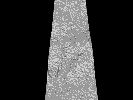
SHARAD-1.gifUnder the Ice... (1)55 visiteRadar Sounder Instruments orbiting Mars have looked beneath the Martian Surface and opened up the Third Dimension for Planetary Exploration.
The technique's success is prompting scientists to think of all the other places in the Solar System where they would like to use Radar Sounders.
The first Radar Sounder at Mars was the Mars Advanced Radar for Subsurface and Ionospheric Sounding (MARSIS) on the European Space Agency's Mars Express Orbiter. It has been joined by the complementary Shallow Subsurface Radar (SHARAD), operating at a different wavelength aboard NASA's Mars Reconnaissance Orbiter.
The data in this animation are from SHARAD.MareKromiumApr 19, 2008
|
|
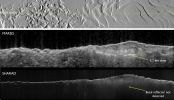
SHARAD-2.jpgUnder the Ice... (2)78 visiteTwo complementary Radar Sounder Instruments work together to discover hidden Martian secrets. They are the Mars Advanced Radar for Subsurface and Ionospheric Sounding (MARSIS) on the European Space Agency's Mars Express orbiter and the Shallow Subsurface Radar (SHARAD) on NASA's Mars Reconnaissance Orbiter.
MARSIS was designed to penetrate deep and it has delivered on its promise. This figure shows the base of Mars' South Polar Layered Deposits at the deepest recorded point of 3,7 Km (2,3 miles).
In contrast, SHARAD was designed as a High-Resolution Radar for a maximum penetration of 1 Km (0,6 mile) has difficulty detecting the base of these layered deposits.
MARSIS was funded by NASA and the Italian Space Agency and developed by the University of Rome, Italy, in partnership with NASA's Jet Propulsion Laboratory, Pasadena, Calif. Italy provided the instrument's digital processing system and integrated the parts. The University of Iowa, Iowa City, built the transmitter for the instrument, JPL built the receiver and Astro Aerospace, Carpinteria, Calif., built the antenna. JPL is a division of the California Institute of Technology in Pasadena. Additional information about Mars Express is at www.esa.int/marsexpress.
SHARAD was provided by the Italian Space Agency (ASI). Its operations are led by the University of Rome and its data are analyzed by a joint U.S.-Italian science team. JPL, a division of the California Institute of Technology, Pasadena, manages the Mars Reconnaissance Orbiter for the NASA Science Mission Directorate, Washington.MareKromiumApr 19, 2008
|
|
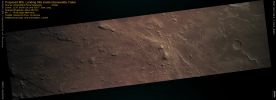
PSP_007481_1560_RED_abrowse.jpgProposed MSL Landing Site in Eberswalde Crater (MULTISPECTRUM; credits: Lunexit)56 visiteThis image covers a portion of Eberswalde Crater, which has an ancient deltaic depositional setting. Eberswalde is an approx. 65 Km diameter, closed basin crater. This image was targeted in the landing ellipse as a possible site for the 2009 Mars Science Laboratory Mission. The image shows resistant mounds and knobs as well as a scoured surface.
The CRISM instrument on board the Mars Reconnaissance Orbiter has detected Phyllosilicates (clays) in the bright layers in the crater. One of the ways clays form on Earth is when water erodes rock and makes fine particles which settle out of water; this often occurs in river deltas and lake beds.
The delta and meandering channels in Eberswalde Crater (to the West of the Landing Ellipse) and the detection of Phyllosilicates provides evidence for possible persistent aqueous activity on Mars.MareKromiumApr 18, 2008
|
|
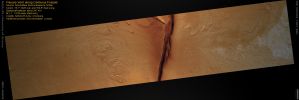
PSP_006999_1965_RED_abrowse.jpgFissure-Vent along Cerberus Fossae (MULTISPECTRUM; credits: Lunexit)61 visitenessun commentoMareKromiumApr 18, 2008
|
|
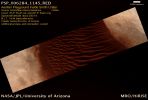
PSP_006284_1145_RED_abrowse-00.jpgLarge Dunefield inside Smith Crater (MULTISPECTRUM; credits: Lunexit)54 visiteThis image shows a Dark Dunefield in Smith Crater. The dark color of the dunes indicates that they are probably made of basaltic sand, a dark volcanic rock that is common on Mars. This is in contrast to dunes on Earth, which are dominated by quartz, a rare mineral on Mars.
The dunes here are “transverse dunes” that, based on analogy with similar features on Earth, form by winds that blow in a direction perpendicular to the crests. However, Secondary ripples on top of the dunes are oriented at right angles; that indicates a second wind regime that has redistributed the sand after the original dunes formed. The multiple orientations of the dunes may be partly caused by their location within the crater, whose own topography can act to redistribute regional wind patterns.
The dark streaks on the lighter terrain outside of the Dunefield are interpreted as DD tracks, where mini-tornadoes reveal darker ground beneath the bright dust of the surface.
Some long DD Tracks are visible in the southern part of the dune field and climb onto the troughs of the transverse dunes. There are also a few faded tracks at the northern part of the dune field.MareKromiumApr 18, 2008
|
|

PSP_006284_1145_RED_abrowse-01.jpgOn the edge of the Dunefield... (MULTISPECTRUM; credits: Lunexit)54 visitenessun commentoMareKromiumApr 18, 2008
|
|
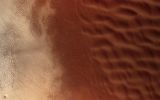
PSP_006284_1145_RED_abrowse-02.jpgOn the edge of the Dunefield... (MULTISPECTRUM; credits: Lunexit)65 visitenessun commentoMareKromiumApr 18, 2008
|
|
| 2237 immagini su 187 pagina(e) |
|
|
|
|
|
167 | |
|
|
|
|
|
|





