| Ultimi arrivi - Mars Reconnaissance Orbiter (MRO) |
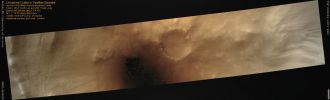
PSP_008181_2405_RED_abrowse.jpgUnnamed Crater in Vastitas Borealis (MULTISPECTRUM-2; credits: Lunexit)79 visitenessun commentoMareKromiumLug 02, 2008
|
|
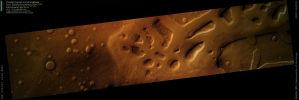
PSP_006567_2220_RED_abrowse-00.jpgFlooded Terrain in Terra Sabaea (MULTISPECTRUM; credits: Lunexit)56 visiteTwo distinctly different terrain types are visible in this image of the Northern Lowlands of Mars: an older, heavily cratered landscape has been inundated by much younger flows.
The valley floors are filled with flows that have relatively smooth surfaces and very few superposed impact craters.
In contrast, the mesas and hills making up the older terrain have blocky surfaces, perhaps fragmented by ancient impacts. MareKromiumLug 01, 2008
|
|
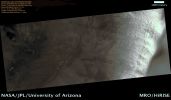
PSP_007153_2505_RED_abrowse.jpgDunes in Vastitas Borealis (MULTISPECTRUM; credits: Lunexit)56 visiteWindblown sand can be used to tell us the wind direction on Mars. Small-scale features, such as Ripples and Wind Tails, indicate the most recent wind directions.
Wind-Tails may be the remnants of a formerly widespread mantle of sediment that has been removed. Alternatively, they may have formed when aeolian sediment is deposited in the wind-shadow zone behind obstacles such as the 1,5 mt diameter boulders on the crater rim (Sx of the image). Their orientation points in the downwind direction and in this frane you can see two wind tails that extend from some boulders, thus indicating winds blowing from at least two different directions.
Ripples occur on the surface of all dunes imaged at HiRISE resolution on Mars and the alignment of Ripples often results from the influence of more than one wind direction.
In this frame, the Ripples are superimposed on a low dome dune.
On Earth, ripples on the surface of sand dunes may re-orientate in a matter of hours, but the time required to re-orientate Ripples on Mars is unknown.MareKromiumLug 01, 2008
|
|
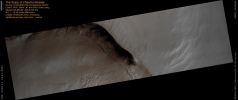
PSP_008191_2645_RED_abrowse.jpgNorth Polar Scarp (MULTISPECTRUM; credits: Lunexit)57 visitenessun commentoMareKromiumGiu 30, 2008
|
|
PSP_008189_2930_RED_abrowse.jpgFrost in Vastitas Borealis (MULTISPECTRUM; credits: Lunexit)60 visitenessun commentoMareKromiumGiu 28, 2008
|
|
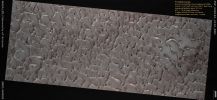
PSP_008185_2610_RED_abrowse.jpgFrosted Dunes (MULTISPECTRUM; credits: Lunexit)80 visitenessun commentoMareKromiumGiu 28, 2008
|
|
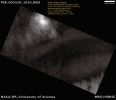
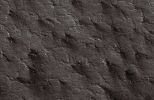
PSP_003520_1010_RED_abrowse-00.jpgSouth Polar Spiders (ctx frame - MULTISPECTRUM-2; credits: Lunexit)55 visiteThis image is located in the South Polar Region of Mars and we can see “spiders” likely caused by the sublimation of Carbon Dioxide ice.
As this happens, the gas moves through channels until it reaches the surface and vents out. These vents show up as the dark streaks because they carry dust and dirt up to the surface.MareKromiumGiu 27, 2008
|
|
PSP_003520_1010_RED_abrowse-01.jpgSouth Polar Spiders (edt - MULTISPECTRUM-2; credits: Lunexit)56 visitenessun commentoMareKromiumGiu 27, 2008
|
|
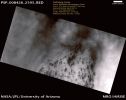
PSP_008426_2595_RED_abrowse-00.jpgPolygons, Crater Layers, and Defrosting Dunes (ctx frame - MULTISPECTRUM-2; credits: Lunexit)57 visiteThe North Polar Region is surrounded by a large sea (erg) of dark sand dunes that become covered by seasonal CO2.
As the Northern Hemisphere begins to warm in the Spring, the frozen CO2 sublimates.
The wind blows from an East-Northeasterly direction and leaves dark streaks behind (exposed basalt) from the evaporating Carbon Dioxide. This image displays defrosting sand dunes in an unnamed crater.MareKromiumGiu 27, 2008
|
|
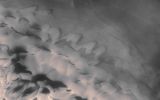
PSP_008426_2595_RED_abrowse-01.jpgPolygons, Crater Layers, and Defrosting Dunes (edm n. 1 - MULTISPECTRUM-2; credits: Lunexit)59 visiteThe dune morphology in this image is complex. Because of the presence of the ice, it is difficult to determine all of the dune types. These jumbled dunes may result from erosion of the layers within the crater walls that act as a dune source. However, two common types of dunes can be classified: the outer ring of the dune field is composed of chains of Barchan Dunes whereas the central area of the field contains transverse dunes.
Barchans are characterized by their crescent-shape with steep horns in the downwind direction. The transverse dunes have asymmetric, nearly parallel ridges and are oriented perpendicular to the wind direction.MareKromiumGiu 27, 2008
|
|
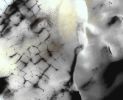
PSP_008426_2595_RED_abrowse-02.jpgPolygons, Crater Layers, and Defrosting Dunes (edm n. 2 - MULTISPECTRUM-2; credits: Lunexit)57 visiteAnother feature of interest is the Sublimating Polygons that have very small ripples on top of them. Polygons are created from a freeze-thaw processes similar to features on Earth that undergo annual contraction of the Permafrost Regolith.MareKromiumGiu 27, 2008
|
|
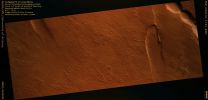
PSP_008130_1745_RED_abrowse-00.jpgSmall but deep Collapse Pit, North of Arsia Mons (context frame - MULTISPECTRUM; credits: Lunexit)73 visitenessun commentoMareKromiumGiu 25, 2008
|
|
| 2237 immagini su 187 pagina(e) |
 |
|
|
|
|
163 | |
|
|
|
|





