| Ultimi arrivi - Mars Reconnaissance Orbiter (MRO) |
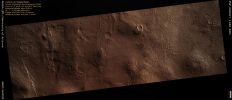
PSP_008427_1380_RED_abrowse-00.jpgAutumn in Hellas Basin (ctx frame - MULTISPECTRUM-2; credits: Lunexit)87 visiteIt is now fall in the Southern Hemisphere and in the giant impact crater known as Hellas Basin small boulders cast long shadows. The long shadows emphasize small scale topographic features and wind erosion is responsible for much of the morphology in this Region.
MareKromiumLug 15, 2008
|
|
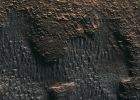
PSP_008427_1380_RED_abrowse-01.jpgAutumn in Hellas Basin (edm n. 1 - MULTISPECTRUM-2; credits: Lunexit)56 visiteFrost is condensing, and shows up as silver/gray patches in this MULTISPECTRUM image: this is seasonal CO2 frost.
Closer to the Pole, CO2 condenses from the atmosphere and forms a Seasonal Polar Cap. At this latitude we do not expect a thick layer to form but rather the frost collects in cold protected areas on poleward-facing slopes.MareKromiumLug 15, 2008
|
|
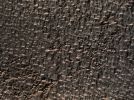
PSP_008427_1380_RED_abrowse-02.jpgAutumn in Hellas Basin (edm n. 2 - MULTISPECTRUM-2; credits: Lunexit)62 visitenessun commentoMareKromiumLug 15, 2008
|
|
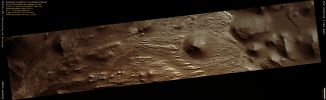
PSP_008708_1780_RED_abrowse.jpgGeologic Contacts in Juventae Chasma (MULTISPECTRUM-2; credits Lunexit)56 visiteMany of the Troughs of Valles Marineris contain mounds composed of light-toned Layered Deposits and Scientists have been debating both the origin of these Layered Deposits and their age of deposition relative to the Troughs themselves.
Some scientists think that the Layered Deposits formed first and then were covered by lava flows that make up the plains. Later, formation of the troughs of Valles Marineris created large openings through the plains that exposed the buried Layered Deposits.
Others have argued that the light-toned Layered Deposits formed after the Troughs and filled up portions of the canyons.
The chaotic terrain in Juventae is believed to have formed when subsurface water in the ground flowed away, causing collapse of the ground and leaving behind numerous hills along the floor of the Trough.
In this HiRISE image, the geologic contacts between the wallrock (darker units on the left - Sx - of the image), light-toned Layered Deposits, and darker hills of the chaotic terrain are visible. By studying the image, scientists hope to determine what are the relative ages of these different units in order to decipher the Geologic History of this Region.
(note: a stereo image of this location could be even more helpful because it will show the three-dimensional relationships between the different units, thus revealing more information about their relative ages)
MareKromiumLug 15, 2008
|
|
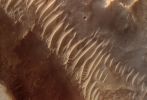
PSP_008523_2060_RED_abrowse-01.jpgSubchannels in Kasei Valles (EDM - MULTISPECTRUM; credits for the additional process. and color.: Dr Paolo C. Fienga - Lunexit Team)56 visiteCaption NASA:"This Region is very dusty, and therefore Dust Streaks can be seen covering the flat Mesas. Within the Channels, large Dunes of Dust have formed from Winds blowing through the Channels themselves. On the steep Slopes of the Dunes, smaller set of Ripples can be seen".MareKromiumLug 07, 2008
|
|
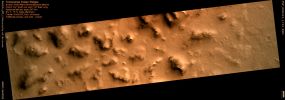
PSP_008323_1735_RED_abrowse-00.jpgTARs and Unusual "Star Ripples" (MULTISPECTRUM; credits: Lunexit)64 visiteThis blocky terrain is southwest of Schiaparelli Crater and is surrounded by a field of Transverse Aeolian Ridges (TARs) and unusual "Star Ripples" (dunes).
TARs are linear ripples with crest-ridge morphologies that can vary in shape; these morphologies include forked, sinuous, barchanoid, networked or feathered characteristics. The ridges also appear to transition into star dunes.
Star Dunes are complex features and are not yet fully understood on Earth. They form by multidirectional wind regimes with a dominant Primary Wind. Chains of Star Dunes often appear to have a massive linear appearance, or can be modified linear or Barchan Dunes with the formation of secondary slipfaces (on the steeper slope). On Earth, there are incipient Star Dunes, such as in the Dumont Dune field in the Mojave Desert, that display similar characteristics. The Dumont embryonic Star Dunes may result from dunes merging as they overrun one another, or are modified preexisting dunes, which could also be the case in this image.
Martian weather models predict that the dominate wind comes from a South-Westerly direction. This direction aligns nicely with the Transverse Ripples and the main arms of the Star Ripples.
This suggests that the Star Ripples were also affected by a different wind pattern or "Secondary Winds" or "Secondary Airflow". (Secondary Airflow is the airflow and sediment transport around the slopes of the dune).
Formation of incipient Star Dunes depends on the nature (strength, direction, and duration) of the Primary Wind and the volume of the sand to create the dune. Secondary airflow maintains the dune arms. The last factor is the deposition or removal of the sand by grainfall or grainflow avalanching. Grainfall and grainflow transports material from the main crestline slipface and along-slope or down-slope which maintains the secondary arm crest.MareKromiumLug 07, 2008
|
|

PSP_008075_1590_RED_abrowse.jpgLight-toned Rocks (MULTISPECTRUM; credits: Lunexit)72 visiteThis observation shows a portion of an approximately 30 kilometer diameter impact crater located to the south of Valles Marineris.
The image reveals that the central uplift inside the crater is a mixture of dark-toned and light-toned materials. It’s likely that some of the rocks in the center of the crater represent units at depth that we wouldn’t otherwise see along the plains that surround the crater. The light-toned units in particular are not visible in the plains surrounding this crater so they could be material that is buried beneath the plains and only visible inside craters or other vertical exposures, such as those created by faults.
Some of the light-toned material appears angular and blocky, consistent with material that has been disrupted and uplifted by an explosion associated with the crater’s formation. The reason why some material appears light-toned is unknown but could be due to a different composition than the darker-toned unit.
Many light-toned units seen elsewhere on Mars, including within Valles Marineris, are made of sulfates so there may be sulfate-rich rocks buried beneath the plains at this location and the formation of the crater exposed them. In any case, the distinct materials visible within impact craters suggest that the crust on Mars may contain many units of variable composition.MareKromiumLug 03, 2008
|
|
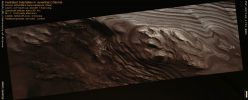
PSP_007126_1755_RED_abrowse.jpgFeatures of Juventae Chasma (MULTISPECTRUM; credits: Lunexit)58 visiteQuesta località è stata analizzata da molti Anomaly Hunters per via dell'esistenza di un PRESUNTO terrazzamento ripreso dalla Sonda Mars Express; un Terrazzamento che avrebbe dovuto (di)mostrare l’esistenza di una possibile cava (ergo di un'Opera Artificiale).
Bene: eccoVi dunque una nuova immagine di Juventae Chasma, questa volta ottenuta dalla sonda MRO e finalmente ad Alta Definizione.
Basterebbe lasciar parlare l’immagine, che più di mille parole può (chissà, forse purtroppo) per smentire una tale e colossale svista da parte della corrente complottista che vide nella elaborazione digitale ESA la prova provata dell'esistenza di una miniera laddove non c'è null'altro se non l'Opera della Natura (intrigante e selvaggiamente ammiccante, MA SEMPRE E SOLO NATURA!).
È verissimo che solo chi fa sbaglia, ma se è vero che a volte si sbaglia anche a non fare, cogliamo questa occasione per analizzare meglio la base di partenza di questa vicenda.
Tutto è nato dalle parole che troviamo nel libro dell’Ing. Piccaluga (che salutiamo) il quale, dopo aver teorizzato che tali pareti siano lavorate in modo troppo simmetrico e regolare per essere "naturale", mostra come controprova (anzi, come “prova che non avrei mai voluto trovare”) il frame Mars Global Surveyor MOC2-433.
Parafrasando il testo dell’Ingegnere, questo frames MGS, pur riprendendo la sagoma del sito, non mostra più i terrazzamenti; la cava è diventata un rilievo assolutamente piatto (e naturale), e quindi non resta che “prendere atto che l’immagine è stata contraffatta completamente (…) non c’è altra spiegazione”.
Ma attenzione: occorre precisare che ci sono anche altre due ipotesi da considerare: o i terrazzamenti sono stati aggiunti dall’ESA (!), o i lavori, la scritta e la cava sono stati eseguiti nell’arco di un anno (la pseudo foto ESA è del 26 marzo 2004).
Insomma, il sito artificiale è troppo evidente, la corrente liberale dell’ESA ha deciso di “lasciare al loro destino la NASA ed i suoi ingannevoli trucchi fotografici” e, per il Caro Ingegnere, “rimane inaccettabile che un Ente tanto prestigioso possa aver operato in modo così scorretto”.
Parole dure, forse condivise da altri Scrittori ed Appassionati, ma anche ingannevoli, come le "pseudo-foto" dell'ESA.
E si, INGANNEVOLI, poichè - diremmo capziosamente - lo scenario sopra delineato non contempla una terza (e diremmo ESSENZIALE) possibilità: l’errore umano dello Scrittore. La "svista", insomma...
Non entrando nel merito delle analisi che mostrerebbero la presunta cava (qui ben visibile come mai...) visto la difficoltà di analisi dei frames orbitali e della loro intrinseca ambiguità (tutti possono vederci tutto ed il suo contrario) dobbiamo evidenziare la svista riferita al frame Mars Global Surveyor come mezzo di prova.
Ebbene quel frame mostra - semplicemente - un altro rilievo, nulla di più… E comunque quel frame sarebbe stato realmente anomalo qualora avesse effettivamente mostrato i terrazzamenti in questione, semmai.
Non solo: la “scorretta NASA”, in realtà e sempre con la sonda MGS, aveva già mostrato (e ben prima dell’ESA!) proprio il rilievo controverso ora in questione: eccovi date e seriali, per Vostra opportuna informazione
16 Ottobre 2000 frame M12-00299
30 Settembre 2003 frame E23- 01035 (con un bel dettaglio della inesistente miniera)
27 Settembre 2004 frame R12-00618
13 Aprile 2006 frame S05-01549
Che dire quindi?
Lasciando la parola ancora al Caro Ingegnere leggiamo che “resto, fino a prova contraria, fermo nella convinzione che gli Americani abbiano cancellato le tracce di un sito artificiale (…) la mia sincera speranza è che ci sia una spiegazione a quanto osservato”.
Giusto.
Speriamo quindi di aver fatto una cosa gradita a TUTTI mostrandoVi svariati, possibili e PLAUSIBILI spunti, scenari e riferimenti i quali, nel loro insieme, costituiscano un'adeguato back-ground per un'auspicabile - e, nei confronti della Ricerca e dei Ricercatori del Futuro (Ricerca e Ricercatori con la "R" maiuscola...) - opportuna ed onesta “errata corrige”.
O no?!?MareKromiumLug 03, 2008
|
|
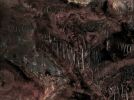
PSP_007055_2015_RED_abrowse-4.jpgVolcanic and Clay Materials near Nili Fossae (edm n. 3 - natural colors; credits: Lunexit)56 visiteChe ne dite di queste "dune"? "Curiose", vero? MareKromiumLug 03, 2008
|
|
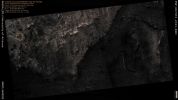
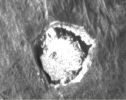
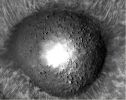
PSP_007055_2015_RED_abrowse-0.jpgVolcanic and Clay Materials near Nili Fossae (ctx frame - MULTISPECTRUM; credits: Lunexit)56 visiteThis image is located West of the Nili Fossae Trough, one of the proposed Landing Sites for the Mars Science Laboratory. Here, we combine information from two other MRO instruments, the Context Camera (CTX) and the Compact Reconnaissance Imaging Spectrometer for Mars (CRISM), to provide insight into the geology of the Region.
Nota Lunexit: sicuramente le informazioni NASA su questo frame sono interessanti e preziose, ma noi Vi invitiamo a prestare un PARTICOLARE ATTENZIONE alla struttura ed alla configurazione superficiale delle dune che caratterizzano tutta la zona ripresa.
Si tratta, in effetti, di dune che, in passato, a causa della loro conformazione ed albedo, hanno ingannato innumerevoli Ricercatori i quali le avevano scambiate per "tubazioni" affioranti.
L'edt n. 3 (elaborato in colori naturali) Vi permetterà di cogliere al meglio non solo la - riteniamo incredibile - conformazione di queste mega-dune, ma anche la loro del tutto peculiare colorazione.MareKromiumLug 03, 2008
|
|
PSP_007055_2015_RED_abrowse-1.jpgVolcanic and Clay Materials near Nili Fossae (edm n. 1)57 visitenessun commentoMareKromiumLug 03, 2008
|
|
PSP_007055_2015_RED_abrowse-2.jpgVolcanic and Clay Materials near Nili Fossae (edm n. 2)57 visitenessun commentoMareKromiumLug 03, 2008
|
|
| 2237 immagini su 187 pagina(e) |
 |
|
|
|
|
162 | |
|
|
|
|





