| Ultimi arrivi - Mars Reconnaissance Orbiter (MRO) |

PIA10140-DarkFans~0.jpgBright Streaks and Dark Fans (MULTISPECTRUM; credits: Lunexit)58 visiteIn a Region of the South Pole known informally as "Ithaca", numerous Fans of dark frost form every Spring. HiRISE collected a time lapse series of these images, starting at Ls = 185 and culminating at Ls = 294. "Ls" is the way we measure time on Mars: at Ls = 180 the Sun passes the Equator on its way South; at Ls = 270 it reaches its maximum subsolar latitude and Summer begins.
We believe that the bright streaks are fine frost condensed from the gas exiting the vent. The conditions must be just right for the bright frost to condense. MareKromiumLug 19, 2008
|
|

PIA10141-AraneiformTerrain~0.jpgAraneiform and Lace Terrains (MULTISPECTRUM; credits: Lunexit)57 visiteThe South Polar Terrain on Mars contains landforms unlike any that we see on Earth, so much that a new vocabulary is required to describe them. The word "araneiform" means "spider-like".
There are radially organized channels on Mars that look spider-like, but we don't want to confuse anyone by talking about "spiders" when we really mean "channels", not "bugs."
This picture shows an example of "connected araneiform topography", such as terrain that is filled with spider-like channels whose arms branch and connect to each other. Gas flows through these channels until it encounters a vent, where is escapes out to the atmosphere, carrying dust along with it. The dark dust is blown around by the prevailing wind.
This image also shows a different Region where the channels are not radially organized. In this Region they form a dense tangled network of tortuous strands. We refer to this as "lace". MareKromiumLug 19, 2008
|
|

PIA10142-SeasonalDryIce~0.jpgTranslucent Seasonal Ice (MULTISPECTRUM; credits: Lunexit)61 visiteIn a Region near the South Pole of Mars, translucent Carbon Dioxide ice covers the ground seasonally. For the first time we can "see" the translucent ice by the affect it has on the appearance of the surface below.
Dark fans of dust from the surface drape over the top of the seasonal ice.
The surface would be the same color as the dust except that the seasonal ice affecting its appearance. Bright bluish streaks are frost that has re-crystallized from the atmosphere.
Sunlight can penetrate through the seasonal layer of translucent ice to warm the ground below. That causes the seasonal ice layer to sublime (evaporate) from the bottom rather than the top. MareKromiumLug 19, 2008
|
|
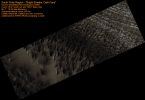
PIA10144-DarkFans~0.jpgBright Streaks and Dark Fans (MULTISPECTRUM; credits: Lunexit)57 visiteThe South Polar Region of Mars is covered every year by a layer of Carbon Dioxide (CO2) ice. In a Region called the "cryptic terrain", the ice is translucent and sunlight can penetrate through the ice to warm the surface below.
The ice layer sublimates (evaporates) from the bottom. The Dark Fans of dust seen in this image come from the surface below the layer of ice, carried to the top by gas venting from below. The translucent ice is "visible" by virtue of the effect it has on the tone of the surface below, which would otherwise have the same color and reflectivity as the Fans.
Bright streaks in this image are fresh frost. The CRISM team has identified the composition of these streaks to be Carbon Dioxide.
Nota Lunexit: questa è la surface feature che ha "stimolato" l'immaginazione di Joseph Skipper e Richard Hoagland. Secondo costoro, le "dark features" sarebbero alberi simili ai "pioppi" terrestri... Ogni ulteriore commento ci sembra davvero inutile.MareKromiumLug 19, 2008
|
|
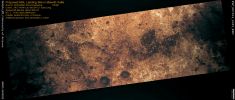
PSP_007612_2045_RED_abrowse~0.jpgProposed MSL Landing Site in Mawrth Vallis (MULTISPECTRUM; credits: Lunexit)63 visitenessun commentoMareKromiumLug 19, 2008
|
|
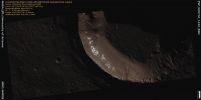
PSP_008792_1410_RED_abrowse.jpgLight-Toned Layers in Crater Wall (MULTISPECTRUM; credits: Lunexit)56 visiteThis approximately 8 Kilometer-diameter Impact Crater is interesting because of the light-toned band visible in the upper slopes of the Inner Crater Wall.
Because the light-toned materials are confined to a distinct elevation within the Crater, it is possible that it represents a well-defined Layer exposed in the Crater Walls.MareKromiumLug 19, 2008
|
|

PSP_008778_1685_RED_abrowse.jpgMistery Mounds (MULTISPECTRUM; credits: Lunexit)57 visiteThis image was targeted because a previous MGS-MOC image (R1100035) showed an distinctive field of Mounds on the floor of an ancient, large, filled-in Unnamed Crater.
The origin of the Mounds was unclear, so we hoped that a HiRISE image with higher resolution and color would solve the mystery. The HiRISE image shows much more detail on the Mounds and other rough textures, indicating that this is an eroded bedrock surface, perhaps exposed by removal of an overlying layer of fine-grained materials by the wind.
But how did the rocks form, and why did they erode onto Mounds? It could have been lava or impact ejecta or fluvial sediments, perhaps altered and indurated by groundwater.
The Mounds could be due to how it was deposited — like hummocky Impact Ejecta — or how it was indurated. In other words, we haven't solved the mystery!...
Yet we may get new clues from future images of similar terrains in places where the origin is more interpretable, or from other datasets such as the mineral content determined by CRISM.MareKromiumLug 19, 2008
|
|
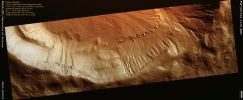
PSP_007143_1370_RED_abrowse.jpgGully Alcoves (MULTISPECTRUM; credits: Lunexit)59 visiteSeveral characteristics of crater wall gullies are visible in this image that provide possible insight into the formation mechanisms of gullies on Mars.
Gullies near the left side (North) of the image are deeper and originate in alcoves near the rim of the Crater. Gullies near the middle of the image are shallow and contain a more complex array of small channels. These smaller gullies initiate from a uniform elevation within the Crater Wall rather than at the Crater Rim. This suggests that the materials which flow down the Crater slopes to form the gullies originates at a specific layer exposed in the Crater Wall.
The undulating pattern of ridges on the Crater Floor (lower side of the image) appear similar to features interpreted as elsewhere on Mars that involve ice-rich materials.MareKromiumLug 19, 2008
|
|

PSP_007493_2650_RED_abrowse~0.jpgNorth Polar Layered Deposits covered by Seasonal Frost (MULTISPECTRUM; credits: Lunexit)57 visiteThis image shows an exposure of the North Polar Layered Deposits (NPLD). The layering visible here might have been formed by recent climate variations on Mars, similar to ice ages on Earth.
While the Polar Layered Deposits are mostly water ice, exposures such as this are typically covered by a layer of reddish dust, protecting the underlying ice from evaporation during the Summer. This dusty layer hides the internal composition of the Polar Layered Deposits from view, but variations in the slopes of the surfaces of the layers are still visible.
The slope of each layer is probably affected by the internal composition, so the topography of exposures like this is of interest to scientists. When this image was taken (Northern Spring), the surface was mostly covered by seasonal CO2 frost.
This white frost layer helps to highlight the surface slopes because the visible brightness variations are mainly caused by topographic variations. Therefore, this image will be useful for photoclinometric, or "shape from shading" analyses that can yield topographic maps limited only by the resolution of the image.
MareKromiumLug 19, 2008
|
|
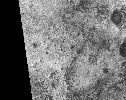
PSP_007612_2045-GIF.gifProposed MSL Landing Site in Mawrth Vallis - Ellipse 2 (GIF-Movie; credits: Carlo Contu)71 visiteSiamo nella Regione di Mawrth Vallis: una Regione di grandissimo interesse geologico (o forse sarebbe meglio dire "Mineralogico", vista la apparente varietà di minerali esposti e già individuati) la quale, forse, in un prossimo futuro, potrebbe costituire la "Casa" del Mars Science Laboratory Rover (anche se noi dubitiamo che il MSL Rover scenda effettivamente in questa zona del Pianeta Rosso...). +
Il dettaglio intrigante che ci viene proposto in questo suggestivo filmato GIF realizzato dal nostro Carissimo Amico e Partner, Carlo Contu, attiene un rilievo tanto piccolo, quanto bizzarro: una modesta collinetta con due lati "piallati".
Si tratterà di una frana o di qualcosa di più - diciamo così... - "esotico" (tipo uno scavo a cielo aperto)?
La Verità, anche in questo caso - e come sempre - non la conosciamo: noi possiamo solo invitarVi a guardare questo filmato ed a riflettere sui suoi particolari (uno su tutti, ma che NON Vi suggeriremo, in attesa che qualcuno di Voi se ne accorga e ne parli, in sede di commento).
Che altro dire? Complimenti a Carlo Contu e...Buona Esplorazione!MareKromiumLug 18, 2008
|
|

PSP_006952_1870_RED_abrowse~0.jpgDark Dunefield in West Arabia Terra (MULTISPECTRUM and Yellow/Orange Filters ON; credits: Lunexit)58 visiteThis image shows dunes in an unnamed crater in the west Arabia Terra Region.
The rim of the crater lies to the South of the image (Sx)and a dark, toned field of Barchan Sand Dunes rests on the crater floor in the Northern portion of the observation.
Barchan Dunes are commonly found on Earth, and are generally crescent-shaped with a steep slip face bordered by horns oriented in the downwind direction. Barchan Dunes form by unidirectional winds and are good indicators of the dominant wind direction. In this case, the strongest winds blew approximately North to South.
These dunes are most likely composed of basaltic sand that has collected on the bottom of the crater.
Superimposed on their surface are smaller secondary dunes which are commonly seen on terrestrial dunes of this size. Many smaller and brighter bed forms — most likely small dunes or granule ripples — also cover the substrate between the larger dark dunes. The dark dunes overlie the small bright bed forms indicating that the darker dunes formed more recently.
MareKromiumLug 16, 2008
|
|

PSP_006952_1870_RED_abrowse-00~0.jpgDunefield in West Arabia Terra Unnamed Crater (context frame; MULTISPECTRUM - credits: Lunexit)72 visiteThis image shows dunes in an unnamed crater in the West Arabia Terra region.
The rim of the crater lies to the South of the image (Sx) and a dark, toned field of barchan sand dunes rests on the crater floor in the Northern portion of the observation (Dx). MareKromiumLug 16, 2008
|
|
| 2237 immagini su 187 pagina(e) |
 |
|
|
|
|
161 | |
|
|
|
|





