| Ultimi arrivi - Mars Reconnaissance Orbiter (MRO) |
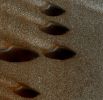
PSP_008839_2575_RED-01.jpgDunes and Polygons (edm - natural colors; credits: Lunexit)56 visitenessun commentoMareKromiumAgo 04, 2008
|
|

PSP_008963_1650_RED-01.jpgMER Spirit Rover at Martian Mid-Winter (edm - natural, but enhanced, colors; credits: Lunexit)58 visitenessun commentoMareKromiumAgo 04, 2008
|
|
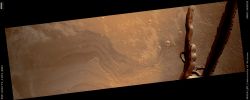
Psp_008779_1905_red.jpgThe Head of Athabasca Valles (natural colors; credits: Lunexit)57 visiteThis observation is located at the head of the Athabasca Valles Channel System, which lies just North of Mars’ Equator, in a low-elevation Region known as Elysium Planitia.
Athabasca Valles has an interesting geologic history. It was probably carved by one or more catastrophic floods of water, but more recently, a flood of lava coursed through the channel system. Both the water and the lava erupted from a few discrete points (or “vents”) along the Cerberus Fossae, a 1600-Km(1000-mile) long network of extensional (or “normal”) faults. The two prominent troughs that cut across the Southern end of this HiRISE image are part of the Cerberus Fossae. They are distinct fault segments that overlap at their tips, as one tapers in and the other pinches out.
They were not always as wide as they are today. Erosional processes have widened the troughs over time. Major eruptions occurred along both of the fault segments seen in this image, though they occurred to either side of the imaged area itself. Lava that erupted from the western vent covers the northern half of the image. The lava has raised, lobate margins and is slightly darker in tone than the older cratered plains it embays. The lava also has a banded appearance of subtly contrasting lighter and darker tones, that correspond to variations in surface roughness.
The bands are concentric to a vent located immediately west of the imaged area. Unfortunately, vents along the Cerberus Fossae are not well preserved.MareKromiumAgo 04, 2008
|
|
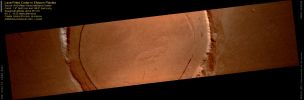
Psp_008753_1880_red.jpgLava-filled Crater in Elysium Planitia (natural colors; credits: Lunexit)58 visiteElysium Planitia is a part of the Martian Lowlands that has been repeatedly covered by vast floods of lava. This image shows an older Impact Crater that has been filled by one of the youngest of those lava floods.
Only sections of the circular rim of the Crater remain uncovered. The lava surface consists of ridged plates that have rafted apart with smoother lava filling between the plates. The ridges formed as the solidifying lava crust was crumpled by compression, and the gaps between the plates formed as the crust was pulled apart. Similar compression and extension of lava crust has been observed in the largest lava flows in Iceland.
The most puzzling aspect of this image is that the lava in the floor of the Crater appears to have sunk down compared to its surroundings. This happened after a thick crust had formed on the lava. The most likely explanation is that the last molten lava inside the flow drained away through a now buried gap in the crater rim.
A final point of interest are the small circular cones visible near the center of the Crater. These formed when ground water (or ice) was turned to steam by the heat of the lava flow. This steam exploded through the flow, producing the small cratered cones.MareKromiumLug 30, 2008
|
|

PSP_008927_2010_RED-00.jpgPossible MSL Landing Site in Nili Fossae Trough (natural colors; credits: Lunexit)57 visiteNili Fossae Trough is a linear trough about 25 Km wide, formed in response to the creation of the Isidis Basin.
Nili Fossae has diverse deposits, some containing Phyllosilicates (Clay Deposits which typically form in the presence of water), and others with the minerals Olivine and Pyroxene.
This image is part of a series covering the 25 km Landing Ellipse; they are used to determine the safest possible Landing Site for the Mars Science Laboratory Rover. In this frame, relatively smooth rock exposures is visible, as well as sand ripples and some small knobs. There are few large rocks in the area, while the surface seems to be mostly flat, fractured rock.
This landscape is located in the South-Eastern part of the Landing Ellipse.MareKromiumLug 30, 2008
|
|

PSP_008927_2010.jpgUnnamed Crater in Nili Fossae Region (True Colors; credits: Dr M. Faccin)57 visitenessun commentoMareKromiumLug 29, 2008
|
|
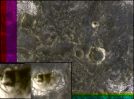
Mawrth_Vallis-The_Pyramid-HSol.jpgThe "Pseudo-Pyramid" of Mawrth Vallis (credits: Dr M. Faccin)96 visiteEd ecco qui, in versione a colori naturali ed extra-magnificata, la pseudo-piramide di Mawrth Vallis.
Opera della Natura? Opera "Artificiale"? Secondo noi, si tratta di un rilievo assolutamente particolare, questo è certo, e quindi da studiare. Ma il fatto di scendere ulteriormente in dettaglio e parlare di "artificialità", visti gli elementi (scarsissimi!) che abbiamo a disposizione, a nostro - onesto - parere, sembra eccessivo (e l'idea di restare colpiti anche noi dalla "Sindrome di' Hoagland", sinceramente, non ci riempie di gioia...).
Sempre complimenti al Dr Faccin per l'elaborazione ed all'ottimo Carlo Contu, per l'individuazione del rilievo.MareKromiumLug 29, 2008
|
|

Mawrth_Vallis-The_Waterfall-CC.gifZooming on the "Waterfall" - Mawrth Vallis (GIF-Movie, by Carlo Contu)58 visiteAcquisition date: January, 04, 2008
Local Mars Time: 14:19
Latitude: 23,0° North
Longitude: 341,6° East
Range to target site: 309,9 Km
Original image scale range: 31 cm/pixel (with 1 x 1 binning) so objects ~93 cm across are resolved
Map projected scale: 25 cm/pixel and North is up
Map projection: EQUIRECTANGULAR
Emission angle: 22,7°
Phase angle: 60,1°
Solar incidence angle: 38°, with the Sun about 52° above the horizonMareKromiumLug 27, 2008
|
|

Mawrth_Vallis-The_Pyramid-GIF.gifZooming on a "Pseudo-Pyramid" - Mawrth Vallis (GIF-Movie, by Carlo Contu)62 visiteAcquisition date: January, 05, 2007
Local Mars Time: 15:32
Latitude: 22,5° North
Longitude: 341,8° East
Range to target site: 286,8 Km
Original image scale range: 28,7 cm/pixel (with 1 x 1 binning) so objects ~86 cm across are resolved
Emission angle: 6,3 °
Phase angle: 59,4 °
Solar incidence angle: 53°, with the Sun about 37° above the horizon MareKromiumLug 27, 2008
|
|

PIA10145-CrypticTerrain~0.jpgCryptic Terrain (MULTISPECTRUM; credits: Lunexit)72 visiteThere is an enigmatic Region near the South Pole of Mars known as the "cryptic" terrain. It stays cold in the Spring, even as its albedo darkens and the Sun rises in the sky.
This Region is covered by a layer of translucent seasonal CO2 ice that warms and evaporates from below. As CO2 gas escapes from below the slab of seasonal ice it scours dust from the surface. The gas vents to the surface, where the dust is carried downwind by the prevailing wind.
The channels carved by the escaping gas are often radially organized and are known informally as "spiders". MareKromiumLug 19, 2008
|
|
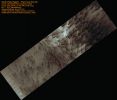
PIA10146-Fans~0.jpgTranslucent Seasonal Ice (MULTISPECTRUM; credits: Lunexit)96 visiteEvery year seasonal CO2 ice, known to us as "dry ice", covers the Poles of Mars. In the South Polar Region this ice is translucent, allowing sunlight to pass through and warm the surface below. The ice then sublimes (evaporates) from the bottom of the ice layer, and carves channels in the surface.
The channels take on many forms. In the image shown here the gas from the dry ice has etched wide shallow channels. This Region is relatively flat, which may be the reason these channels have a different morphology than the "spiders" seen in more hummocky terrain. MareKromiumLug 19, 2008
|
|

PIA10139-FansField~0.jpgFans Field (MULTISPECTRUM; credits: Lunexit)59 visiteAt the very beginning of Spring in the Southern Hemisphere on Mars the ground is covered with a seasonal layer of CO2 ice.
In this image there are 2 lanes of undisturbed ice bordered by 2 lanes peppered with Fans of dark dust.
When we zoom in to the image, we see that the Fans are seen to be pointed in the same direction, dust carried along by the prevailing wind. The Fans seem to emanate from spider-like features.
Image Data: the image is centered at -86,4° Latitude and 99,1° East Long.
The range to the target site was 276,1 Km (about 172,6 miles). At this distance the image scale is 55,2 cm/pixel (with 2x2 binning) so objects ~166 cm across are resolved.
The image was taken at 16:27 MLT (middle afternoon), with the Sun just 2° above the Local Horizon. MareKromiumLug 19, 2008
|
|
| 2237 immagini su 187 pagina(e) |
 |
|
|
|
|
160 | |
|
|
|
|





