| Ultimi arrivi - Mars Reconnaissance Orbiter (MRO) |

PSP_009039_1660_RED.jpgCraters in South-Eastern Syria Planum (natural colors; credits: Lunexit)58 visiteThis image shows two landforms that appear similar, but are the result of two very different geologic processes.
These two depressions are craters. The smaller, rounder crater formed when an asteroid collided with Mars. This impact blasted out the pre-existing rocks, forming this quasi-circular crater.
The larger, more irregular-shaped crater is a Pit Crater. These types of craters form through collapse of the ground surface into large underground voids. In this Region of Mars, these underground voids are likely caused by the movement of magma (molten rock) through the subsurface. As the magma moves underground, it forces the rock apart and forms large “caverns.” These voids are structurally unstable and can lead to collapse of the overlying rock, forming pit craters at the surface.
Impact Craters are distinguished from Pit Craters by the presence of a raised rim. Rock blasted out during the impact falls back to the ground and accumulates near the crater, forming this raised rim. Upward warping of the ground during the impact process also contributes to the raised appearance of the crater rim. Since Pit Craters form through collapse, their rims are at the same level, or perhaps slightly lower, than surrounding ground surface.
The Impact Crater has a bright streak extending South-East (toward the upper right). The bright material is dust, deposited downwind of the crater by prevailing winds. Zooming into the streak, small bedforms, presumably composed of dust or dust aggregates, are visible. Similar features are seen in other dusty regions of Mars.MareKromiumAgo 17, 2008
|
|
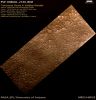
PSP_008681_2550_RED.jpgTransverse Dunes in Vastitas Borealis (natural colors; credits: Lunexit)58 visiteThe Vastitas Borealis Region, or Northern Lowlands, is a large area of low-lying surface that surrounds Mars’ North Pole.
On average, the Region is 4-5 Km lower in elevation than the mean radius of the Planet. How this basin formed is not known, although researchers have postulated that it could have been the result of a very large-scale impact sometime in Mars’ distant past. As of this writing, it is Summer in the Martian Northern Hemisphere, allowing the HiRISE camera to image this Region in full sunlight.
The sinuous landforms are dunes composed of sand that is made of basalt (a volcanic rock) or gypsum (a hydrous sulfate). There is a transition of modified barchanoid (crescent shaped dunes, generally wider than they are long) and transverse chains into star dunes; the winds change a lot in this area. The orientation of the barchanoid and transverse dunes indicate that the winds that formed them blow from the East (right side of image).
In some areas there are a few linear dunes. The light-toned, smaller bedforms are designated Transverse Aeolian Ridges (TARs).
MareKromiumAgo 17, 2008
|
|

PSP_009003_1890_RED.jpgPseudo-Pyramid and Fissures in Cerberus Fossae (Extremely Enhanced and Saturated Natural Colors; credits for the additional process. and color.: Dr Paolo C. Fienga - Lunexit Team)135 visiteThis image shows a part of the Cerberus Fossae Region, a system of aligned fissures that lays East of Elysium.
The fissures were probably the source of floods of both water and lava. The most recent event was a massive outpouring of basaltic lava (a fluid-type of lava like that commonly erupted by Kilauea in Hawaii), which produced a host of volcanic features in the Region, as described by Jaeger et al. (2007).
Here, as at other locations, the fossae appear a dark red in the Lunexit Natural Color image. Dark red tones are usually associated with basaltic rock. The reddish ripples found on the trough floor could be wind-blown sand comprised of fine fragments of basalt. The upper plains are a relatively bland tone, perhaps due to a thin coating of dust; however, impact craters in the image also show reddish boulders and ripples, indicating that they have excavated the same basaltic rock layers cut by the fossae. This is typical of the Region, as floods of lava coat much of the area.
The mesas of older rock on the left side of the fissures are remnants of a former surface, now eroded. The surrounding Region has many knobs and larger protruding topography, which may be remnants of the same materials. The topmost layer in each mesa is very resistant to weathering, as in places it actually overhangs the lower rocks. This cap layer could be solidified lava, although it appears somewhat bland in color.
Although the mesa is clearly eroded and the cap rock breaks up into boulders, few rocks are visible at the bottom of the slope. The lava plains may have buried the former basal slope, or debris may have been swept away by lava or floodwater, that could also have contributed to eroding the mesa.MareKromiumAgo 17, 2008
|
|

PSP_009162_1570.jpgFresh 5-Kilometer Diameter Rayed Crater (False Colors; credits: Dr M. Faccin)57 visiteThe crater featured in this scene formed on top of ejecta from a nearby rampart crater, located to the North.
The crater’s distinct rim indicates that it is relatively young. There is bright material on many of the crater walls that might be landslides of dust or another bright substance.
The mounds of material on the crater floor probably formed during late stages of crater’s own formation. The crater floor is speckled with even smaller craters.MareKromiumAgo 15, 2008
|
|
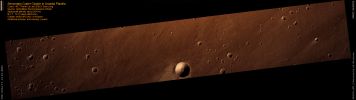
PSP_006271_2210_RED_abrowse.jpgPrimary and Secondary Craters in Arcadia Planitia (MULTISPECTRUM; credits: Lunexit)57 visiteThese unusual craters were spotted in Arcadia Planitia, which is part of an extensive region of Mars blanketed by a thick layer of bright dust.
Light southeasterly winds during southern spring and summer blow the dust towards the northwest (top left of the picture in the cutout above). The dust is trapped temporarily in the lee of crater rims, both inside the craters and along the outside rims where they form streamers that resemble St. Nick’s beard.
MareKromiumAgo 10, 2008
|
|

PSP_006278_2225_RED_abrowse.jpgUnusual Surface Patterns inside Moreux Crater (MULTISPECTRUM; credits: Lunexit)63 visiteUnusual surface patterns near the center of Moreux Crater suggest a complicated history of glacial flow. A series of ridges and troughs originating from the crater’s central peak to the west of this image terminate in this area in a jumble of twisted patterns and circular depressions.
The superposition of impact craters and sand dunes on top of these ridges and troughs suggests that the flow patterns are old and that any ice may be largely gone. The round depressions may have formed when large sections of relatively clean ice were left in place to melt or sublimate. The ridges would be analogous to moraines in Earth glaciers, formed from rock and debris mixed with the ice that flow with the glacier.
The complicated and twisting patterns indicate that the ice flowed into this area, which is at a lower elevation on the crater floor, and piled up behind itself as the flow stalled. Numerous boulders are also scattered over the surface of ridges and troughs.
Boulders may have been carried into place with the ice and as the ice was removed, the boulders were left in place.
MareKromiumAgo 10, 2008
|
|

PSP_008982_1965.jpgLayered Deposits in Arabia Terra Region (True Colors; credits: Dr M. Faccin & Lunexit)56 visiteThis image shows the floor of an Unnamed Impact Crater in Arabia Terra that has Layered Deposits. There are many craters in this Region where layering is observed.
These layers are often exposed along the sides of large isolated mounds, small knobs and mesas, and other positive relief features. In some cases, the layering is expressed as narrow sinuous ridge-like structures along crater floors.
The presence of Layered Deposits is of particular interest because these materials are not likely to be related to the impact event, but rather post-impact infill of the crater. Modification of the deposits has now revealed layers of material.
HiRISE and other instruments onboard the Mars Reconnaissance Orbiter may provide more clues to the origin of the these deposits.MareKromiumAgo 10, 2008
|
|
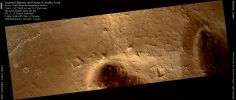
Psp_008982_1965_red.jpgLayered Deposits in Arabia Terra Region (natural colors; credits: Lunexit)58 visiteThis image shows the floor of an Unnamed Impact Crater in Arabia Terra that has Layered Deposits. There are many craters in this Region, where layering is observed.
These layers are often exposed along the sides of large isolated mounds, small knobs and mesas, and other positive relief features. In some cases, the layering is expressed as narrow sinuous ridge-like structures along crater floors.
The presence of Layered Deposits is of particular interest because these materials are not likely to be related to the impact event, but rather post-impact infill of the Crater. Modification of the Deposits has now revealed layers of material.
HiRISE and other instruments onboard the Mars Reconnaissance Orbiter may provide more clues to the origin of the these deposits.MareKromiumAgo 07, 2008
|
|
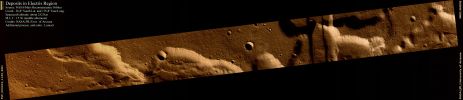
Psp_009029_1430_red.jpgDeposits in Electris Region (natural colors; credits: Lunexit)64 visiteThis observation reveals a portion of a long outcrop of a deposit in the Electris Region of Mars.
The Electris' Deposits occur over a range of landforms and relief and the process(es) responsible for their emplacement remain speculative.
Close examination of the outcrops reveal layering that in some places appear to include meter-scale blocks. Comparison with other HiRISE images of the deposit will enable more detailed mapping of its extent and nature and should provide new insight into the origin of these enigmatic materials.MareKromiumAgo 07, 2008
|
|

Psp_009011_1705_red.jpg"Apparent Valley", West of Ganges Chasma (natural colors; credits: Lunexit)62 visiteThis image shows an "Apparent Valley" North of a 37-Km long pit called Ophir Cavus. This valley is just West of another 155-Km long valley system called Allegheny Vallis, that also emanates from the pit.
The association of valleys with the pit suggests that water was released when the pit formed, perhaps when volcanic eruptions melted ice in the surface or subsurface.
The HiRISE image reveals light-toned units along portions of the plains and these could be minerals deposited by the flowing water or alteration of the plains by the water that once flowed here.MareKromiumAgo 07, 2008
|
|

PSP_008930_1880_RED.jpgStair-Stepped Mounds in Meridiani Planum (natural, but enhanced, colors; credits: Lunexit)56 visiteThis image shows layered sedimentary rocks that fill an impact crater in the Meridiani Planum Region of Mars.
These layered rocks may have formed through the accumulation of sediment (sand and dust) that were transported into this crater by blowing wind or flowing water. These sediments formed an extensive deposit that once covered the floor of the surrounding impact crater.
This crater is so large that the HiRISE image is entirely within it, and the crater rim is not visible. These sedimentary rocks were then eroded, likely by the wind. The original sand and dust were deposited in distinct layers within the crater; these layers now give the mounds their distinctive stair-stepped appearance, and are all that remain from this once extensive deposit.MareKromiumAgo 04, 2008
|
|
PSP_008839_2575_RED-00.jpgDunes and Polygons (ctx frame - natural colors; credits: Lunexit)80 visiteAt high Northern Latitudes, shallow troughs in the ice-rich ground form polygonal patterns. The polygons form over many years as the near-surface ice contracts and expands seasonally.
On top of this patterned ground in this image are dunes. Loose sand and dust are blown across the hard-cemented surface until collecting and forming a dune.
Streaks of dust are visible in the following edm-frame, coming from the horns of the dunes, while the higher portion of the dune blocks the dust from being blown across the surface.
Small ripples are also visible, and the small bright spots are the remnants of the seasonal Carbon Dioxide (CO2) Polar Cap that coats this area in the Winter.MareKromiumAgo 04, 2008
|
|
| 2237 immagini su 187 pagina(e) |
 |
|
|
|
|
159 | |
|
|
|
|





