| Ultimi arrivi - Mars Reconnaissance Orbiter (MRO) |
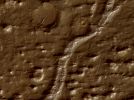
PSP_009318_1465_RED-01.jpgChloride Salt Deposits within a Channel in Terra Sirenum (edm - natural colors; credits: Lunexit)69 visitenessun commentoMareKromiumAgo 30, 2008
|
|
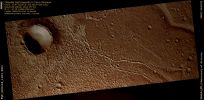
PSP_009318_1465_RED-00.jpgChloride Salt Deposits within a Channel in Terra Sirenum (ctx frame - natural colors; credits: Lunexit)77 visiteThis image shows a series of knobs, channels and inverted channels in the ancient Southern Highlands of Mars.
The inverted channels, which now appear as sinuous ridges, are filled with a fractured light-toned material that is also apparent in the knobs and nearby bedrock. Previous analyses of the infrared data from TES and THEMIS of similar materials in Terra Sirenum and elsewhere on Mars suggest that these light-toned materials are deposits of chloride salts such as Sodium Chloride (ordinary rock salt).
Salt deposits are key targets in the search for ancient life on Mars, because they represent places where bodies of liquid water may have ponded and evaporated.
The salt forms an ideal setting in which to preserve signs of biological activity. The clear association of the salt with the sinuous channels visible here suggests that the material was precipitated from brines that once flowed through these channels.
The fractured surface of the deposits is consistent with cracking by desiccation (rapid drying) of the thick salts as they were deposited.MareKromiumAgo 30, 2008
|
|

PSP_009161_1450_RED-00.jpgLong Shadows over Ariadnes Colles (ctx frame- natural colors; credits: Lunexit)56 visiteAriadnes Colles is a labyrinth-like cluster of hills, mesas and knobs located near Terra Cimmeria, in the Southern Highlands of Mars.
This image, which covers a portion of that labyrinth, was acquired only a few Soles away from Winter Solstice.
Winter Solstice occurs in the shortest Sol of the year, when the Sun travels the lowest in the Martian sky, making shadows appear very long. These conditions are ideal to analyze modest relief features, that would pass unnoticed when illuminated from above but are highlighted when illuminated from the side.MareKromiumAgo 30, 2008
|
|
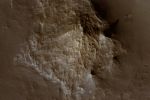
PSP_009161_1450_RED-01.jpgLong Shadows over Ariadnes Colles (edm - natural colors; credits: Lunexit)58 visiteThis edm shows one of the hills in detail.
The hill appears criss-crossed by long fractures and most of them made apparent by the shadows they cast.
The shadows indicate that the fractures “stick out” from their surroundings, and hence that they are more resistant to erosion. In terrestrial environments this occurs when fluids flow along the fractures, leaving behind cementing minerals or when fractures are filled by igneous materials.MareKromiumAgo 30, 2008
|
|
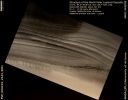
PSP_009293_2645_RED.jpgStructure of the North Polar Layered Deposits (natural colors; credits: Lunexit)57 visiteThe North Polar Layered Deposits on Mars are thought contain a record of global climate changes, similar to ice ages on Earth. This image shows that the geologic history of the NPLD has been complex enough to form angular unconformities.
An angular unconformity represents a gap in the geologic record, where erosion has removed material followed by deposition of more material on the eroded surface. In this image, the angular unconformities are recognized by the truncation, or cutting off of layers, for example right of center and at bottom center.
Also visible in this image are numerous streaks, perhaps caused by recent redistribution of frost by winds.MareKromiumAgo 29, 2008
|
|
PSP_009138_2025_RED-01.jpgMineralogical Diversity in Nili Fossae (edm - natural colors; credits: Lunexit)57 visitenessun commentoMareKromiumAgo 21, 2008
|
|
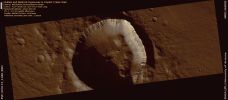
PSP_009155_1480_RED.jpgGullies and Bedrock Exposures in Impact Crater Wall (natural colors; credits: Lunexit)57 visiteThis image shows a rather pristine crater with Gullies and Bedrock Exposures. The Gullies are mostly on the South-Facing (such as the Poleward facing) wall. Some of the gully channels are very sharp, indicating that they have not been modified much since they formed.
Other channels criss-cross each other, demonstrating that there were multiple periods of activity. Scientists do not know how closely these were spaced in time.
The South and East walls of the Crater (upper right of the frame) have very distinct bright layers. These layers are possibly Ancient Bedrock. These walls also have what appear to be bright Landslides.MareKromiumAgo 21, 2008
|
|
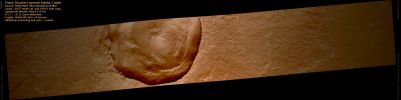
PSP_009160_2350_RED.JPGFresh Double-Layered Ejecta Crater (natural colors; credits: Lunexit)56 visiteThis scene features a High Latitude, Northern Hemisphere Crater with double-layered ejecta. The sharp rim and lack of small superposed craters indicates that this Crater is relatively young.
The semi-circular feature that parallels the Crater Rim is a terrace that probably formed as part of the Crater wall collapsed into the center. The circular mound in the center likely formed at the same time as the Crater itself.
Large craters on Mars can have central peaks; this Crater looks like it was on the cusp of having one. The linear features surrounding the Crater on its ejecta are striations that formed during the impact as material and wind exploded out from the center.
On the right side (Dx) of the scene, is a very distinct ejecta flow lobe (Lobate Ejecta). Lobate Ejecta is thought to form when an impact occurs on a surface with lots of volatiles — such as ices that quickly turn to gas when they are heated. The gases help make the ejecta flow like a fluid.MareKromiumAgo 21, 2008
|
|

PSP_009138_2025_RED-00.jpgMineralogical Diversity in Nili Fossae (ctx frame - natural colors; credits: Lunexit)56 visiteThere is evidence of phyllosilicate material (clays) throughout this Nili Fossae Region. The evidence comes from the OMEGA experiment on the European Space Agency’s Mars Express Spacecraft and CRISM on the Mars Reconnaissance Orbiter, Infrared Spectrometers that can identify minerals on the surface of Mars.
In the Nili Fossae Region, the spectrometers have found remarkable diversity in surface composition. Because of the evidence for clays and other interesting geology, Nili Fossae is also being considered as a Landing Site for the Mars Science Laboratory Rover.
HiRISE has targeted several places where OMEGA and CRISM show extreme diversity, with this being one example. In this specific area, low-calcium pyroxene (LCP) materials are adjacent to these clays.
The cracked terrain areas evident at the highest resolution - see the next edm frame - provide clues to the sequence of events which occurred in Nili Fossae.MareKromiumAgo 21, 2008
|
|
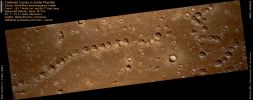
PSP_009177_1985_RED.jpgCratered Cones in Isidis Planitia (natural colors; credits: Lunexit)56 visiteThis image shows part of a broad field of cratered cones in the Isidis Planitia region of Mars. The cones occur over a wide area and are commonly aligned in chains, like those here.
The cratered-cone morphology suggests formation by eruption of some material. The cones resemble small volcanoes on Earth called cinder cones, and are approximately the same size. Another possibility is that these are mud volcanoes, formed by eruption of wet, pressurized mud. This has been suggested as an important process in some parts of Mars. The aligned chains probably indicate sites of weakness, perhaps faults, where lava or mud could preferentially rise.
The scene is relatively bland in color, but this could be due to a thin coating of dust veiling color differences. The cones are clearly not very young or pristine; they have a battered, pitted appearance. However, they have not been heavily eroded, as features like the cone rims are still sharp in most cases. This state is typical of the cones in Isidis region.
MareKromiumAgo 21, 2008
|
|

PSP_009114_2645_RED.jpgEroding Dunes in Chasma Boreale (natural colors; credits: Lunexit)58 visiteSand moves along a planetary surface by a process scientists call “saltation”, whereby the individual grains are driven by the wind and bounce forward in short hops. In a process that is not yet completely understood, sheets of saltating sand grains organize themselves into sand dunes, visible in this image as the dark features.
Sand dunes move by having the wind push sand grains up and over the top of the dune where they then slide down to the base. The steep side of the dune that the sand grains slide down is called "slip-face" and it is the constant transport of sand from the downwind side of the dune to the "slip-face" that makes the dune move forward in this direction. HiRISE data allow us to see which side of these dunes has the steeper slope (such as the aforementioned "slip-face"), telling us what direction the dune — and strong near surface winds — are moving.
Yet something else is also happening to these particular dunes. Dark streaks lead away from the dunes toward the lower left of the image. These streaks are caused by sand grains being blown off the dunes and saltating away. This is not ordinarily a cause for concern because in a stable dune, individual grains are constantly added and removed; however, there does not appear to be any influx of sand upwind of these dunes, so they are probably being eroded.
It is also interesting that these streaks do not point in the same direction as the "slip-face". One possible scenario is that the dunes migrated Westward when sand supply was more plentiful. Today, the wind direction has shifted, blowing more toward the South-West, and the influx of new sand has ceased, such that in the future, the dunes will completely erode away. Repeated HiRISE observations will be able to look for changes in the shape and size of these dunes.MareKromiumAgo 21, 2008
|
|

PSP_005410_1115_RED_abrowse.jpgPolar Pit Gullies (MULTISPECTRUM; credits: Lunexit)58 visiteThis image shows Polar Pit Gullies in a depression. The gullies do not appear to have been active recently, as their channels and alcoves are covered with polygonal fractures and ripples that have formed over time. The alcoves contain boulders from eroding layers up-slope. Several of the alcoves extend to the slope rim, suggesting head-ward erosion.
The rest of the scene contains abundant polygonal ground, thought to have formed by processes involving ground ice. This image is at a High Latitude where polygonal terrain is common. This feature is not found in Equatorial Regions, which supports a relationship with ground ice because ground ice is not stable near the equator today.
There are several muted circles on the plains in the lower half of the image; these are possibly relaxed craters. If a crater forms in ice-rich ground, the ice enhances the degradation of the crater and gives the crater a “softened” appearance.MareKromiumAgo 17, 2008
|
|
| 2237 immagini su 187 pagina(e) |
 |
|
|
|
|
158 | |
|
|
|
|





