| Ultimi arrivi - Mars Reconnaissance Orbiter (MRO) |

Psp_008680_2050_red.jpgCharacterize Surface Hazards and Science of Possible MSL Rover Landing - Mawrth Vallis (natural colors; credits: Lunexit)57 visitenessun commentoMareKromiumSet 07, 2008
|
|

PSP_008218_1815_red.jpgCharacterize Surface Hazards and Science of MSL Rover Landing Site - Equatorial Regions (Saturated Natural Colors; credits for the additional process. and color.: Dr Paolo C. Fienga - Lunexit Team) 79 visitenessun commentoMareKromiumSet 06, 2008
|
|

PSP_009396_2590_red.jpgDefrosted Margin of the North Polar Erg (natural colors; credits: Lunexit)59 visiteThis image shows a traverse across a section of the North Polar Erg, a vast Sea of Sand that surrounds the Polar Cap.
The source of the dunes may be from the eroding North Polar Layered Deposits. Wind, acting on this mixture of sand, dust and ice, has formed several dune types on top of bright megaripples and polygons. A dark mantle of sand lies beyond the dunes.
The central part of the field contains transverse dunes with the dominant wind direction coming from the North/West-West. The outer edges of the Dunefield transition into "Star Dunes" (with multiple arms) and "Barchanoid Dunes" (crescent-like shape). The Star Dunes indicate a multidirectional wind regime or a change in wind direction over the Dunefield’s evolution.
The dunes are somewhat confined to their location and may have taken hundreds of years to form.MareKromiumSet 04, 2008
|
|
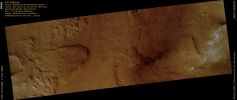
Psp_009368_1720_red.jpgIus Chasma (natural colors; credits: Lunexit)56 visiteThis image spans the floor of Ius Chasma’s Southern Trench. Ius Chasma is located in the Western Region of Valles Marineris, the Solar System’s largest canyon. This canyon is well known for its fine stratigraphic layers modified by wind and water.
The outcrops contain interchanging layers of dark and bright rocks. The layered deposits consist of dark basalt lava flows and bright sedimentary layers. The sediments are likely to be from atmospheric dust, sand, or alluvium from an ancient water source. The layers are visible on the gentle slopes above the canyon floor, in pitted areas, and in small mesa buttes. The floor of the canyon is littered with megaripples that are aligned in a North-South direction.
Ius Chasma is believed to have been shaped by a process called "sapping" that occurred when water seeped from the layers of the cliffs and evaporated before it reached the canyon floor. This process is thought to have dominated during the Amazonian Period.
Ius Chasma also has several structural features such as East trending normal Faults and Grabens that deformed the canyons. Recent geomorphological events include Mass Wasting (Avalanches) and minor Sapping from Gullies that continued to erode the canyon walls.MareKromiumSet 04, 2008
|
|
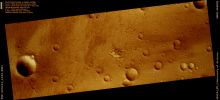
Psp_009319_1650_red.jpgDust Devil Tracks in Gusev Crater (Extremely Enhanced Natural Colors; credits for the additional process. and color.: Dr Paolo C. Fienga - Lunexit Team)60 visiteGusev Crater is decorated by tracks made by Dust Devils that have been observed by the Mars Exploration Rover Spirit, Mars Orbiter Camera (MOC), and HiRISE images.
Dust Devils are of interest because they may clean the Solar Panels that provide power to Spirit, and are partially responsible for dust transportation on the surface of Mars.
Dust Devils are actually giant convective vortices that form as a result of atmospheric vertical instability. Solar radiation warms the surface, forcing air to rise to an atmospheric convective boundary, where it then cools. The denser, cold air parcel descends and generates a circulation that creates a suction effect.
As the Dust Devil picks up material from the bright dust-mantled surface, it exposes the darker basaltic substrate. These scribble marks will follow the prevailing winds and tend to cluster together as the lower albedo surface heats up more quickly.
Scientists are trying to understand the relationship between Dust Devils and craters and other topographic features that generate multiple wind directions.MareKromiumSet 04, 2008
|
|

PSP_009233_2535_RED_abrowse-00.jpgEvolution of North Polar Dunes (ctx frame - natural colors; credits: Lunexit)73 visiteThis small unnamed crater is adjacent to the North Polar Erg and contains a fascinating Dunefield. Scientists are interested in the source of the dunes in the crater and the evolution of the Dunefield’s circular shape.
Wind transports material and shapes the dunes; the dominant wind comes from a Westerly-SouthWesterly direction and forms barchans (crescent-shaped) and barchanoid dunes. Secondary winds also play a role in shaping the dunes.
This can be seen in the Southern part of the Dunefield where the barchans transition into transverse dunes. On the northern edge of the dune field are opposite facing barchans formed by winds from the North-East.MareKromiumSet 04, 2008
|
|

PSP_009233_2535_RED_abrowse-02.jpgEvolution of North Polar Dunes (edm - natural colors; credits: Lunexit)57 visiteThe circular shape of this Dunefield is interesting because the outer dunes reflect changing winds whereas the central dunes do not.
This could indicate several distinct stages in the formation of the Dunefield. On top of the dark dunes are tiny ripples similar to those seen on top of sand dunes on Earth.
It is likely that these dune ripples are active, as shown by avalanches (grainflow) from the crest of the dunes.MareKromiumSet 04, 2008
|
|

PSP_009192_1890_RED-01.jpgRelatively Recent Slope Streak started from a Dust Devil (edm - natural colors; credits: Lunexit)57 visitenessun commentoMareKromiumAgo 31, 2008
|
|
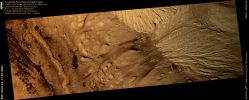
PSP_009149_1750_RED.jpgInverted Riverbed in Gale Crater (False Colors; credits: Lunexit)57 visiteGale Crater is a large, approximately 152 Km-diameter impact crater that lies near the Martian Equator. Contained within the crater is a massive central mound of layered material. With an average vertical thickness of almost 4 Km (about 2,4 miles), the Gale Crater Layered Deposits are twice as thick as the layers exposed along the Grand Canyon on Earth. Shown here is a portion of the mound with an inverted fluvial or river channel.
Topographic inversion occurs when sediments are cemented together, forming a harder layer that is resistant to later erosion. This later erosion has preferentially removed material outside the channel, leaving the former riverbed exposed as a ridge — such as a topographic high.
This inverted channel was originally detected by scientists using Mars Orbiter Camera (MOC) images onboard the Mars Global Surveyor Spacecraft.
Color variations visible in this image are mostly due to variable amounts of loose dark sediment that has accumulated unevenly across the scene.MareKromiumAgo 30, 2008
|
|
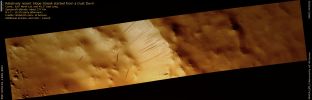
PSP_009192_1890_RED-00.jpgRelatively Recent Slope Streak started from a Dust Devil (ctx frame - natural colors; credits: Lunexit)58 visiteThis Slope Streak occurred in the time between a Viking image of the bottom of this crater (713A57, which saw no streak) and a MOC image (R12/01917, as reported by Schorghofer et al. (2007).
That paper suggested that the Slope Streak may have been caused by a Dust Devil that had passed by (its track is visible in the MOC image). Our HiRISE image shows that there isn’t a small hill or anything at this Slope Streak’s apex, but that the dust devil track really does intersect with the apex. It is likely that the Dust Devil may have caused this Slope Streak.
Dark Slope Streaks are visible in many places on the Martian surface, often where the dust cover is thick.
One explanation for Dark Slope Streaks is that they are little avalanches in the dust. The apexes of Slope Streaks (such as the point where they start from) are often at little hills or ridges on a larger slope, with the thinking that the dust here is already close to being too steep, and then any little perturbation will start one of these tiny avalanches.
Small craters have also been seen at slope streak apexes.MareKromiumAgo 30, 2008
|
|
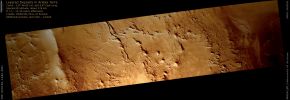
PSP_009180_1840_RED.jpgLayered Deposits within Unnamed Crater in Arabia Terra (natural colors; credits: Lunexit)57 visiteArabia Terra is an area of Mars that has an abundance of Layered Deposits within Impact Craters.
The Region of Arabia has plateau material that is thought to be part of the ancient highland crust that is Noachian in age according to Martian timescale. Thus, the layered deposits may represent some of the earliest eroded and infilled materials on Mars.
In this Unnamed Crater, we see layering exposed along the margins of a scarp-like bench.
The layering is of particular interest because on Earth, they may represent multiple sequences of deposited material or some geologic process (subaerial or subaqueous) that has modified and/or deposited material on the surface in some constant fashion.
If the layered sequences are consistently the same, we can infer that the conditions of their deposition were the same for some period of time. If the layers changed in some way (e.g., thickens and thins), then we can infer that some condition(s) caused this to happen.
From these observations and analyses, scientists can attempt to quantify and reconstruct what the ancient conditions were like in this Region of Mars.MareKromiumAgo 30, 2008
|
|
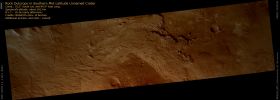
PSP_009151_1465_RED.jpgRock Outcrops in Southern Mid-Latitude Crater (natural colors; credits: Lunexit)57 visiteThis image shows part of the floor of a large Impact Crater in the Southern Hemisphere. The crater lies at the edge of the Hellas Impact Basin; although it is roughly 50 Km across, it is dwarfed by the giant Hellas structure, which has seen a varied and interesting geologic history.
This image captures a diverse range of rocks on the Crater Floor. A small cliff running across the middle of the image marks the edge of one rock unit, but variations in tone or texture in the northern part of the image suggest a varied history of deposition. Exposures of light, intermediate and dark materials may correspond to different types of deposition, or perhaps alteration after the rocks were laid down. Some units appear rich in boulders, suggesting that they are breaking up into blocks, while at other sites there are thin layers.
This diversity indicates a varied geologic history. Hellas Basin is a low Region, and may have once held lakes or seas where sediments could have been deposited.
This site is also just west of Hadriaca Patera, an old volcano. Sediment could also have been deposited by wind, or in streams on the surface. Unraveling the history of the region will require many images to illustrate the diversity of rocks and map out where they occur.MareKromiumAgo 30, 2008
|
|
| 2237 immagini su 187 pagina(e) |
 |
|
|
|
|
157 | |
|
|
|
|





