| Ultimi arrivi - Mars Reconnaissance Orbiter (MRO) |
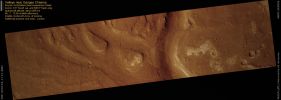
Psp_009578_1715_red.jpgValleys Near Ganges Chasma (natural colors; credits: Lunexit)59 visiteSeveral valleys as well as light-toned material are visible in this HiRISE image of a portion of Allegheny Vallis along the Plains West of Ganges Chasma.
The main valley, which starts in a pit called Ophir Cavus and extends for 155 Km into Ganges Chasma, is visible in the center of the image from left to right. Smaller and shallower valleys can be seen mostly to the north (Sx) of the image.
The observation that there are several valleys here suggests that water flowed for some extended period of time or multiple times in order to change direction and produce different valleys.
Light-toned material is visible on the upper surfaces of the plains but not inside the valleys, perhaps because smaller amounts of water could interact with the lava plains at these higher elevations, while in the valleys larger amounts of flowing water eroded and removed the plains unit. The light-toned nature on the upper surfaces could have resulted from chemical alteration of the lava plains or deposition of evaporites as the water disappeared and left behind minerals once carried in the water.MareKromiumOtt 02, 2008
|
|
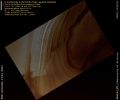
Psp_009390_2595_red.jpgUnconformity in North Polar Layered Deposits (natural colors; credits: Lunexit)59 visiteThis image features the North Polar Layered Deposits. The flat tongue-shaped feature at the bottom of the image is the surface of the cap.
The bright textured region near the top of the image is polygonal ground, which is commonly found in the Martian High-Latitudes. Polygonal ground formation is thought to relate to temperature cycles in ice-rich soil.
Just south of the polygonal ground, a bright layer within the cap can be seen eroding in the form of landslides, particularly near the center of the image.
The most noticeable part of the polar cap is visible in an unconformity, the horizontal break in the cap layers. An unconformity is caused by non-uniform erosion or deposition. In this case, non-uniform erosion or deposition might have occurred due to variable climate over geologic time.
MareKromiumOtt 02, 2008
|
|
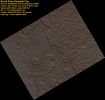
PSP_004000_0945_RED_browse~0.jpgThe "South Polar Residual Cap" (natural colors; credits: Lunexit)56 visite
Like Earth, Mars has concentrations of water ice at both poles. Because Mars is so much colder, however, the seasonal ice that is deposited at high latitudes in the winter and is removed in the spring (generally analogous to winter time snow on Earth) is carbon dioxide ice. Around the south pole there are areas of this carbon dioxide ice that do not disappear every spring, but rather survive winter after winter&emdash;this persistent carbon dioxide ice is called the south pole residual cap.
Relatively high-standing smooth material is broken up by circular, oval, and blob-shaped depressions, forming a pattern called "swiss cheese" terrain. The high-standing areas are carbon dioxide ice with thicknesses probably of several meters. The depressions are thought to be caused by the removal of carbon dioxide ice by sublimation (the change of a material from solid directly to gas). By looking at different sized depressions in an image such as this, and by comparing images of the same place from year to year, the development of "swiss cheese" terrain can be observed.
The sublimation process may begin anywhere as a small depression. Once this small depression is formed, it expands laterally in all directions, creating the rounded depressions we see today. As most depressions seem to have a similar depth and have relatively flat bottoms, there is likely some layer below, possibly of water ice, that cannot be as easily removed by sublimation. Thus, while the south polar residual cap as a whole is present every year, there are certainly annual changes taking place within it.
Especially apparent and interesting in this image are the strips of material that parallel the edges of many depressions. Often there are two or more concentric strips that are smooth like the surrounding surface, but seem to be lower than the surrounding surface and in places appear to be tilted down towards the center of the depression. Inner strips are sometimes broken up into chunks. It may be that the uppermost smooth layer is a bit more resistant to sublimation than the material just below it&emdash;the quicker removal of the underlying material might cause the stronger upper layer to detach from the surrounding terrain and settle down towards the center of the depression.
Alternatively, these ringing strips may indicate that many layers are present within the carbon dioxide ice. Another interesting feature is the faint crisscrossing network of ridges on the upper smooth terrain. These may also be complexly involved in the sublimation and deposition of carbon dioxide ice.
With the high resolution capability of HiRISE, we intend to measure the amount of expansion of the depressions over one or more Mars years. Knowing the amount of carbon dioxide removed can give us an idea of the current atmospheric and climate conditions, and possibly how Mars climate may be changing.
MareKromiumSet 28, 2008
|
|

Psp_008210_2415_red~0.jpgKnobs and Small Craters with Ice in Northern Arcadia Planitia (natural colors; credits: Lunexit)67 visitenessun commentoMareKromiumSet 28, 2008
|
|
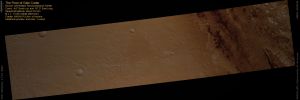
Psp_009650_1755_red.jpgCrater Floor and Central Mound in Gale Crater (natural colors; credits: Lunexit)58 visitenessun commentoMareKromiumSet 28, 2008
|
|

PSP_008234_2405_red-PCF-LXTT.jpgPeriglacial Landscape in Northern Tempe Terra (Enhanced Natural Colors; credits for the additional process. and color.: Dr Paolo C. Fienga - Lunexit Team)58 visitenessun commentoMareKromiumSet 28, 2008
|
|
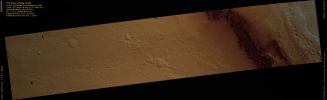
Psp_009505_1755_red.jpgThe Floor of Gale Crater (natural colors; credits: Lunexit)58 visitenessun commentoMareKromiumSet 28, 2008
|
|

Psp_009571_1755_red.jpgCrater Floor and Central Mound in Gale Crater (Natural Colors; credits for the additional process. and color.: Dr Paolo C. Fienga - Lunar Explorer Italia)58 visitenessun commentoMareKromiumSet 28, 2008
|
|
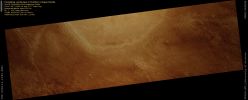
PSP_008214_2285_red.jpgPeriglacial Landscape in Northern Utopia Planitia (Saturated Natural Colors; credits for the additional process. and color.: Dr Paolo C. Fienga - Lunexit Team)72 visitenessun commentoMareKromiumSet 28, 2008
|
|
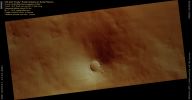
PSP_009527_1670_RED.JPGOld and "Dusty" Volcano in Syria Planum (natural colors; credits: Lunexit)57 visiteThis image shows an old volcano in Syria PlanumRegion, near the edge of the Tharsis volcanic rise. This is a Region where extensive volcanism has occurred; in many places, the upper walls of Valles Marineris have cut through lava flows.
The basic shape of the old volcano is visible here, but the entire region has been coated by dust.
This makes it difficult to learn more about the volcanic processes that have occurred at this site. However, the mantle is interesting by itself. It has probably settled out of the atmosphere, either as dust or possibly volcanic ash, since it seems to coat the entire region uniformly. (Mars has frequent, massive Dust Storms which could create large deposits over time.) This mantle has a regular, scalloped texture that is visible at several scales.
The texture is not well understood; it is common in volcanic terrains, but also occurs on some other rock outcrops.
HiRISE scientists are studying images like this one to determine how it forms.MareKromiumSet 25, 2008
|
|

Psp_009502_1980_red.jpgDark Spot Near Olmpus Mons Volcano (natural colors; credits: Lunexit)57 visiteThis image covers a relatively dark-toned patch of ground West of the Olympus Mons volcano. This spot is one of several "Dark Areas" in this Region of Mars.
These Dark Spots are distinctive because much of the surrounding area appears to be covered by light-toned dust.
In pre-HiRISE images, the origin of this Dark Spot was ambiguous. This HiRISE image reveals that the dark color is likely the result of accumulations of Basaltic Sand (smooth, brown-colored material in this natural color view) on top of otherwise relatively dust-free bedrock.
Evidence of layering is also visible within the dark area. There are alternating bands of lighter- and darker-toned material, consistent with alternating layers of bedrock. These alternating bands are not apparent outside of the Dark Area. This may mean that alternating layers of bedrock only occur within the dark area, or that these bedrock layers occur throughout the region but are covered and obscured by light-toned dust outside of the Dark Area.MareKromiumSet 25, 2008
|
|

Psp_009501_1755_red.jpgTube-Fed Lava Flow Field (natural colors; credits: Lunexit)58 visiteThis Lava Flow Field is part of a Small Shield Volcano within the Lava Plains South of Pavonis Mons. It illustrates the importance of Lava Tubes in the formation of large lava flow fields.
Shield Volcanoes are often covered by a combination of open Lava Channels and partly enclosed Lava Tubes, through which lava once flowed when the volcano was active. Tubes are often located axial to topographic ridges, and after a Lava Flow ends, a tube can drain leaving an empty space into which the roof can collapse.
However, if a tube is filled to capacity or under pressure when the lava is flowing, narrow ridge-like features and/or small Lava Flow breakouts can form.
This scenario is one possible explanation for the Ridged Lava Flow in the center of this image.
Here, a narrow wall-like feature is axial to a larger topographic ridge that appears to be the source for a series of smaller Lava Flows.MareKromiumSet 25, 2008
|
|
| 2237 immagini su 187 pagina(e) |
 |
|
|
|
|
154 | |
|
|
|
|





