| Ultimi arrivi - Mars Reconnaissance Orbiter (MRO) |
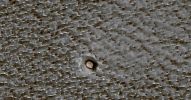
PSP_009942_2645_RED_abrowse-01.jpgSmall Crater on Planum Boreum (edm - natural colors; credits: Lunexit)67 visiteThis edm frame shows an example of a rare, small crater (approx. 115 meters, or 125 yards, in diameter). Scientists can count these shallow craters to attain an estimate of the age of the upper few meters of the Planum Boreum Surface.
The colors come from the presence of dust and of ice of differing grain sizes. The blueish ice has a larger grain size than the ice that has collected in the crater. The reddish material is dust. The smooth area stretching to the upper right, away from the crater may be due to winds being channeled around the crater or to fine-grained ice and frost blowing out of the crater.MareKromiumOtt 17, 2008
|
|
PSP_009942_2645_RED_abrowse-00.jpgSmall Crater on Planum Boreum (ctx frame - natural colors; credits: Lunexit)78 visiteImpact craters on the surface of Planum Boreum, popularly known as the North Polar Cap, are rare. This dearth of craters has lead scientists to suggest that these deposits may be geologically young (a few million years old), not having had much time to accumulate impact craters throughout their lifetime.
It is also possible that impacts into ice do not retain their shape indefinitely, but instead that the ice relaxes (similar to glass in an old window), and the crater begins to disappear.MareKromiumOtt 17, 2008
|
|

PIA11230.jpgDust Storm in the North Polar Regions54 visiteCaption NASA:"This is an image of Mars taken from orbit by the Mars Reconnaissance Orbiter's Mars Color Imager (MARCI). The Red Planet's Polar Ice-Cap is in the middle of the image. Captured in this image is a 37.000 square-kilometer (almost 23.000 miles) Dust Storm that moved counter-clockwise through the Phoenix Landing Site on Oct 11, 2008, or Sol 135 of the Mission.
Viewing this image as if it were the face of a clock, Phoenix is shown as a small white dot, located at about 10 AM. The storm, which had already passed over the Landing Site earlier in the day, is located at about 9:30 AM".MareKromiumOtt 15, 2008
|
|

Spirit-OrbitalView-20081009-MRO.jpgGusev Crater and Spirit: Aerial View57 visiteCaption NASA:"Clear skies and low-angle sunlight are an outdoor photographer's dream. On the shortest day of Martian winter, June 24, 2008, Spirit had both. Conditions were ideal for an orbiter's shot of the Mars Rover parked on the sunlit slope of a volcanic plateau.
Shadows outlined shapes in the landscape, such as the upturned edges of the bowl-shaped plateau known as "Home Plate". Shadows also reveal nearby ridges, slopes, and large boulders. Spirit is the dark "bump", marked by a yellow arrow.
Detailed images such as this one will help scientists select a future path for Spirit. For plotting a path on Mars, a powerful orbiting camera, long shadows, and a clear sky are about as good as it gets".MareKromiumOtt 14, 2008
|
|
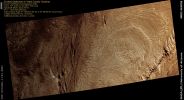
PSP_009460_1745_RED_abrowse-00.jpgCeti Mensa (ctx frame - natural colors; credits: Lunexit)59 visiteThis image shows a steep-sided depression in light-toned, layered rocks in the Valles Marineris Canyon System.
This formation, known as Ceti Mensa, is located in Western Candor Chasma in the Northern Valles.
The origin of Ceti Mensa and other Layered Deposits within the canyons is a source of much debate: proposed interpretations include lake deposits, deposits of volcanic ash, deposits of windblown sand and dust and glacial deposits. Recent spectral observations by the Mars Express and Mars Reconnaissance Orbiter Spacecraft have identified crystalline Iron Oxides and Hydrated Magnesium Sulfate minerals on Ceti Mensa.
These minerals are regarded as indicators of the presence of liquid water during their formation.
The Hydrated Sulfate mineral "Kieserite", in particular, most commonly forms on Earth by evaporation of brines.MareKromiumOtt 12, 2008
|
|

Psp_009460_1745_red.jpgCeti Mensa (edm - natural colors; credits: Lunexit)57 visiteThis image gives us another clue to the formation of Ceti Mensa. Close-up examination shows fine banding in the layers of Ceti Mensa that is exposed by the ongoing erosion. The banding is produced by alternating bright and dark material. The thickness of the individual bands ranges from a few meters down to the resolution limit of the image, a few tens of centimeters. The bands are parallel, although they appear wavy on the irregular, eroded surface.
The banding visible in this image most closely resembles terrestrial lake deposits and similar rocks formed in aqueous, low energy depositional environments. Structures such as cross-bedding that are hallmarks of wind-deposited sediments are absent, as are cobbles and clasts that are typical of glacial sediments. If this interpretation is correct, the thickness of Ceti Mensa suggests formation in standing bodies of water that were several kilometers deep.MareKromiumOtt 12, 2008
|
|

Psp_009619_1630_red.jpgDouble Impact Crater (natural colors; credits: Lunexit)95 visiteThis image shows a double impact crater in Syria Planum, and probably formed when a binary asteroid pair (two asteroids closely orbiting each other, while also orbiting the Sun) struck the Surface. The asteroids must have been about the same size, on the order of a few hundred meters across, to produce these craters.
How is it possible to say that the double crater is due to a binary asteroid, instead of two independent impacts? Neither crater shows signs of burial by ejecta from the other. More importantly, the ejecta (material thrown out of the craters) shows signs of interacting; the ridges extending to the southeast of the crater probably formed when ejecta from the craters collided in midair, causing more debris to pile up at certain points.
This means that the impacts occurred within moments of each other.
Ejecta interaction features like this can also form in association with “secondary” craters (craters made by debris from other impacts, rather than by asteroids), since many secondary craters form at once. In this case, however, a binary asteroid is the likely cause. The very large size is one indicator (secondary craters are generally much smaller than the “primary” crater), and there is not an obvious nearby source crater. While secondary craters are common, binary impacts are expected to occur as well, since binary asteroid pairs are observed.
This crater pair is also of geologic interest since it exposes a cross-section of the local rocks. Thin, flat layers are visible in the upper walls. Since this region has seen extensive volcanic activity, these may be a mix of old lava flows and other volcanic debris. Exposures like this provide evidence for the extent and thickness of these deposits. MareKromiumOtt 11, 2008
|
|

PSP_009696_2575_RED.JPGDunes and Translucent Ice-Spot in the Northern Plains (Saturated and Enhanced Natural Colors; credits for the additional process. and color.: Dr Paolo C. Fienga - Lunexit Team) 58 visiteThis Terrain is located near the North Pole. The bright patch of material is ice, which might have been deposited in the previous Winter.
After ice in the form of surface frost is deposited from the Atmosphere, it experiences changes throughout the Martian Year. Some of the ice has a polygonal texture which probably formed when temperature variations created stress and cracks in the ice.
The dark features scattered throughout the scene are Dunes. The streaks emanating from the Dunes trending in the South/West direction indicate the dominant direction of the wind in recent times.MareKromiumOtt 11, 2008
|
|
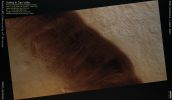
PSP_006659_1460_RED_abrowse~0.jpgGullies in Dao Vallis (MULTISPECTRUM; credits: Lunexit)57 visiteGullies on the North-West side of Dao Vallis, a Martian outflow channel, are the focus of this observation. The outflow channels are thought to have been carved by gigantic, ancient floods.
Gullies are largely thought to be the result of water flow, but the origin of the water is much debated.
One theory proposes that melting snowpack, or a mantling (blanketing) unit, forms gullies. Such a mantling unit is visible here between some of the gullies, in the full high-resolution image. Some alcove-shaped features appear to have mantling material in them.
If the mantling unit is indeed related to gully formation, then gullies are potentially forming here.
MareKromiumOtt 07, 2008
|
|

North_Polar_Features-Layers-MRO-PCF-LXTT.jpgNon-Conformities (Absolute Natural Colors; credits for the additional process. and color.: Dr Paolo C. Fienga - Lunexit Team)60 visiteCaption NASA:"How did these layers of red cliffs form on Mars? No one is sure. The Northern Ice Cap on Mars is nearly divided into two by a huge division named Chasma Boreale. No similar formation occurs on Earth. Pictured here, several dusty layers leading into this deep chasm are visible. Cliff faces, mostly facing left but still partly visible from above, appear dramatically reddish. The light areas are likely water ice. This image spans about 1 Km near the North of Mars, and the elevation drop from right to left is over one kilometer. One hypothesis relates the formation of Chasma Boreale to underlying volcanic activity".MareKromiumOtt 06, 2008
|
|
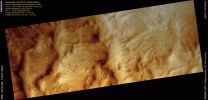
Psp_009548_1420_red.jpgEnigmatic Terrain in Hellas Planitia (Saturated Natural Colors; credits for the additional process. and color.: Dr Paolo C. Fienga - Lunexit Team)60 visiteHellas Planitia is the low-lying plain on the floor of the Hellas Basin, an ancient impact crater over 2000 Km wide. This Basin includes the lowest point on the surface of Mars.
A variety of unusual landforms occur on the floor of the basin due to the low elevation. One hypothesis is that Hellas may once have held lakes or seas, possibly with thick ice that might account for some of these features.
This image shows a small portion of Western Hellas, in a Region of "Enigmatic Ridges".
These ridges form an intricate pattern, enclosing kilometer-wide depressions. These strange features are still not well-understood; one possibility is that they formed in lake-bottom sediments when ice covering the lake touched bottom and shoved wet, loose material to the side.
This HiRISE image reveals that the ridges contain many boulders; sediments deposited on the bottom of a lake might be fine-grained, although they may have hardened to rock later. The image also shows lineations, probably outcropping layers, running between the large ridges.
Because the resolution of HiRISE images is sufficient to see details such as the abundance of boulders and the presence of thin sedimentary layers, images of this and other poorly-understood terrains will be important in interpreting the geological and climatological history of Mars.
This observation is part of a stereo pair along with PSP_007834_1420.MareKromiumOtt 02, 2008
|
|

Psp_009535_2240_red.jpgMerging Lobate Debris Aprons of Deuteronilus Mensae (Natural Colors; credits for the additional process. and color.: Dr Paolo C. Fienga - Lunar Explorer Italia)120 visiteThis image lies within the Deuteronilus Mensae Region, located on the Northern Edge of Arabia Terra and borders the high-standing, heavily cratered Southern Hemisphere and the low, relatively uncratered, plains of the Northern Hemisphere of Mars.
Deuteronilus Mensae is characterized by hills and mesas surrounded by broad debris aprons and this HiRISE image shows examples where lobate-shaped debris aprons appear to overlap.
There is zone of ridges that formed in an area where lobate debris aprons merged from different directions. A current hypothesis is that these ridges are expressions of compressional deformation between two lobes acting like a viscous fluid. One possibility, given the high latitude of the occurrence, is that the lobes of debris are ice-rich and flow somewhat like glaciers.
Recent results from the SHAllow RADar (SHARAD) instrument, also onboard the Mars Reconnaissance Orbiter, indicate that lobate debris aprons in Deuteronilus Mensae are composed of material dominated by ice [Plaut et al., 2008].
This supports the interpretation that these might be potential debris-covered glaciers or rock glaciers.
Some of the detailed textures on the surface of the debris aprons are commonly believed to be the result of ice loss due to sublimation (ice changing into water vapor). On Earth, debris-covered glaciers/rock glaciers typically develop wrinkles and fractures due to stresses in the ice as it flows. Where flows merge, they can buckle and push up ridges producing features similar to those visible here.MareKromiumOtt 02, 2008
|
|
| 2237 immagini su 187 pagina(e) |
 |
|
|
|
|
153 | |
|
|
|
|





