| Ultimi arrivi - Mars Reconnaissance Orbiter (MRO) |
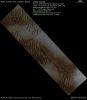
PSP_009739_2580_RED.JPGLinear Dunes in the North Polar Region (possible natural colors; credits: Lunexit)59 visiteThis observation shows linear dunes in the north polar region of Mars. Linear or longitudinal sand dunes are elongated, sharp crested ridges that are typically separated by a sand–free surrounding surface.
These features form from bi-directional winds and extend parallel to the net wind direction. In this case, the net wind direction appears to be from the west-southwest. Linear sand dunes are found in many different locations on Earth and commonly occur in long parallel chains with regular spacing.
Superimposed on the surface of the linear dunes are smaller secondary dunes or ripples. This is commonly observed on terrestrial dunes of this size as well. Polygons formed by networks of cracks cover the substrate between the linear dunes and may indicate that ice-rich permafrost (permanently frozen ground) is present or has been present geologically recently in this location.MareKromiumOtt 23, 2008
|
|
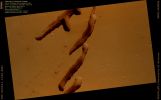
PSP_009913_1910_RED_abrowse-00.jpgFissures in Cerberus Fossae (natural colors; credits: Lunexit)65 visiteThis image shows an example of “en echelon” fractures in the Cerberus Fossae Region.
These fractures formed tectonically, meaning by the movement of Mars’ crust.
En "echelon" means that the fractures are laterally displaced from each other in a way consistent with the lateral displacement of other fractures in the same area.MareKromiumOtt 23, 2008
|
|
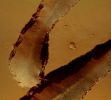
PSP_009913_1910_RED_abrowse-01.jpgFissures in Cerberus Fossae (Enhanced and Saturated Natural Colors; credits: Lunexit)63 visiteThe colors in this frame result from differences in composition of the materials and ALSO represent how the landscape would appear to the human eye. Note that one can make out boulders and small dunes at the bottom of these fractures and layering within the walls. Just visible at the top of the image is some well-preserved impact crater ejecta.
The image is 1,2 Km across.MareKromiumOtt 23, 2008
|
|
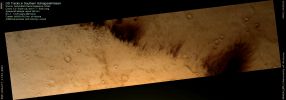
PSP_006477_1745_RED_abrowse-00~0.jpgDD Tracks in Southern Schiaparelli Basin (context frame - False Colors; credits: Lunexit)58 visiteDust-Devils (DD) are vortices of wind that form when air rising from a warm surface encounters shear in the above atmosphere.
Martian Dust-Devils can attain gargantuan proportions, reaching the size of terrestrial tornadoes with plumes that tower up to 9 Km above the surface.
Dust-Devils play an important role in sustaining the aerosols that make up Mars’ Red Sky and in cleaning the Martian Surface after a Dust Storm.
Nota Lunexit: sono quindi i DD, secondo la NASA, la "causa maggiore" del Cielo Rosso di Marte? Interessante riflessioni ed interessante quesito: dunque il Cielo di Marte NON E', naturalmente, "rosso" o "arancio", ma è "tinto di rosso/arancio"!
Pensateci sopra...
MareKromiumOtt 20, 2008
|
|

PIA10148-LizardSkinTerrain~0.jpgLizard-Skin Surface Texture (natural colors; elab. Lunexit)57 visite The South Polar Region of Mars is covered seasonally with translucent CO2 ice.
In the Spring, gas subliming (evaporating) from the underside of the seasonal layer of ice bursts through weak spots, carrying dust from below with it, to form numerous Dust Fans aligned in the direction of the prevailing wind.
The dust gets trapped in the shallow grooves on the surface, helping to define the small-scale structure of the surface. The surface texture is reminiscent of lizard skin.MareKromiumOtt 17, 2008
|
|
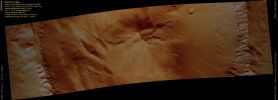
Psp_009677_2135_red.jpgBacolor Crater (natural colors; credits: Lunexit)58 visiteBacolor Crater is a pristine crater in the Northern Hemisphere. The linear striations visible at both sides (Sx and Dx) of the image are from the blast of the formation impact. This crater has a Central Peak, other mounds and terraces on its floor.
All of these features appeared during the final stages of crater formation.
The Northern Wall of the crater has landslides which have sculpted the Crater Rim. The Southern Wall has Gullies, thought to form by fluvial processes.
The Gullies here are more incised (cut into the slope) than the landslides are.MareKromiumOtt 17, 2008
|
|

Psp_009855_2625_red.jpgUnusually-looking "Mound" in the NPLD (natural colors; credits: Lunexit)69 visiteThe North Polar Layered Deposits (NPLD) are composed of a stack of ice-rich layers that is up to several kilometers thick. Each layer is thought to contain information about the climate that existed when it was deposited, so the stack of layers within the NPLD may represent a record of how climate has varied on Mars in the recent past.
We can see these internal layers exposed in the many troughs and scarps that have been cut by erosion into the stack. One of these troughs, visible in this image, contains a 500 meter (1640 feet) thick section of this layering.
However, the layers are not the only interesting thing being shown here. There is a conical mound part-way down the slope that is approximately 40 m (130 ft) high. One possible explanation for this anomaly is that it may be the remnant of a buried impact crater that is now being exhumed. As the NPLD accumulated, impacts occurred throughout its surface which were then buried by additional ice. These buried craters are generally inaccessible to us, but in a few rare locations, erosion that forms a trough (like this one) can uncover these buried structures. For reasons that are poorly understood right now, the ice beneath the site of the crater is more resistant to this erosion, so when material is removed in forming the trough the ice beneath the old impact site remains, creating this isolated hill.
An inspection of the full-resolution data shows that polygonal blocks, up to 10 mt (33 feet) across, make up this mound. Although covered with reddish dust, the blocks resemble ice-rich blocks seen in other exposures of the NPLD.MareKromiumOtt 17, 2008
|
|
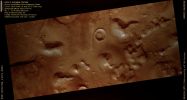
PSP_009708_2205_RED_abrowse-00.jpgHills in Acidalia Planitia (CTX Frame - Enhanced and Darkened Natural Colors; credits for the additional process. and color.: Dr Paolo C. Fienga - Lunexit Team)58 visiteThe hilly landscape visible in this observation may appear at first rather bleak, due to the pervasive soils of uniform brightness blanketing most of the area.
However, upon closer examination, the image reveals rocky outcrops at the top of some of the hills.
These rocks contain clues pointing to a watery past.MareKromiumOtt 17, 2008
|
|
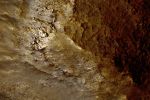
PSP_009708_2205_RED_abrowse-01.jpgHills in Acidalia Planitia (EDM - Enhanced Natural Colors; credits for the additional process. and color.: Dr Paolo C. Fienga - Lunexit Team)58 visiteThis edm frame (375x250 meters, or 410x273 yards) of the HiRISE depicts in detail the rocky layers existing in one of these hills.
CRISM, another of the instruments onboard Mars Reconnaissance Orbiter, has acquired data over this same region showing that the rocky outcrops contain clays. Clays of similar composition form in terrestrial environments favorable for life, where volcanic rocks are in close contact with water.MareKromiumOtt 17, 2008
|
|
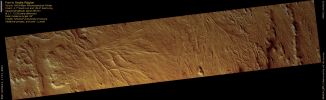
Psp_009623_1755_red.jpgFan in Aeolis Planum Region (natural colors; credits: Lunexit)58 visiteThis image shows a "Fan" of long raised ridges in the Aeolis Region of Mars.
These ridges are thought to be Inverted Stream Channels, where formerly low-lying streambeds have been hardened and then turned into ridges when the surrounding material was eroded.
This can occur if the stream deposited minerals, filling in pore spaces and hardening the streambed.
The assortment of ridges here is extremely complex, with strands cutting across each other. However, the actual stream system here could have been simpler, with ridges preserving different time periods in the history of the system. This possibility is supported by several sites where one ridge runs smoothly across another without disruption. One way for this to occur would be to have one streambed hardened and buried, with the stream subsequently changing course and cutting across its buried old route.
Although not all of the channels were active at once, this site clearly preserves a complex history, probably requiring thousands of years to foMareKromiumOtt 17, 2008
|
|
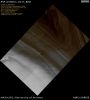
PSP_009663_2635_RED-00.jpgSmall Crater on the North Polar Layered Deposits (CTX Frame - Saturated and Enhanced Natural Colors; credits for the additional process. and color.: Dr Paolo C. Fienga - Lunexit Team) 58 visiteThe North Polar Layered Deposits, and the bright Ice Cap that covers them, are very young (by geologic standards) features. To try and figure out the age of an area, or how quickly it's being resurfaced, planetary scientists count up the number of craters at different sizes. An older surface has more time to accumulate more craters whereas a younger surface, or one that has a lot of geologic activity that destroys craters, doesn't have many impact craters.
These Polar Deposits have a very low crater count so it is possible that the Ice Cap (bright white in this image) might only by about 10.000 years old and the surface of the layered deposits (orange-brown in this image) may be only a few million years old.
This sounds like a long time but is very short compared to other surfaces on Mars.
HiRISE is enabling a more detailed study of these Polar Craters and the target of this observation is visible in the center of the image.MareKromiumOtt 17, 2008
|
|
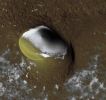
PSP_009663_2635_RED-01.jpgSmall Crater on the North Polar Layered Deposits (EDM - Enhanced Natural Colors; credits for the additional process. and color.: Dr Paolo C. Fienga - Lunexit Team) 58 visiteThis crater proved to be a surprise in a few ways. Its shape is non-circular which is quite unusual for an impact crater. One possibility is that flow of the ice beneath the surrounding terrain has deformed the crater; however, ice-flow rates are thought to be very low on Mars today.
The crater also contains a patch of bright ice despite being surrounded by terrain that has mostly lost its ice cover. This seems typical for these polar craters and it may be that ice within these craters is protected from ablation by shading from the crater walls.MareKromiumOtt 17, 2008
|
|
| 2237 immagini su 187 pagina(e) |
 |
|
|
|
|
152 | |
|
|
|
|





