| Ultimi arrivi - Mars Reconnaissance Orbiter (MRO) |

Psp_009799_2205_red.jpgFeatures of Deuteronilus Mensae (natural colors; credits: Lunexit)73 visiteThis image shows Lineated Valley Fill and Lobate Debris Aprons in the Deuteronilus Mensae Region. Deuteronilus Mensae is located on the northern edge of Arabia Terra and borders the high-standing, heavily-cratered Southern Hemisphere and the low, uncratered plains that cover most of the Northern Hemisphere of Mars.
The Region is characterized by Hills and Mesas surrounded by debris Slopes and broad Valleys.
Many of the valley floors in the Deuteronilus Mensae Region exhibit complex alignments of small Ridges and Pits often called “Lineated Valley Fill”.
The cause of the small-scale texture is not well understood, but may result from patterns in ice-rich soils or ice loss due to sublimation (ice changing into water vapor).
The linear alignment may be caused by downhill movement of ice-rich soil or by glacial flow.
For example, flowing ice on Earth typically develops wrinkles or ridges and pits due to stresses in the ice as it moves.
The result is flow patterns, called “stream lines” that follow the valleys and curve around obstacles. In this image, stream lines are diverted or curve around the Mesas.
The mesas in this image are also surrounded by aprons of debris that appear to have flowed away from the Mesa. Recent results from the SHAllow RADar (SHARAD) instrument, another instrument onboard the Mars Reconnaissance Orbiter, indicate that lobate debris aprons in Deuteronilus Mensae, similar to those visible here, are composed of material dominated by ice [Plaut et al., 2008] and are interpreted to be potential debris-covered glaciers or rock glaciers.
The Debris Aprons in this image appear to lie on top of the Lineated Valley Fill and are therefore probably younger deposits.MareKromiumOtt 30, 2008
|
|
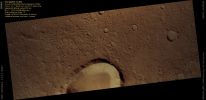
Psp_009665_1525_red.jpgElongated Crater (natural colors; credits: Lunexit)61 visiteThis scene captures about half of a crater with an elongated rim.
When craters form, they typically have a circular shape. This crater has been modified since it formed, possibly by tectonic processes or excavation, although its raised rim indicates that these processes have not heavily eroded the rim since formation.
The terrain surrounding the crater consists of megaripples, degraded craters, and rough terrain, possibly due to ancient lava flows from the nearby Hadriaca Patera.
Determining the age of these features and the processes that formed them may be possible; one such process is the interaction between the ripples and bedrock. The Transverse Aeolian Ripples (or "TARs") with a N-S wind direction appear to be lithified because the rugged bedrock, impact craters, and ejecta overlay the ripples, indicating that the ripples are older.
In the larger craters, brighter (possibly newer) ripples suggest a dominant wind direction from the North-West.MareKromiumOtt 30, 2008
|
|
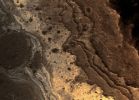
PIA11377.jpgMartian "Opal" (natural colors; credits: Lunexit)64 visiteNASA's Mars Reconnaissance Orbiter has revealed Martian rocks containing a hydrated mineral similar to Opal.
The rocks are light-toned and appear cream-colored in this natural-color image taken by the High Resolution Imaging Science Experiment (HiRISE) camera. Images acquired by the orbiter reveal that different layers of rock have different properties and chemistry.
The Opal minerals are located in distinct beds of rock outside of the large Valles Marineris Canyon System and are also found in rocks within the canyon. The presence of opal in these relatively young rocks tells scientists that water, possibly as rivers and small ponds, interacted with the surface as recently as two billion years ago, one billion years later than scientists had expected.
The discovery of this new category of minerals spread across large regions of Mars suggests that liquid water played an important role in shaping the Planet's Surface and possibly hosting life. MareKromiumOtt 29, 2008
|
|

PSP_009739_2580_RED_abrowse-2.jpgResidual Ice (edm - natural colors; credits: Lunexit)58 visiteIl dettaglio, palese tanto nella versione in b/n del frame, quanto in quella a colori naturali, è stato individuato dal bravissimo Dr Barca e, inizialmente, ci ha fatto pensare ad una possibile estrusione d'acqua la quale, poco dopo essere stata "espulsa", si è rapidamente congelata.
Ma sbagliavamo, poichè non si tratta, a nostro parere, del residuo di un fenomeno estrusivo.
Non lo è, perchè le estrusioni d'acqua (e fango) si manifestano - di solito, e "visivamente" - con accumuli caotici di blocchi di ghiaccio sporco di varie dimensioni intorno ad un'area di ghiaccio più limpido la quale è compatta e posizionata centralmente rispetto agli altri blocchi e blocchetti (provate a visualizzare, per capire bene, la conseguenza di uno "spruzzo" - tipo geyser - di acqua e fango, con l'acqua che poi gela rapidamente).
In Islanda, se volete, si può vedere qualcosa di simile.
Nel nostro caso di specie, comunque, si può dire che la posizione del dettaglio in oggetto è indicativa di un'area su cui si trova del semplice ghiaccio "sporco" (ghiaccio d'acqua, a giudicare dall'albedo e dal colore) residuale, sfuggito al disgelo grazie alla protezione offertagli dalla duna che lo sovrasta.
La configurazione delle dune che caratterizzano la zona, inoltre, ci dice che l'area gelata è posizionata su una superficie decisamente più bassa rispetto al Datum medio della regione, e quindi con niente (o poco) Sole che scioglie e niente (o poco) vento che "gratta & smuove".
Un accumulo di ghiaccio, quindi, destinato a "sopravvivere" MOLTO a lungo!...MareKromiumOtt 25, 2008
|
|
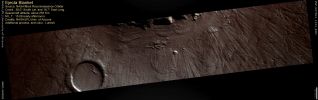
PSP_007822_1415_RED_abrowse~0.jpgEjecta Blanket (MULTISPECTRUM; credits: Lunexit)81 visiteThe Ejecta Blanket of a large (20 Km diameter) impact crater is shown here in vivid detail. The ejecta formed strong linear patterns in the topography that extend radially outward from the crater. This ejecta is rocky material that was ejected from the crater as a result of the high-velocity impact of an object about 100-200 meters in diameter, which probably escaped from the asteroid belt.
Since the impact event, this ejecta has been subject to millions of years of wind erosion that may have etched the surface and accentuated the radial pattern. There are also small-scale landforms such as fractured mounds that may have formed due to the presence of subsurface ice (note: this is a so-called "periglacial phenomenon"). MareKromiumOtt 25, 2008
|
|
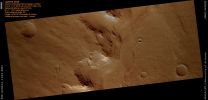
Psp_009601_1920_red.jpgLayered Shelf (possible natural colors; credits: Lunexit)59 visiteThis image shows the edge of a Layered Shelf in a large Impact Crater. Sediments form a bench with a flat top and steep edge along part of the interior wall. This site shows part of the steep edge of those deposits.
The bench is formed by an upper layer that is relatively hard and resistant, while lower rocks are soft. Once the upper cap layer is removed, the weaker material below is easily eroded. This structure can be seen here: at the very top of the bench is a relatively steep lip, while material below has a muted appearance. A few steep outcrops lower on the slope suggest that there could be other strong layers.
Because of pervasive dust cover, it is difficult to learn much about the nature of the rocks here. Dust builds up by settling out after the many large Martian Dust Storms. (The dark streaks running downhill are seen in many dusty parts of Mars and are thought to be traces of dust avalanches). However, some small-scale structures are visible through the dust. Some fine layering is also visible, particularly near the base of the slope.
The layers are probably still covered by dust, but not enough to completely obscure the underlying structure.MareKromiumOtt 23, 2008
|
|
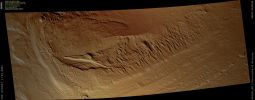
PSP_009927_1750_RED_abrowse-00.jpgExposed Layers in Gale Crater (Enhanced Natural Colors; credits: Lunexit)59 visiteGale Crater contains a massive central mound of layered material that has an average vertical thickness of almost 4 Km (about 2,4 miles), making it more than twice as thick as the layers exposed along the Grand Canyon on Earth.
Gale Crater is approximately 152 Km in diameter.MareKromiumOtt 23, 2008
|
|
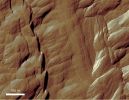
PSP_009927_1750_RED_abrowse-01.jpgExposed Layers in Gale Crater (EDM- Enhanced Natural Colors; credits: Lunexit)60 visiteThis edm is a small portion of a HiRISE image detailing the fine-scale layering evident in the upper mound. The layered deposits can be divided into 2 types: a lower mound with near-horizontal, flat layers, and an upper mound with more numerous, thinner layers (some of which have greater degree of tilt than the lower layers).
The origin of these thin, repetitive layers is unknown, but they likely reflect environmental changes that occurred while the layers were being deposited.
Today, erosion by wind scour has shaped them into the stair-step pattern that is reminiscent of parts of the American South-West.MareKromiumOtt 23, 2008
|
|
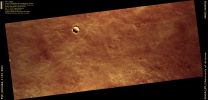
PSP_009488_1745_RED_abrowse-00.jpgMartian Caves (ctx frame - possible natural colors; credits: Lunexit)58 visitePit Craters exist in Volcanic Regions across Mars, and form when surface materials collapse into large underground cavities. Such pits are generally bowl-shaped, filled with sediment, and are relatively shallow when compared with their diameters.
Recently, a small number of anomalous Pit Craters were identified with strikingly different visible and thermal characteristics such as: sheer cliff walls; deep interiors that can extend out-of-sight beneath the surface and temperature fluctuations that behave unlike any known feature on Mars.MareKromiumOtt 23, 2008
|
|

PSP_009488_1745_RED_abrowse-01.jpgMartian Caves (edm n. 1 - possible natural colors; credits: Lunexit)57 visiteThe pair of Pit Craters visible here are the smallest “anomalous” pits known to exist at this time. These have either vertical or sub-vertical interior walls (sub-vertical means that they are not visible from a nearly overhead viewing perspective), and each pit is deep enough that sunlight does not hit the floor when the Sun is at or near the Zenith.
Unfortunately, the only thermal-infrared camera currently orbiting Mars cannot resolve features this small, so the temperature characteristics of these pits must remain unknown for now, underscoring the need for a high-resolution thermal instrument on future missions.
Intriguingly, when pit craters on Earth have similar characteristics to the pair shown here, they often have cave entrances in their bases connecting to large underground networks. Current investigations are determining whether the anomalous Martian Pits may be shown to contain such entrances.MareKromiumOtt 23, 2008
|
|

PSP_009488_1745_RED_abrowse-02.jpgMartian Caves (edm n. 2 - possible natural colors; credits: Lunexit)65 visiteThe ability to detect and explore Martian caves is of intense interest to many disciplines in Planetary Science. Caves, in fact, may expose entire sets of stratigraphic layers, providing windows into Mars’ Geologic and Atmospheric histories.
MareKromiumOtt 23, 2008
|
|

PSP_009488_1745_RED_abrowse-03.jpgMartian Caves (edm n. 3 - possible natural colors; credits: Lunexit)57 visiteCave environments can also protect organic life from extremely harsh conditions on the Martian Surface, and may provide future human explorers with secure habitats. Accordingly, caves are considered among the most promising locations to find preserved evidence of past or present microbial life.
Furthermore, the challenges associated with Mars cave exploration may inspire a full range of new technologies, such as advanced robotics and target-specific landing capabilities.MareKromiumOtt 23, 2008
|
|
| 2237 immagini su 187 pagina(e) |
 |
|
|
|
|
151 | |
|
|
|
|





