| Ultimi arrivi - Mars Reconnaissance Orbiter (MRO) |
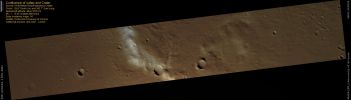
Psp_009669_1500_red.jpgConfluence of Valley and Crater (natural colors; credits: Lunexit)58 visiteThis image shows the South-Eastern Rim of a large degraded Impact Crater where a Valley breaches the Crater Rim. The Valley itself, no longer pristine, is difficult to locate in the image.
However, it appears to be in the center, near the right of the Crater Rim. It is possible that this Valley transported water into the Crater, forming a lake in the ancient past.
The scene is peppered with craters of various sizes and states of degradation, indicating that the surface is not young.
A few craters are young enough to still have raised rims. One of these, located on the floor of the larger crater, has distinct raised ejecta radiating out from it.
The crater also has dunes on its floor, indicating that aeolian processes have modified it since it formed.MareKromiumNov 07, 2008
|
|
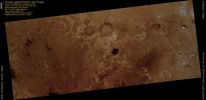
PSP_009929_2020_RED_abrowse-00.jpgAncient Layered Rocks in Nili Fossae (ctx frame - natural colors; credits: Lunexit)57 visiteThis image covers a flat plain in the Nili Fossae Region of Mars. The portion shown here is roughly 400 meters, or 1/4 of a mile, across.MareKromiumNov 07, 2008
|
|

PSP_009929_2020_RED_abrowse-01.jpgAncient Layered Rocks in Nili Fossae (edm - natural colors; credits: Lunexit)66 visiteBright, fractured Bedrock is visible underlying Dunes or Ripples of Wind-Blown Sand.
The parallel, dark brown curves across the Bedrock Surface (underneath the Dunes) that can be seen in this edm frame, are the edges of successive rock layers.
These may appear dark because dark sand has become trapped at the edges of the layers. Successive layers in the bedrock are also exposed in the walls of degraded impact craters elsewhere in the ctx image.
The Layered Rocks here are billions of years old, and infrared spectra from the CRISM instrument have inferred that they contain minerals such as Clays and Carbonate that likely formed when liquid water chemically altered these rocks.
This evidence for past water activity, combined with the general flatness of this particular location, make it a good candidate Landing Site for future Mars Rover missions.MareKromiumNov 07, 2008
|
|
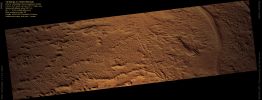
PSP_009966_1735_RED_abrowse-00.jpgInverted Channels and Yardangs in Aeolis Mensae (ctx frame - natural colors; credits: Lunexit)60 visiteThis image shows wind-eroded Layered Deposits in Aeolis Mensae. Aeolis Mensae is located close to the Volcanic Region of Elysium Planitia and near the boundary of the high-standing, heavily cratered Southern Hemisphere and the low, sparsely-cratered plains that cover most of the Northern Hemisphere of Mars.
MareKromiumNov 07, 2008
|
|

PSP_009966_1735_RED_abrowse-01.jpgInverted Channels and Yardangs in Aeolis Mensae (edm - natural colors; credits: Lunexit)61 visiteAeolis Mensae is well-known for its unusual features commonly related to wind activity on the Planet’s Surface. Near the bottom of the image (see the edm here) is a long, sinuous, flat-topped feature that has been exposed by wind erosion.
This sinuous ridge is one of several similar ridges in the region that are believed to be former stream channels now preserved in inverted relief.
On Earth, inverted relief occurs when formerly low-lying areas become elevated because the original depression is filled with materials, such as lava, that are more resistant to erosion than the surrounding terrain. In the case of stream channels, the streambed may contain larger rocks and/or sediments that have been cemented by chemicals precipitating from flowing water that remain, while adjacent fine material is blown away by the wind. In this location, it is most likely that water once flowed through this channel and deposited sediments that eventually filled the channel and became cemented.
Over time, wind eroded the surrounding surface leaving the remnant channel exposed as a raised flat-topped ridge.
On either side of the Inverted Channel and throughout the image are several linear, streamlined ridges oriented roughly South to North. These are Yardangs, such as streamlined remnants of material shaped by the action of sand-blown sediments that eroded away weaker material.
Landforms such as these are common in desert areas on Earth. The orientation of the Yardangs indicates the primary wind direction.MareKromiumNov 07, 2008
|
|
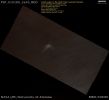
PSP_010180_2645_RED_abrowse-00.jpgSmall and young Impact Crater in the NPLD (ctx frame - natural colors; credits: Lunexit)59 visiteThis image shows a small impact crater on the bright North Polar Perennial Ice Cap. Mars has Ice Caps at both its North and South Poles.
The Perennial, or Permanent, portion of the North Polar Cap consists almost entirely of water ice.MareKromiumNov 06, 2008
|
|

PSP_010180_2645_RED_abrowse-01.jpgSmall and young Impact Crater in the NPLD (edm - natural colors; credits: Lunexit)56 visiteThe Impact Crater is about 66 meters (215 feet) in diameter. Ejecta from this Crater can be seen extending primarily to the North-West.
The asymmetry in the crater ejecta can be an effect of atmospheric winds associated with the impact itself but, in this case, is most likely the result of an oblique impact (a low impact angle with respect to the horizontal).
As impact angles decrease, the ejecta blanket is increasingly offset downrange.
The impactor that formed this crater approached the surface from the South-East. The slightly elliptical shape of the crater is also a result of an oblique impact.MareKromiumNov 06, 2008
|
|

PSP_010057_2040_RED.JPGUnnamed Crater with Ridges and DD Tracks (natural colors; credits: Lunexit)59 visiteThis image shows two features of interest on the floor of a large impact crater. The first is the set of roughly parallel ridges on the crater floor that point towards the crater center north of the image. These may be Inverted Stream Channels, where old streambeds became resistant to erosion due to cementation or simply deposition of large rocks. This is consistent with the slightly wavy, sinuous shape of the ridges, but these examples are not particularly well-preserved.
More recently, this site has become blanketed by dust, settling out after Global Dust Storms. This obscures much of the fine-scale geology, but allows HiRISE to see the effects of a recent process: Dust Devils. These have left the dark stripes across the surface by disturbing the dust cover. Most followed straight paths, but a few loops or turns are visible. Dust Devils may be an important factor in the Martian climate system because they lift dust into the atmosphere, helping to trigger larger Dust Storms.MareKromiumNov 06, 2008
|
|
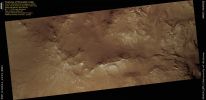
PSP_010012_2225_RED_abrowse-00.jpgDeep Rocks Unveiled at Bonestell Crater (ctx frame; natural colors; credits: Lunexit)58 visiteImpact craters are sometimes nicknamed “Mother Nature's drill holes” because, thanks to them, deep rock formations are exposed at the surface. Bonestell Crater is a good example.
This image depicts part of the floor of this relatively young impact crater located in the Northern Lowlands. The Northern Lowlands occupy most of the northern half of Mars. They are younger than the Southern Highlands, as shown by the lower number of impact craters, and well below the Planet’s Average Elevation. Their origin is still a mystery.
Bonestell is about 42 Km (approx. 26 miles) in diameter and about 1250 meters (4100 feet) deep. The rocky hills on the floor of this crater constitute its “Central Peak”.
Central peaks form due to elastic rebound of subsurface materials immediately after impact. The rocks in Bonestell's Central Peak may have been 4-to-8 Km below the surface before impact.MareKromiumNov 06, 2008
|
|
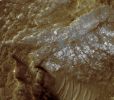
PSP_010012_2225_RED_abrowse-01.jpgDeep Rocks Unveiled at Bonestell Crater (edm; natural colors; credits: Lunexit)57 visiteThis edm (437x500 mt or 479x547 yards) of the HiRISE image shows a portion of Bonestell's Central Peak. HiRISE reveals details in the structure and color of these deep rocks that will help scientists decipher the origin and history of the Northern Lowlands.MareKromiumNov 06, 2008
|
|
Psp_007242_2650_red.jpgChasma Boreale (natural colors; credits: Lunexit)59 visitenessun commentoMareKromiumNov 06, 2008
|
|
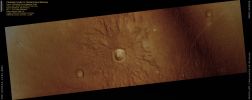
Psp_009654_2245_red.jpgPedestal Crater in Deuteronilus Mensae (natural colors; credits: Lunexit)59 visiteThis crater with spectacular ejecta is located in the Northern Mid-Latitudes in the Deuteronilus Mensae, located near the dichotomy boundary, where the Southern Highlands transition into the Northern Lowlands.
The crater has raised, fluidized ejecta. Scientists think that fluidized ejecta forms when an impact occurs into ice-rich material. The interior of the crater shows some material, particularly on the West wall, that has detached and is flowing into the crater center. This suggests the presence of ground ice.MareKromiumNov 06, 2008
|
|
| 2237 immagini su 187 pagina(e) |
 |
|
|
|
|
150 | |
|
|
|
|





