| Ultimi arrivi - Mars Reconnaissance Orbiter (MRO) |

PSP_006969_1725_RED_abrowse-00.jpgThe Floor of Noctis Labyrinthus (context frame - MULTISPECTRUM; credits: Lunexit)59 visiteThis image shows part of Noctis Labyrinthus, the “Labyrinth of the Night.” This is a system of connecting troughs which form a maze-like network at the western end of Valles Marineris, the giant canyon system of Mars.
The individual troughs are usually kilometers across; this image shows part of the floor of one of the troughs, with some intriguing fine-scale features.
Near the center of the image, the floor is broken up into many small knobs and hills, probably eroded remnants of a larger geologic unit.MareKromiumNov 17, 2008
|
|

PSP_006968_1735_RED_abrowse~0.jpgMound of Layers in East Candor Chasma (MULTISPECTRUM; credits: Lunexit)59 visiteThis image shows the Northern portion of East Candor Chasma, part of the Valles Marineris Canyon System. In the center of the image is a light-toned mound that has dozens of layers exposed along its edge. As the upper layers weather and break apart into smaller grains, these grains subsequently fall down the edge, burying layers beneath and producing triangular-shaped debris aprons.
The color image of the mound doesn’t show any significant color variations between the different layers.
However, another instrument on MRO called CRISM (Compact Reconnaissance Imaging Spectrometer for Mars) has observed compositional differences between the layers and these results have been helpful in deciphering the origin of these layers.
This deposit is one of several examples exhibiting sulfate-rich layers with alternating hydration states. Cliff-forming Kieserite-rich layers alternate with slope-forming polyhydrated sulfate layers. (Kieserite is a mineral containing Magnesium).
The apparent lack of slumping, channels, cross-bedding or bed truncation supports quiescent water or deposition from the air as the most likely origin for the layers.MareKromiumNov 17, 2008
|
|

PSP_008598_2155_RED_abrowse~0.jpgLineated Valley Fill in Coloe Fossae (MULTISPECTRUM; credits: Lunexit)68 visiteThis Region consists of several relatively straight and narrow canyons located near the boundary between the high-standing, heavily cratered areas of the Southern Hemisphere and the low, uncratered plains that cover most of the Northern Hemisphere of Mars.
Transitional areas such as this are known as the “Fretted Terrain” and are characterized by a complicated mix of cliffs, mesas, buttes, and canyons.
This image reveals a canyon with relatively steep and smooth walls. The floor of the canyon displays a complex set of ridges and grooves that are generally parallel to the canyon walls.
The material comprising the canyon floor is common observed in Fretted Terrain and is called "Lineated Valley Fill" (LVF).
The cause of the LVF texture is not well understood but may result from patterns of ice rich soils or ice loss. The linear alignment may be caused by the downhill movement of ice-rich soil, or glacial flow in dirty ice or ice-rich soil.MareKromiumNov 17, 2008
|
|

PSP_010052_1560_RED.jpgFeatures of Eberswalde Crater (natural colors; credits: Lunexit)58 visiteEberswalde Crater is an approx. 65-Km diameter, closed Basin Crater. It contains a delta, which indicates that flowing water was present for an extended period of time in the past.
Parts of the Crater have inverted channels that have higher relief because a more resistant material was deposited in the channel and therefore it was less susceptible to erosion than the surrounding area. The image also shows resistant knobs and mounds as well as a scoured surface.
The CRISM instrument on-board MRO has detected Phyllosilicates (Clays) in some of the bright layers here. On Earth, clays form in the presence of water, so this is more evidence that there was a persistent flow of water in Eberswalde.MareKromiumNov 13, 2008
|
|

PSP_010090_1255_RED.jpgSpring over Russel Crater (natural colors; credits: Lunexit)60 visiteSpring is already starting to show its influence at the Russell Crater field of sand dunes. Channels down the face of the largest dune show dark spots where the sublimation of the seasonal carbon CO2 Ice Cap has begun.
This active process (where ice evaporates directly to gas) dislodges loose material, leaving dark streaks down steep slopes. The process starts when the Sun peeks above the horizon at the end of Antarctic Night.
Bright streaks may be loose frost cascading down steep slopes.MareKromiumNov 13, 2008
|
|
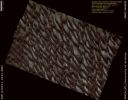
PSP_010071_2615_RED.jpgGypsum-rich Dunes in Olympia Undae Region (natural colors; credits: Lunexit)60 visiteIn this enhanced-natural color image are dunes within the largest collection of dunes on Mars, Olympia Undae, near the margin of the North Polar Layered Deposits, Planum Boreum.
This section of Olympia Undae is particularly interesting because the dunes are rich in Gypsum (---> Gesso), a mineral that forms in the presence of water. The material comprising these dunes is thought to have eroded from geologic units near the base of the NPLD, but these units have poor to no gypsum content.
Therefore, water likely affected these dunes after the sand had eroded out from the NPLD. Several ideas have been proposed to explain the formation of Gypsum, including hydrothermal (hot water) activity and melting of water-ice in the NPLD.
While gypsum dunes on Earth (for example, at White Sands, New Mexico) are white (the color of Gypsum), these Martian Dunes are dark due to the presence of basaltic grains that lower the brightness of the dunes.
CRISM, another instrument on MRO, has found that the crests of the dunes are the most Gypsum-rich. So, what is the bright, polygonally-fractured material in the low spaces between the dunes?
Perhaps it is Polar Ice lying beneath, desiccated (dried) gypsum material whose fine grain size makes it difficult for CRISM to detect, or something else altogether.MareKromiumNov 13, 2008
|
|
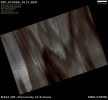
PSP_010086_2615_RED.jpgInfilled Crater on the North Polar Layered Deposits (natural colors; credits: Lunexit)58 visiteThe Polar Deposits of Mars are among the most geologically active on the Planet today. This image illustrates several processes affecting the Polar Landscape both today and in the recent past.
Frost streaks cross this image from lower left to lower right and are a testament to the power of the wind to redistribute material in this Region. In the center of the image lies an impact crater about 130 meters across (425 feet). Craters on the Polar Deposits are rare because the very active surface processes remove them quickly. This particular crater is likely to have been formed less than 100.000 years ago, which is very recent in geologic terms.
Streaks of material emanating from the crater rim have been created as the ice and dust being transported across the surface by the wind encounters that obstacle.
Although its initial depth was probably about 25 m (80 ft), the crater has been infilled with ice and dust and is now quite shallow. However, in one portion of the crater (upper area), the fill material has been removed, creating a pit adjacent to the crater wall. This pit contains a fresh deposit of ice and may be in the beginning stages of being infilled again. These cycles of infilling and erosion will eventually erase the crater from the landscape.
Scientists can examine many of these craters at different stages in their lifespan, from the very fresh to the almost erased. Using these data we can make estimates of how active this part of the Martian Surface is today.
Of course we need to find these rare craters first! Craters this size are usually about 200 Km (approx. 125 miles) apart in this Region, with the intervening landscape being relatively featureless.MareKromiumNov 13, 2008
|
|

PSP_010027_1745_RED.jpgLayers in Candor Mensa (natural colors; credits: Lunexit)58 visiteThis image shows Layered Sedimentary Deposits in Candor Mensa, a broad plateau of thickly stacked sedimentary rocks in Candor Chasma, part of the giant troughs of Valles Marineris.
Valles Marineris is a system of tectonic depressions formed by down-dropping faults; the floors are among the lowest points on the surface of Mars, and may have once held lakes. Some sites show evidence for streams or rivers. The troughs may have also been sites of volcanic activity.
Currently, the deep floors contain massive deposits of bright sedimentary rocks. Some of the deposits are several kilometers thick, and have diverse composition and appearance. They were probably formed by many different processes in different environments.
At this site, most of the bright rocks exhibit a scalloped, patterned texture.
This is thought to be associated with low-density deposits undergoing wind erosion, although the process is still not well-understood. Despite this relatively uniform texture, some variations are evident. The Southern (left) part of the Deposit is relatively uniform, while the central portion appears to have thin layers.
On close inspection, the layers near the center of the image are all composed of the same material; they are probably visible due to slight topographic steps caused by variations in the strength of the rock. The layers have been highlighted by a mantle of dark, wind-blown sand ripples, which cover the flat parts of the stepped structure. At low resolution, this gives the appearance of alternating light and dark layers.
In the Northernmost part of the image (right), the sediments have an entirely different texture, ranging from massive to fractured. These sediments also show evidence of layering.
Interpretation of these sediments is complicated by younger mantling materials. In addition to the sand ripples (some of which may have hardened to rock), a relatively massive dark layer appears to cap or drape the deposit in many places, including the southern part of this image.MareKromiumNov 13, 2008
|
|

PSP_006487_1580_RED.jpgCollapse Features in Tyrrhena Patera (natural colors; credits: Lunexit)57 visiteIn this image you can notice a set of craters around the rim of Tyrrhena Patera. Tyrrhena Patera is a volcano in the Southern Highlands with shallow slopes, and only 2 Km (about 1,2 miles) of vertical relief.
The craters are aligned and are known as Pit Crater Chains. These are common in Volcanic Regions on Mars.
They are not formed by a meteorite impact, but by collapse into some void space underground.
Because the Pit Crater Chains and Concentric Fractures are generally aligned, these are most likely due to extension in the Region, where parts of the Martian Crust pull apart during growth of the volcano or emplacement of dikes.
Another way pit crater chains can occur is when Lava Tubes partially collapse forming chains of holes along the roof of the Lava Tubes themselves.
A third possibility is that these may be associated with collapse of the underground magma chamber.MareKromiumNov 13, 2008
|
|

PSP_010008_2630_RED.jpgStructure of the North Polar Layered Deposits (natural colors; credits: Lunexit)59 visiteThis image shows an exposure of the North Polar Layered Deposits (NPLD) within the Northern Residual Ice Cap. The NPLD are thought to have been formed by recent climate changes on Mars, like ice ages on Earth.
Scientists are studying the NPLD to learn more about these climate changes on Mars. In many places, the NPLD layers appear to extend over large areas, suggesting that they were deposited from atmospheric suspension. If the layers in this image are horizontal and continuous, the apparent curves are caused by erosion of valleys into the NPLD. To determine whether this is the case, HiRISE has acquired two images of this location to form a stereo pair. Analysis of this stereo pair will allow the orientation and thickness of the layers to be measured across the region of stereo coverage, constraining hypotheses for their formation.
Also visible in this image are bright and dark streaks that may be caused by the redistribution of frost by winds.MareKromiumNov 13, 2008
|
|

PSP_007392_2650_RED_abrowse~0.jpgNorthern Hemisphere Ice Cap (False Colors; credits: Lunexit)58 visiteThis image shows layering within the Northern Hemisphere Ice Cap, which probably reflects seasonal variability in accumulation of the ice versus sublimation (going from solid to a gas).
The presence of sand dunes indicates transport of sedimentary materials by wind. Erosion of layering is apparent as a series of undulating ridges at the transition between the Layered Terrain and the Dune-Field.
Near the top of the image several vents occur where materials from the shallow subsurface are erupted onto the surface. MareKromiumNov 09, 2008
|
|
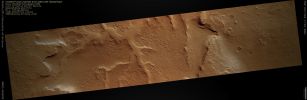
PSP_007394_1750_RED_abrowse~0.jpgInverted Fluvial Channels and Craters with Ejecta Rays (natural colors; credits: Lunexit)58 visiteThe lower part of this image shows well-defined overlapping channels, which have inverted topography (i.e.: they were once low spots that have been filled in with sediments and now eroded in a such a way that they appear as topographically high regions).
The channels have a winding and intersecting geometry indicating the shifting of the channels over time, a feature consistent with the flow of water in rivers. The channels have small craters that have excavated the channel materials and ejected them to form well-defined rays. There are dark slope streaks (toward the top of the image) showing transport of fine dust down the slope of an eroded bedrock terrain.MareKromiumNov 09, 2008
|
|
| 2237 immagini su 187 pagina(e) |
 |
|
|
|
|
149 | |
|
|
|
|





