| |

| Ultimi arrivi - Mars Reconnaissance Orbiter (MRO) |

PSP_005514_1360_RED_abrowse~0.jpgDunefield inside Rabe Crater (False Colors - elab. Lunexit)58 visiteThis image shows part of the floor of Rabe Crater, a large (about 108 Km, or approx. 67 miles in diameter) impact crater in the Southern Highlands.
Dark dunes — accumulations of wind blown sand — cover part of crater's floor and contrast with the surrounding bright-colored outcrops. The extreme close-up view reveals a thumbprint-like texture of smaller ridges and troughs covering the surfaces of the larger dunes.
These smaller ripples are also formed and shaped by blowing wind in the thin atmosphere of Mars.
One puzzling question is why the dunes are dark compared with the relative bright layered material contained within the Crater.
The probable answer is that the source of the dark sand is not local to this Crater; rather, this topographic depression has acted as a sand trap that has collected material being transported by winds blowing across the plains outside the Crater. MareKromiumDic 10, 2008
|
|

PSP_009313_1560_RED.jpgMars 6 Landing Region (natural colors; credits: Lunar Explorer Italia)75 visiteMars Local Time: 15:30 (middle afternoon)
Coord. (centered): 23,6° South Lat. and 341,2° East Long.
Spacecraft altitude: 259,9 Km (such as about 162,5 miles)
Original image scale range: 26,0 cm/pixel (with 1 x 1 binning) so objects ~78 cm across are resolved
Map projected scale: 25 cm/pixel
Map projection: EQUIRECTANGULAR
Emission Angle: 0,2°
Phase Angle: 70,3°
Solar Incidence Angle: 70° (meaning that the Sun is about 20° above the Local Horizon)
Solar Longitude: 102,0° (Northern Summer)
Credits: NASA/JPL/University of Arizona
Additional process. and coloring: Lunar Explorer ItaliaMareKromiumDic 09, 2008
|
|

PSP_009320_1805_RED.jpgLayering in Crater Wall (natural colors; credits: Lunar Explorer Italia)62 visiteMars Local Time: 15:26 (early afternoon)
Coord. (centered): 0,3° North Lat. and 147,2° East Long.
Spacecraft altitude: 273,0 Km (such as about 170,6 miles)
Original image scale range: 27,3 cm/pixel (with 1 x 1 binning) so objects ~54,6 cm across are resolved
Map projected scale: 25 cm/pixel
Map projection: EQUIRECTANGULAR
Emission Angle: 1,9°
Phase Angle: 53,9°
Solar Incidence Angle: 55° (meaning that the Sun is about 35° above the Local Horizon)
Solar Longitude: 102,2° (Northern Summer)
Credits: NASA/JPL/University of Arizona
Additional process. and coloring: Lunar Explorer ItaliaMareKromiumDic 09, 2008
|
|

PSP_009309_2725_RED.jpgHigh-Latitude Exposure of North Polar Layered Deposits (possible True Colors; credits: Lunar Explorer Italia)73 visiteMars Local Time: 19:52 (evening)
Coord. (centered): 87,5° North Lat. and 327,2° East Long.
Spacecraft altitude: 317,6 Km (such as about 198,5 miles)
Original image scale range: 31,8 cm/pixel (with 1 x 1 binning) so objects ~95 cm across are resolved
Map projected scale: 25 cm/pixel
Map projection: EQUIRECTANGULAR
Emission Angle: 5,2°
Phase Angle: 60,3°
Solar Incidence Angle: 64° (meaning that the Sun is about 26° above the Local Horizon)
Solar Longitude: 101,9° (Northern Summer)
Credits: NASA/JPL/University of Arizona
Additional process. and coloring: Lunar Explorer ItaliaMareKromiumDic 09, 2008
|
|

PSP_009311_1735_RED.jpgPeri-Equatorial Surface Features (possible True Colors; credits: Lunar Explorer Italia)69 visiteMars Local Time: 15:27 (early afternoon)
Coord. (centered): 6,5° South Lat. and 33,9° East Long.
Spacecraft altitude: 264,3 Km (such as about 165,2 miles)
Original image scale range: 26,4 cm/pixel (with 1 x 1 binning) so objects ~52,9 cm across are resolved
Map projected scale: 25 cm/pixel
Map projection: EQUIRECTANGULAR
Emission Angle: 3,0°
Phase Angle: 57,1°
Solar Incidence Angle: 59° (meaning that the Sun is about 31° above the Local Horizon)
Solar Longitude: 101,9° (Northern Summer)
Credits: NASA/JPL/University of Arizona
Additional process. and coloring: Lunar Explorer ItaliaMareKromiumDic 09, 2008
|
|
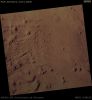
PSP_009304_2015_RED.jpgRidges in Olympus Mons Aureole (possible True Colors; credits: Lunar Explorer Italia)56 visiteMars Local Time: 15:21 (early afternoon)
Coord. (centered): 21,4° North Lat. and 221,3° East Long.
Spacecraft altitude: 283,8 Km (such as about 177,4 miles)
Original image scale range: 28,4 cm/pixel (with 1 x 1 binning) so objects ~85 cm across are resolved
Map projected scale: 25 cm/pixel
Map projection: EQUIRECTANGULAR
Emission Angle: 0,2°
Phase Angle: 46,1°
Solar Incidence Angle: 46° (meaning that the Sun is about 44° above the Local Horizon)
Solar Longitude: 101,7° (Northern Summer)
Credits: NASA/JPL/University of Arizona
Additional process. and coloring: Lunar Explorer ItaliaMareKromiumDic 09, 2008
|
|
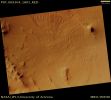
PSP_009304_1805_RED.jpgEquatorial Rocky Terrain (possible True Colors; credits: Lunar Explorer Italia)58 visiteMars Local Time: 15:25 (early afternoon)
Coord. (centered): 0,6° North Lat. and 223,9° East Long.
Spacecraft altitude: 269,2 Km (such as about 168,2 miles)
Original image scale range: 53,9 cm/pixel (with 1 x 1 binning) so objects ~1,62 mt across are resolved
Map projected scale: 50 cm/pixel
Map projection: EQUIRECTANGULAR
Emission Angle: 0,0°
Phase Angle: 55,1°
Solar Incidence Angle: 55° (meaning that the Sun is about 35° above the Local Horizon)
Solar Longitude: 101,7° (Northern Summer)
Credits: NASA/JPL/University of Arizona
Additional process. and coloring: Lunar Explorer ItaliaMareKromiumDic 09, 2008
|
|
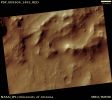
PSP_009304_1495_RED.jpgSmooth Hills (possible True Colors; credits: Lunar Explorer Italia)57 visiteMars Local Time: 15:31 (middle afternoon)
Coord. (centered): 30,2° South Lat. and 227,9° East Long.
Spacecraft altitude: 253,6 Km (such as about 158,5 miles)
Original image scale range: 50,7 cm/pixel (with 1 x 1 binning) so objects ~1,52 mt across are resolved
Map projected scale: 50 cm/pixel
Map projection: EQUIRECTANGULAR
Emission Angle: 0,3°
Phase Angle: 74,9°
Solar Incidence Angle: 75° (meaning that the Sun is about 15° above the Local Horizon)
Solar Longitude: 101,7° (Northern Summer)
Credits: NASA/JPL/University of Arizona
Additional process. and coloring: Lunar Explorer ItaliaMareKromiumDic 09, 2008
|
|

PSP_009304_2405_RED.jpgRocky Terrain in the Northern Plains (possible True Colors; credits: Lunar Explorer Italia)80 visiteMars Local Time: 15:07 (early afternoon)
Coord. (centered): 60,0° North Lat. and 214,8° East Long.
Spacecraft altitude: 311,3 Km (such as about 194,5 miles)
Original image scale range: 31,1 cm/pixel (with 1 x 1 binning) so objects ~93 cm across are resolved
Map projected scale: 25 cm/pixel
Map projection: EQUIRECTANGULAR
Emission Angle: 0,3°
Phase Angle: 47,9°
Solar Incidence Angle: 48° (meaning that the Sun is about 42° above the Local Horizon)
Solar Longitude: 101,7° (Northern Summer)
Credits: NASA/JPL/University of Arizona
Additional process. and coloring: Lunar Explorer ItaliaMareKromiumDic 09, 2008
|
|
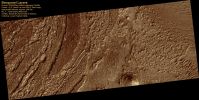
PSP_004078_2015_RED_browse-00.jpgLayered Deposits in Becquerel Crater (possible natural colors; credits: Lunar Explorer Italia)58 visiteImage PSP_004078_2015 shows light-toned layered deposits along the floor of Becquerel Crater, an impact crater in Arabia Terra. The deposits consist of stacked, repeating layers which consistently appear to be only a few meters thick.
The surface of the deposits also appears to be cracked into blocks a meter or so in length.
Layered deposits, such as these, form from sediments once deposited within the crater. Possible origins for the sediments include windblown debris, volcanic ash falling from the sky, or sediments that accumulated in a lake on the crater floor. The regular thickness of the layers suggests that they were most likely deposited in a water environment or by wind in a cyclic process.
Some of the layering has a dark appearance that produces an alternating bright-dark “zebra” banding. This may be the result of a thin surface layer of coarser and darker basalt sand collected on the more level surfaces, rather than indicating compositional differences in the eroded layered beds. Faults can also be seen displacing portions of the layered bed. An example of this can be seen just left of center in the bottom half of the subimage. The faulting indicates that the deposits have experienced disruption since their emplacement.
MareKromiumDic 08, 2008
|
|
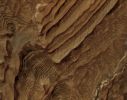
PSP_004078_2015_RED_browse-01.jpgLayered Rocks within Becquerel Crater (enhanced natural colors; credits: Lunar Explorer Italia)61 visiteRhythmic bedding in sedimentary bedrock within Becquerel Crater on Mars is suggested by the patterns in this image from the High Resolution Imaging Science Experiment (HiRISE) camera on NASA's Mars Reconnaissance Orbiter.
Three dimensional analysis based on stereo pairs of images confirmed the regularity of repetition in the thickness of the beds. In the left half of this image, some of the rhythm is apparent as a series of bundles of about 10 individual layers per bundle. By corresponding to a known 10-to-one pattern in changes in the tilt of Mars' Rotation Axis, this pattern suggests the periodicity in the rock layers results from cyclical changes in the Planet's tilt.
This view covers an area about 1150 meters (0,7 miles) wide. Individual layers in the scence average 3,6 meters (12 feet) thick. The view is presented in enhanced natural colors emphasizing the differing compositions of surface material. Sand trapped in relative low points in the terrain appears grey-blueish. Sedimentary rocks appear brown.
Faulting apparent in the image suggests that the deposits are hardened rock, not softer material. Tilting of the layers in different ways and the surface topography made the three-dimensional analysis necessary for determining the thickness of layers.
This image is a portion of the HiRISE image catalogued as PSP_004078_2015, taken on June 10, 2007.
The location of the imaged area is at 22° North Latitude, 352° East Longitude, within the Arabia Terra Region.MareKromiumDic 06, 2008
|
|

Psp_001860_1685_red.jpgLight-colored terrain in the Southern Highlands (possible True Colors; credits: Lunar Explorer Italia)58 visiteThis HiRISE image shows part of the floor of a large impact crater in the southern highlands, north of the giant Hellas impact basin. Most of the crater floor is dark, with abundant small ripples of wind-blown material. However, a pit in the floor of the crater has exposed light-toned, fractured rock.
The light-toned material appears fractured at several different scales. These fractures are called joints, and result from stresses on the rock after its formation.
Joints are similar to faults, but have undergone virtually no displacement. With careful analysis, joints can provide insight into the forces that have affected a unit of rock, and thus into its geologic history. The fractures appear dark; this may be due to trapping of dark, wind-blown sand in the crack, to precipitation of different minerals along the fracture, or both.MareKromiumNov 30, 2008
|
|
| 2237 immagini su 187 pagina(e) |
|
|
|
|
|
146 | |
|
|
|
|
|
|





