| |

| Ultimi arrivi - Mars Reconnaissance Orbiter (MRO) |
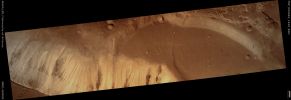
Psp_009683_1830_red.jpgPossible "Intravalley Paleolake" in Shalbatana Vallis (possible True Colors; credits: Lunar Explorer Italia)59 visiteMars Local Time: 15:30 (middle afternoon)
Coord. (centered): 3,0° North Lat. and 316,7° East Long.
Spacecraft altitude: 272,1 Km (such as about 170,1 miles)
Original image scale range: 54,4 cm/pixel (with 1 x 1 binning) so objects ~1,63 mt across are resolved
Map projected scale: 50 cm/pixel
Map projection: EQUIRECTANGULAR
Emission Angle: 5,5°
Phase Angle: 50,1°
Solar Incidence Angle: 55° (meaning that the Sun is about 35° above the Local Horizon)
Solar Longitude: 115,1° (Northern Summer)
Credits: NASA/JPL/University of Arizona
Additional process. and coloring: Lunar Explorer ItaliaMareKromiumDic 21, 2008
|
|

Psp_009657_2660_red.jpgSmall Crater on the North Polar Layered Deposits (possible True Colors; credits: Lunar Explorer Italia)60 visiteMars Local Time: 12:33 (early afternoon)
Coord. (centered): 86,0° North Lat. and 255,9° East Long.
Spacecraft altitude: 317,4 Km (such as about 198,4 miles)
Original image scale range: 31,8 cm/pixel (with 1 x 1 binning) so objects ~95 cm across are resolved
Map projected scale: 25 cm/pixel
Map projection: EQUIRECTANGULAR
Emission Angle: 1,7°
Phase Angle: 64,5°
Solar Incidence Angle: 63° (meaning that the Sun is about 27° above the Local Horizon)
Solar Longitude: 114,2° (Northern Summer)
Credits: NASA/JPL/University of Arizona
Additional process. and coloring: Lunar Explorer ItaliaMareKromiumDic 21, 2008
|
|
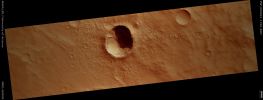
Psp_009622_1590_red.jpgMedium-size Impact Crater (possible True Colors; credits: Lunar Explorer Italia)60 visiteMars Local Time: 15:31 (middle afternoon)
Coord. (centered): 20,9° South Lat. and 184,4° East Long.
Spacecraft altitude: 257,3 Km (such as about 160,8 miles)
Original image scale range: 51,5 cm/pixel (with 1 x 1 binning) so objects ~1,54 mt across are resolved
Map projected scale: 50 cm/pixel
Map projection: EQUIRECTANGULAR
Emission Angle: 3,5°
Phase Angle: 70,5°
Solar Incidence Angle: 68° (meaning that the Sun is about 22° above the Local Horizon)
Solar Longitude: 112,9° (Northern Summer)
Credits: NASA/JPL/University of Arizona
Additional process. and coloring: Lunar Explorer ItaliaMareKromiumDic 21, 2008
|
|
PSP_009725_2485_RED.jpgPhoenix Landing Site (possible True Colors; credits: Lunar Explorer Italia)133 visiteMars Local Time: 14:48 (early afternoon)
Coord. (centered): 68,2° North Lat. and 234,3° East Long.
Spacecraft altitude: 324,1 Km (such as about 202,6 miles)
Original image scale range: 32,4 cm/pixel (with 1 x 1 binning) so objects ~97 cm across are resolved
Map projected scale: 25 cm/pixel
Map projection: EQUIRECTANGULAR
Emission Angle: 15,6°
Phase Angle: 66,9°
Solar Incidence Angle: 53° (meaning that the Sun is about 37° above the Local Horizon)
Solar Longitude: 116,6° (Northern Summer)
Credits: NASA/JPL/University of Arizona
Additional process. and coloring: Lunar Explorer ItaliaMareKromiumDic 20, 2008
|
|
PSP_006528_1120_RED_abrowse-00~0.jpgSources of Basaltic Sand (context frame; MULTISPECTRUM - credits: Lunexit)57 visiteSand dunes are among the most prominent wind-formed features found on Mars. Their morphologies depend on the winds and also on the local supply of sand grains, so they provide clues to the nature of both the Martian Atmosphere and Surface.
Dunes form through the accumulation of coarse sand grains carried by the wind by means of saltation, or bouncing along the surface. Monitoring the present day dune activity can help determine the timescale over which Martian rocks are eroded, as the impacting grains sandblast the surface over time. The sands of Mars must be continually replenished as the coarse grains are ground into fine dust by repeated impacts. Finding the hidden sources of fresh sand is a challenge for HiRISE.MareKromiumDic 20, 2008
|
|
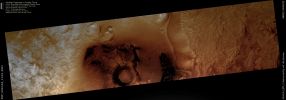
PSP_006504_1910_RED_abrowse-00~0.jpgAeolian Features in Arabia Terra (MULTISPECTRUM; credits: Lunexit)65 visiteThis observation shows part of the floor of a large impact crater in Arabia Terra. This crater formed in the distant past when a large asteroid or comet struck Mars, and it has been heavily modified since formation.
The crater was partially filled by sediments, forming the rock outcrops and layers visible in this image.
After this material was laid down, part of the deposits were eroded away. The central part of the image has been carved especially deeply, forming a distinct depression.
This depression has been a site of aeolian transport of sand in more recent times. A particularly interesting aspect of this site is that there appears to have been multiple styles of aeolian activity. Both large sand dunes (the dark hills) and smaller ripples (sharp, light-toned narrow ridges) are visible.
While ripples are often found in association with dunes, the different colors suggest that the material is not the same.
(At full resolution, the surfaces of both the dunes and the large ripples are covered with much smaller ripples)
Even where the ripples and dunes are in contact, there is a distinct contrast between the materials: dark sand appears to fill a trough between two large light ripples, suggesting that the dark sand has moved more recently. This could be due to different grain sizes, since certain sizes are most easily lifted by the wind.MareKromiumDic 20, 2008
|
|
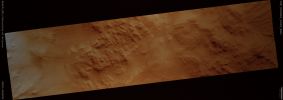
PSP_009660_2020_RED.jpgWest Olympus Mons (Extremely Saturated Natural Colors; credits for the additional process. and color.: Dr Paolo C. Fienga - Lunar Explorer Italia)60 visiteMars Local Time: 15:25 (early afternoon)
Coord. (centered): 21,5° North Lat. and 221,9° East Long.
Spacecraft altitude: 280,3 Km (such as about 175,2 miles)
Original image scale range: 28,0 cm/pixel (with 1 x 1 binning) so objects ~56,1 cm across are resolved
Map projected scale: 25 cm/pixel
Map projection: EQUIRECTANGULAR
Emission Angle: 0,4°
Phase Angle: 47,5°
Solar Incidence Angle: 47° (meaning that the Sun is about 43° above the Local Horizon)
Solar Longitude: 114,3° (Northern Summer)
Credits: NASA/JPL/University of Arizona
Additional process. and coloring: Lunar Explorer ItaliaMareKromiumDic 19, 2008
|
|
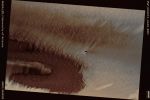
PSP_009655_2620_RED.jpgSmall Crater on the North Polar Layered Deposits (possible True Colors; credits: Lunar Explorer Italia)58 visiteMars Local Time: 14:02 (early afternoon)
Coord. (centered): 81,8° North Lat. and 333,1° East Long.
Spacecraft altitude: 318,6 Km (such as about 199,1 miles)
Original image scale range: 31,9 cm/pixel (with 1 x 1 binning) so objects ~96 cm across are resolved
Map projected scale: 25 cm/pixel
Map projection: EQUIRECTANGULAR
Emission Angle: 4,9°
Phase Angle: 64,3°
Solar Incidence Angle: 60° (meaning that the Sun is about 30° above the Local Horizon)
Solar Longitude: 114,1° (Northern Summer)
Credits: NASA/JPL/University of Arizona
Additional process. and coloring: Lunar Explorer ItaliaMareKromiumDic 19, 2008
|
|
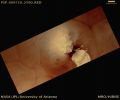
PSP_009710_2590_RED.jpgRelatively Fresh Ice-Patch near the North Polar Layered Deposits (possible True Colors; credits: Lunar Explorer Italia)60 visiteMars Local Time: 14:57 (early afternoon)
Coord. (centered): 78,7° North Lat. and 285,2° East Long.
Spacecraft altitude: 323,6 Km (such as about 202,2 miles)
Original image scale range: 32,4 cm/pixel (with 1 x 1 binning) so objects ~97 cm across are resolved
Map projected scale: 25 cm/pixel
Map projection: EQUIRECTANGULAR
Emission Angle: 11,8°
Phase Angle: 50,0°
Solar Incidence Angle: 60° (meaning that the Sun is about 30° above the Local Horizon)
Solar Longitude: 116,1° (Northern Summer)
Credits: NASA/JPL/University of Arizona
Additional process. and coloring: Lunar Explorer ItaliaMareKromiumDic 19, 2008
|
|
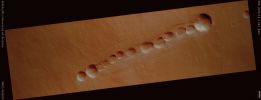
PSP_009712_1785_RED.jpgPit-Chain in South-Western Pavonis Mons (possible True Colors; credits: Lunar Explorer Italia)61 visiteMars Local Time: 15:30 (middle afternoon)
Coord. (centered): 1,4° South Lat. and 245,1° East Long.
Spacecraft altitude: 254,6 Km (such as about 159,1 miles)
Original image scale range: 50,9 cm/pixel (with 1 x 1 binning) so objects ~1,53 mt across are resolved
Map projected scale: 50 cm/pixel
Map projection: EQUIRECTANGULAR
Emission Angle: 0,5°
Phase Angle: 56,9°
Solar Incidence Angle: 56° (meaning that the Sun is about 34° above the Local Horizon)
Solar Longitude: 116,2° (Northern Summer)
Credits: NASA/JPL/University of Arizona
Additional process. and coloring: Lunar Explorer ItaliaMareKromiumDic 19, 2008
|
|
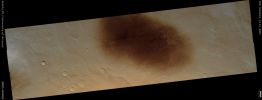
Psp_009652_2115_red.jpgOlivine Deposits (possible True Colors; credits: Lunar Explorer Italia)59 visiteMars Local Time: 15:25 (early afternoon)
Coord. (centered): 31,0° North Lat. and 79,6° East Long.
Spacecraft altitude: 289,5 Km (such as about 180,9 miles)
Original image scale range: 29,0 cm/pixel (with 1 x 1 binning) so objects ~57,9 cm across are resolved
Map projected scale: 25 cm/pixel
Map projection: EQUIRECTANGULAR
Emission Angle: 6,4°
Phase Angle: 39,7°
Solar Incidence Angle: 46° (meaning that the Sun is about 44° above the Local Horizon)
Solar Longitude: 114,0° (Northern Summer)
Credits: NASA/JPL/University of Arizona
Additional process. and coloring: Lunar Explorer ItaliaMareKromiumDic 19, 2008
|
|

Psp_009520_1520_red.jpgVery recent small Impact Crater near Hadriaca Patera (Enhanced and Saturated Natural Colors; credits for the additional process. and color.: Dr Paolo C. Fienga - Lunar Explorer Italia)60 visiteMars Local Time: 15:35 (middle afternoon)
Coord. (centered): 27,9° South Lat. and 90,7° East Long.
Spacecraft altitude: 256,9 Km (such as about 160,5 miles)
Original image scale range: 51,4 cm/pixel (with 1 x 1 binning) so objects ~1,54 mt across are resolved
Map projected scale: 50 cm/pixel
Map projection: EQUIRECTANGULAR
Emission Angle: 4,1°
Phase Angle: 70,5°
Solar Incidence Angle: 73° (meaning that the Sun is about 17° above the Local Horizon)
Solar Longitude: 109,3° (Northern Summer)
Credits: NASA/JPL/University of Arizona
Additional process. and coloring: Lunar Explorer ItaliaMareKromiumDic 19, 2008
|
|
| 2237 immagini su 187 pagina(e) |
|
|
|
|
|
141 | |
|
|
|
|
|
|





