| |

| Ultimi arrivi - Mars Reconnaissance Orbiter (MRO) |

PSP_010546_2615_RED_abrowse-01.jpgSand Slide (EDM - Absolute Natural Colors; credits for the additonal process. and color.: Dr Paolo C. Fienga - Lunar Explorer Italia)78 visiteSand Dunes are found in numerous Regions of Mars. These Dunes are in the North Polar Region: high latitude dunes are covered seasonally with Carbon Dioxide - CO2 - Frost (such as dry ice frost).
This edm shows a place where material has slipped from the crest of the dune and slid down to form a deposit at the bottom.
The material may have been loosened by the activity associated with sublimation (evaporation from a solid to a gas) of seasonal frost.
Coord. (centered): 81,6° North Lat. and 135,1° East Long.
Spacecraft altitude: 321,6 Km (such as about 201,0 miles)
Original image scale range: 64,3 cm/pixel (with 1 x 1 binning) so objects ~1,93 mt across are resolved
Map projected scale: 50 cm/pixel
Map projection: EQUIRECTANGULAR
Emission Angle: 6,2°
Phase Angle: 65,4°
Solar Incidence Angle: 71° (meaning that the Sun is about 19° above the Local Horizon)
Solar Longitude: 147,6° (Northern Summer)
Credits: NASA/JPL/University of Arizona
Additional process. and coloring: Lunar Explorer Italia MareKromiumGen 15, 2009
|
|

Psp_010434_1575_red.jpgFan at Valley Mouth (possible True Colors; credits: Lunar Explorer Italia)61 visiteThis image shows the intersection of a Valley with the floor of a large Impact Crater. The Valley appears to have transported sediment that was deposited on the Crater Floor when the flow slowed. As the Eastern side of the lobate deposit appears to have been sheared off, it is possible that continuing flow from the valley eroded into its own deposits.
The deposit is noticeably different in color from the crater floor, indicating that the Valley transported different sediments. Since the large crater is shallow, likely due to infilling, this suggests that multiple sources of sediment and perhaps multiple deposition processes have affected the geology at this site.
The deposited material in the lobe at the Valley Mouth displays some interesting textural features. Small boulders are commonly present on its surface. This may demonstrate relatively energetic deposition as in a flash flood, although it is possible that the boulders are superimposed debris from later impact craters.
The Southern End of the deposit is also fracturing into blocks or slabs. These could be relics of old mud cracks, or of thermal contraction cracks formed in Permafrost.
§§§
Mars Local Time: 15:42 (middle afternoon)
Coord. (centered): 22,4° South Lat. and 336,3° East Long.
Spacecraft altitude: 259,3 Km (such as about 162,1 miles)
Original image scale range: 25,9 cm/pixel (with 1 x 1 binning) so objects ~78 cm across are resolved
Map projected scale: 25 cm/pixel
Map projection: EQUIRECTANGULAR
Emission Angle: 2,6°
Phase Angle: 68,2°
Solar Incidence Angle: 66° (meaning that the Sun is about 24° above the Local Horizon)
Solar Longitude: 143,2° (Northern Summer)
Credits: NASA/JPL/University of Arizona
Additional process. and coloring: Lunar Explorer ItaliaMareKromiumGen 11, 2009
|
|

Psp_010695_2225_red.jpgFlow near the Central Peak of Moreux Crater (possible True Colors; credits: Lunar Explorer Italia)58 visiteThis image is of a flow feature within Moreux Crater, located at about 42° North Lat. and 44,6° East Long., on the edge of Mars’ Highlands/Lowlands Boundary. The Crater itself is roughly 135 Km in diameter.
During the impact that forms craters, a roughly bowl shaped volume is excavated from the Martian Crust. In craters larger than about 7 Km in diameter, a Central Peak (or Mound) forms on the floor of the crater. This image focuses on a portion of the Moreux Central Peak that apparently broke off and slid away, forming a type of Giant Landslide.
Interesting hummocks, swirls and ridges are found on the surface of the Landslide. There are also distinct, almost circular depressions of unknown origin near the foot of the flow.
Both light and dark toned dunes later formed on this landform.
§§§
Mars Local Time: 15:43 (middle afternoon)
Coord. (centered): 42,0° North Lat. and 44,7° East Long.
Spacecraft altitude: 322,4 Km (such as about 201,5 miles)
Original image scale range: 32,2 cm/pixel (with 1 x 1 binning) so objects ~97 cm across are resolved
Map projected scale: 25 cm/pixel
Map projection: EQUIRECTANGULAR
Emission Angle: 22,5°
Phase Angle: 35,7°
Solar Incidence Angle: 58° (meaning that the Sun is about 32° above the Local Horizon)
Solar Longitude: 153,6° (Northern Summer)
Credits: NASA/JPL/University of Arizona
Additional process. and coloring: Lunar Explorer ItaliaMareKromiumGen 11, 2009
|
|

PSP_006806_2215_RED_abrowse~0.jpgRelict Glacial Landform in Deuteronilus Mensae (MULTISPECTRUM; credits: Lunexit)61 visiteThis image shows remnant raised margins and other interior structures of a lobate flow feature emanating the mouth of an alcove along a mesa in Deuteronilus Mensae.
This region of Mars has many features called “lobate debris aprons” that spread out below the scarps of polygonal mesas. Many of the debris aprons have what appear to be lineations or grooves that are parallel to their movement direction indicating flow of the materials.
The flow may be due to the presence of ice in the material. Recent data from the Shallow Radar instrument (SHARAD) on the Mars Reconnaissance Orbiter Spacecraft has indicated a large reservoir of subsurface ice in the Deuteronilus Mensae Region that supports the observational evidence of surface flow.MareKromiumGen 07, 2009
|
|
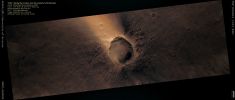
PSP_006841_1935_RED_abrowse~0.jpgJust like a "Butterfly": Dilly Crater... (MULTISPECTRUM; credits: Lunexit)57 visiteThis image covers the primary cavity of the distinctive rayed crater Dilly. Dilly is what is commonly referred to as a “butterfly” crater. This colloquial name refers to the asymmetry of the ejecta giving the appearance of “wings” around an elliptical cavity, and hence, the overall appearance of a butterfly. The “butterfly” appearance and elliptical cavity of Dilly (approx. 2 x 2,3 Km in diameter) are distinctive clues indicating that the crater formed from a low-angle impact (< 45°), likely from the South-West.
In addition to being a “butterfly” crater, Dilly is one of the smallest of the large rayed crater systems discovered in THEMIS nighttime infrared (temperature) images. Dilly, like its rayed counterparts such as Zunil, Gratteri, Tomini, Zumba, and the recently discovered unnamed crater seen in PSP_003611_1970, possesses distinctive rays (i.e.: spoke-like and far-traversing radial ejecta features) that are most readily viewed in THEMIS images. Crater rays are distinctive in the infrared because they are comprised of both dust and coarse, rocky materials, which are contrasted as cold (dark) and warm (bright) respectively. Because rays are ephemeral features, they are noted by scientists as a tell-tale sign of a fresh or well-preserved crater.
In the image, we can also observe that Dilly possesses a very distinctive light-toned South-West-trending streak that indicates modification by wind.
Light-toned dunes are also visible in the bottom of the crater.MareKromiumGen 07, 2009
|
|

PSP_010047_1745_RED-01.jpgStar-like shaped Hill in Terra Tyrrhena (edm - possible True Colors; credits: Lunar Explorer Italia)58 visite...Pubblichiamo questo extra-detail magnification (edm) girando a Voi la domanda postaci dal nostro Caro Amico "Cano00": questa striscia di puntini (si direbbero dei mini-segmenti scuri) allineati, che cos'è? E' un intrigantissimo rilievo superficiale, oppure è un image-artifact?
Ed in ogni caso: COMPLIMENTI a Cano00 per l'occhio (straordinario) che ha avuto!...MareKromiumGen 04, 2009
|
|
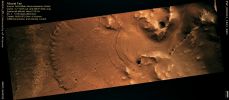
PSP_006941_1825_RED_abrowse~0.jpgAlluvial Fan in Crater East of Maja Valles (MULTISPECTRUM; credits: Lunexit)59 visiteThis image shows a large symmetrical Alluvial Fan at the mouth of a small channel along an unnamed crater. Alluvial fans with a well-defined channel source area are relatively uncommon on Mars.
This fan has a rib-like outer margin and many more terrace-like scarps upslope near the channel mouth. These terraces may indicate the outer margin of sediment deposits during each “pulse” of deposition. Further study of these types of alluvial fans may shed light on past sedimentary environments and conditions on Mars. MareKromiumGen 04, 2009
|
|
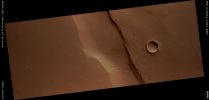
PSP_010054_1765_RED.jpgPlain North-West of Tithonium Chasma (possible True Colors; credits: Lunar Explorer Italia)59 visiteMars Local Time: 15:34 (middle afternoon)
Coord. (centered): 3,6° South Lat. and 268,4° East Long.
Spacecraft altitude: 260,2 Km (such as about 162,6 miles)
Original image scale range: 52,1 cm/pixel (with 1 x 1 binning) so objects ~1,56 mt across are resolved
Map projected scale: 50 cm/pixel
Map projection: EQUIRECTANGULAR
Emission Angle: 0,3°
Phase Angle: 57,8°
Solar Incidence Angle: 58° (meaning that the Sun is about 32° above the Local Horizon)
Solar Longitude: 128,7° (Northern Summer)
Credits: NASA/JPL/University of Arizona
Additional process. and coloring: Lunar Explorer ItaliaMareKromiumGen 02, 2009
|
|
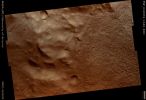
PSP_010059_1640_RED.jpgOlivine Deposits (possible True Colors; credits: Lunar Explorer Italia)56 visiteMars Local Time: 15:38 (middle afternoon)
Coord. (centered): 16,1° South Lat. and 133,7° East Long.
Spacecraft altitude: 259,9 Km (such as about 162,5 miles)
Original image scale range: 26 cm/pixel (with 1 x 1 binning) so objects ~1,04 mt across are resolved
Map projected scale: 25 cm/pixel
Map projection: EQUIRECTANGULAR
Emission Angle: 3,2°
Phase Angle: 61,9°
Solar Incidence Angle: 64° (meaning that the Sun is about 26° above the Local Horizon)
Solar Longitude: 128,9° (Northern Summer)
Credits: NASA/JPL/University of Arizona
Additional process. and coloring: Lunar Explorer ItaliaMareKromiumGen 02, 2009
|
|
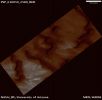
PSP_010059_2580_RED.jpgSample of North Polar Outlier (possible True Colors; credits: Lunar Explorer Italia)61 visiteMars Local Time: 14:46 (early afternoon)
Coord. (centered): 77,9° North Lat. and 113,6° East Long.
Spacecraft altitude: 318,5 Km (such as about 199,1 miles)
Original image scale range: 31,9 cm/pixel (with 1 x 1 binning) so objects ~96 cm across are resolved
Map projected scale: 25 cm/pixel
Map projection: EQUIRECTANGULAR
Emission Angle: 1,7°
Phase Angle: 60,5°
Solar Incidence Angle: 62° (meaning that the Sun is about 28° above the Local Horizon)
Solar Longitude: 128,9° (Northern Summer)
Credits: NASA/JPL/University of Arizona
Additional process. and coloring: Lunar Explorer ItaliaMareKromiumGen 02, 2009
|
|
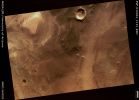
PSP_010063_2135_RED.jpgIsmenius Lacus (possible True Colors; credits: Lunar Explorer Italia)58 visiteMars Local Time: 14:16 (early afternoon)
Coord. (centered): 33,2° North Lat. and 17,4° East Long.
Spacecraft altitude: 296,7 Km (such as about 185,5 miles)
Original image scale range: 29,7 cm/pixel (with 1 x 1 binning) so objects ~59,4 cm across are resolved
Map projected scale: 25 cm/pixel
Map projection: EQUIRECTANGULAR
Emission Angle: 6,9°
Phase Angle: 54,4°
Solar Incidence Angle: 47° (meaning that the Sun is about 43° above the Local Horizon)
Solar Longitude: 129,0° (Northern Summer)
Credits: NASA/JPL/University of Arizona
Additional process. and coloring: Lunar Explorer ItaliaMareKromiumGen 02, 2009
|
|
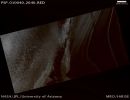
PSP_010040_2640_RED~0.jpgEnds of n. 2 North Polar Troughs (possible True Colors; credits: Lunar Explorer Italia)98 visiteMars Local Time: 14:16 (early afternoon)
Coord. (centered): 83,8° North Lat. and 264,3° East Long.
Spacecraft altitude: 321,4 Km (such as about 200,9 miles)
Original image scale range: 32,2 cm/pixel (with 1 x 1 binning) so objects ~96 cm across are resolved
Map projected scale: 25 cm/pixel
Map projection: EQUIRECTANGULAR
Emission Angle: 7,4°
Phase Angle: 59,4°
Solar Incidence Angle: 65° (meaning that the Sun is about 25° above the Local Horizon)
Solar Longitude: 128,2° (Northern Summer)
Credits: NASA/JPL/University of Arizona
Additional process. and coloring: Lunar Explorer ItaliaMareKromiumGen 02, 2009
|
|
| 2237 immagini su 187 pagina(e) |
|
|
|
|
|
136 | |
|
|
|
|
|
|





