| Ultimi arrivi - Mars Reconnaissance Orbiter (MRO) |
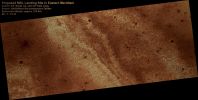
PSP_003326_1800_RED_browse.jpgProposed MSL Landing Site in Eastern Meridiani (possible True Colors; credits: Lunar Explorer Italia)66 visitenessun commentoMareKromiumGen 20, 2009
|
|

PSP_003252_1425_RED_browse-00%7E0.jpgBright Gully Deposit in Terra Sirenum (ctx image - MULTISPECTRUM; credits: Lunar Explorer Italia)68 visiteThis HiRISE image shows a bright gully deposit and other gullies within a crater wall in Terra Sirenum (37,7° South Lat. and 229,0° East Long.).
Three images are available:
(context image - A): The full frame HiRISE image, with the crater at left center; the width of the image is 6 Km;
(close-up of the crater's rim - B): an enlargement showing the crater;
(close-up of the bright gully deposit - C).
Frames B and C have been stretched to enhance contrast. The red box in B shows the location of C. MareKromiumGen 20, 2009
|
|
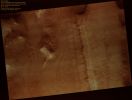
PSP_002545_1430_RED_browse-00~0.jpgJuncture of Two Branches of Dao Vallis (ctx frame - possible True Colors; credits: Lunar Explorer Italia)58 visiteMartian outflow channels are believed to be some of the largest features formed from the catastrophic flooding that scoured the landscape during ancient times. The source of the water likely originated in the subsurface and was somehow disturbed, depressurizing an aquifer, causing a sudden burst of water onto the surface.
This image shows multiple branches of the outflow channel Dao Vallis, which flows towards the West (down), ending near Hellas Basin. Although it is not clear exactly where the water that created these floods ended up, it is possible that Dao Vallis and its neighboring outflow channel, Niger Vallis, deposited water in Hellas Basin and formed a short-lived lake. Within the floor of Dao Vallis is material that appears striped, known as "lineated valley fill".
Valley fill material is thought to be ice-rich material that has flowed or been deposited onto the floor. Several lineations or "flow lines" appear to merge towards the upper left of the scene which supports this idea that the fill materials flowed, similar to slow-moving glacial material on Earth.
Also present in this scene is a mantling deposit which drapes much of the mid-latitudes of Mars. The deposit or "mantle" can be seen on south-facing slopes of positive-relief features, appearing as if its sliding off the walls. The mantle material is thought to be ice-cemented dust that was deposited during times when snowfall occurred on Mars.MareKromiumGen 20, 2009
|
|
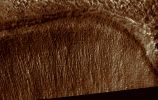
PSP_002545_1430_RED_browse-01~0.jpgJuncture of Two Branches of Dao Vallis (edm - possible True Colors; credits: Lunar Explorer Italia)56 visiteHiRISE images, such as this one (here, approximately 680 mt across), show that the mantled unit is textured and full of boulders, which contrasts with the smooth appearance of this material in MOC images.MareKromiumGen 20, 2009
|
|
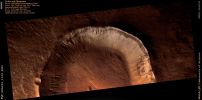
PSP_006261_1410_RED_abrowse.jpgGullies with Meanders (MULTISPECTRUM; credits: Lunexit)57 visiteThis observation features a relatively pristine crater in the Southern Mid-Latitudes. The crater still has a sharp rim on its South end, but it has experienced modification since forming.
The North half of the crater is populated by a large number of gullies that appear to emanate from resistant layers. The layers likely continue around the crater, but the gullies do not. Distinct layers are visible on the South wall of the crater.
It is unknown why gullies form on certain slopes and not others. Interestingly, the gullies themselves are not so pristine. They are covered by dunes and cut by polygonal fractures, indicating that they have been modified by aeolian and periglacial processes, respectively.
There are a large number of boulder tracks visible on the crater walls. Boulder tracks typically are approximately constant in width, and can often be seen at the track ends.
The crater floor has a texture indicative of sublimation processes.
If a soil is ice-rich under Martian conditions, the ice can sublimate causing the ground to collapse and “crinkle” where the ice used to be.
MareKromiumGen 19, 2009
|
|

PSP_006252_2220_RED_abrowse.jpgLineated Valley Fill (MULTISPECTRUM; credits: Lunexit)58 visiteFlow patterns dominate this Region of Mars in Deuteronilus Mensae. Many of the valley floors in the area exhibit complex alignments of small ridges, hills, and pits – often called “lineated valley fill”. The cause of the small-scale texture is not known, but it may result from patterns in ice rich soils or the loss of ice.
The linear alignment we see is probably caused by downhill movement of ice-rich soil, or glacial flow in dirty ice or ice-rich soil.
The result is flow patterns, called “stream lines”, that follow the valleys and around obstacles. Many of the large knobs and mesas in this region are also surrounded by aprons of debris that appear to have flowed away from the knobs and may be ice-rich themselves. Around one large knob in this image the debris flow appears to lie on top of the lineated valley fill and is therefore probably a younger deposit.MareKromiumGen 19, 2009
|
|

PSP_005334_2170_RED_abrowse-00~0.jpgCollapse Pits near Alba Patera (MULTISPECTRUM; elab. Lunexit)57 visiteThis observation shows pits in Acheron Catena, a chain of circular depressions located South-East of Alba Patera, the widest and flattest volcano on Mars.
The layers seen around the pit rims are likely lava flows from Alba Patera or the nearby Tharsis Mons.
The pits probably formed by collapse into empty space beneath the surface as opposed to being formed by an impactor from space. Some of the pits have large piles of material in their centers. These piles are evidence of collapse of the walls, which may have occurred after the main collapse event that formed each pit. The second pit from the right has an indistinct north rim; it appears that there were at least two collapse events here.
A couple of the pits have oval shaped craters on their walls.
The craters were almost certainly circular when they formed, but time and gravity have allowed the deformation of their shape by mass wasting.MareKromiumGen 19, 2009
|
|

PSP_005343_2170_RED_abrowse-00~0.jpgScarp with Landslides and Boulder Tracks (context frame; natural colors - elab. Lunexit)58 visiteThis observation shows an equatorial scarp (cliff) with possible landslides and boulder tracks.
The cliff has several distinct layers visible near its top. There is a smoother, possibly fine-grained layer on top, underlain by a relatively bright and a dark layer. It is possible that the entire cliff face consists of layers but that erosion has not exposed others yet.
There are two main landslide scars, locations where a landslide has carved into the slope. Both of the scars have boulder tracks, several of which have boulders at their ends as they progress down the slope or reach the end of the slope.MareKromiumGen 19, 2009
|
|

PSP_005392_0995_RED_abrowse-01~0.jpgImpact Crater on the South Polar Layered Deposits (EDM n.1; MULTISPECTRUM - credits: Lunexit)57 visiteA problem with using craters to determine age on the icy SPLD is that erosion of the icy substrate and relaxation of crater topography (i. e., relief becoming more gentle) is probably more rapid on ice than on harder rocky surfaces.
A detailed study of craters in ice will help better to understand this process of how craters in ice degrade, or deteriorate, with time.
Perhaps then we will know how to use the number and distribution of craters over the icy polar layered deposits in constraining the geologic and climate history of the Mars Polar Regions.MareKromiumGen 19, 2009
|
|

PSP_007219_1720_RED_abrowse-00~0.jpgFinely-Layered Rocks in Ius Chasma (context-frame - MULTISPECTRUM; credits: Lunexit)59 visiteThe high resolution of HiRISE allows us to see the many Fine Layers, or Strata, of Rock Outcrops all over Mars. This image shows a portion of Ius Chasma in the western portion of the large Valles Marineris Canyon System.
The Outcrop of Rock in the center of the image is about 5,5 Km across. Similar light-toned Strata are observed elsewhere in the canyon system and the CRISM instrument has shown that they often contain sulfate salts. The presence of Sulfate Salts indicate that water once interacted with this area, possibly as fluids that migrated through pre-existing rocks or as shallow evaporating pools of water.MareKromiumGen 17, 2009
|
|

PSP_006262_1080_RED_abrowse-00~0.jpgExposure of Basal Section of South Polar Layered Deposits (MULTISPECTRUM; credits: Lunexit)76 visiteThis observation shows internal layering exposed in a so-called "Basal Section" of the Polar Layered Deposits.
The South Polar Layered Deposits are composed primarily of water ice with a small amount of dust.
Variations in dust content most likely controls the erosion of the layers. The layers were laid down over a large area near the South Pole, probably over the past few million years. They are believed to record recent global climate changes on Mars in much the same way that polar ice in Greenland and Antarctica provide information about varying climatic conditions on Earth.
Several layers appear to be truncated and most likely represent unconformities. Unconformities form when an episode of erosion that removes all or part of a layer, is followed by more deposition.MareKromiumGen 17, 2009
|
|
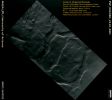
PSP_006980_2610_RED_abrowse.jpgSmooth Surface Features of Chasma Boreale (False Colors; credits: Lunexit)81 visitenessun commentoMareKromiumGen 16, 2009
|
|
| 2237 immagini su 187 pagina(e) |
 |
|
|
|
|
135 | |
|
|
|
|





