| Ultimi arrivi - Mars Reconnaissance Orbiter (MRO) |
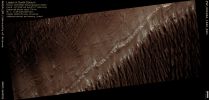
PSP_006984_1840_RED_abrowse~0.jpgLayers in Gordii Dorsum (MULTISPECTRUM; credits: Lunexit)59 visiteThis image shows distinctive differences in the texture of the ground surface in an area of Mars called Gordii Dorsum.
The upper right part of the image contains many subparallel ridges. These ridges are geological features called yardangs (long irregular ridges carved by wind erosion). The lower half of the image is smoother and contains a few small knobs and ridges. This area of Mars contains extensive outcroppings of layered sedimentary rocks that may have formed by the accumulation of sand and dust either blown in by the wind, transported by water, or some combination of processes such as these.
The distinctive surface textures may be due to differences in the rock structure and formation process. Mapping differences in the surface textures such as these may help to reveal how these rocks formed and advance our understanding of the geologic history of Mars.MareKromiumFeb 17, 2009
|
|

ESP_011277_1825_RED_abrowse.jpgUnnamed Crater with Layers in Meridiani Planum (Natural Colors; credits: Lunar Explorer Italia)75 visiteMars Local Time: 15:47 (middle afternoon)
Coord. (centered): 2,2° North Lat. and 357,5° East Long.
Spacecraft altitude: 270,8 Km (such as about 169,2 miles)
Original image scale range: 27,1 cm/pixel (with 1 x 1 binning) so objects ~81 cm across are resolved
Map projected scale: 25 cm/pixel
Map projection: EQUIRECTANGULAR
Emission Angle: 3,9°
Phase Angle: 60,7°
Solar Incidence Angle: 57° (meaning that the Sun is about 33° above the Local Horizon)
Solar Longitude: 178,0° (Northern Summer)
Credits: NASA/JPL/University of Arizona
Additional process. and coloring: Lunar Explorer ItaliaMareKromiumFeb 12, 2009
|
|
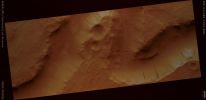
ESP_011289_1950_RED_abrowse.jpgMeander and Tributaries in Scamander Vallis (Enhanced Natural Colors; credits: Lunar Explorer Italia)60 visiteMars Local Time: 15:48 (middle afternoon)
Coord. (centered): 14,6° North Lat. and 29,1° East Long.
Spacecraft altitude: 278,2 Km (such as about 173,9 miles)
Original image scale range: 55,7 cm/pixel (with 1 x 1 binning) so objects ~1,67 mt across are resolved
Map projected scale: 50 cm/pixel
Map projection: EQUIRECTANGULAR
Emission Angle: 5,7°
Phase Angle: 52,4°
Solar Incidence Angle: 58° (meaning that the Sun is about 32° above the Local Horizon)
Solar Longitude: 178,5° (Northern Summer)
Credits: NASA/JPL/University of Arizona
Additional process. and coloring: Lunar Explorer ItaliaMareKromiumFeb 12, 2009
|
|

PSP_001513_1655_RED_abrowse-01.jpgThe MER Spirit Landing Site (edm - Natural Colors; credits: Lunar Explorer Italia)56 visiteThe bright irregularly-shaped feature in area "A" of the image is Spirit's parachute, now lying on the Martian surface. Near the parachute is the cone-shaped "backshell" that helped protect Spirit's lander during its seven-month journey to Mars. The backshell appears relatively undamaged by its impact with the martian surface. Wrinkles and folds in the parachute fabric are clearly visible.
Area "B" of the image shows Spirit's lander. The crater in the upper left-hand portion of the image, just to the northwest of the lander, is the one that the Mars Exploration Rover team named "Sleepy Hollow".
Area "C" shows the damaged remnant of the heat shield that protected the vehicle during the high-speed entry through the Martian atmosphere. The heat shield impacted the surface after being separated from the vehicle during the final stages of the descent.
Area "D" of the image shows the current location of Spirit. Toward the top of the image is "Home Plate", a plateau of layered rocks that Spirit explored during the early part of its third year on Mars. Spirit itself is clearly seen just to the southeast of Home Plate. Also visible are the tracks made by the rover before it arrived at its current location.MareKromiumFeb 09, 2009
|
|

PSP_001513_1655_RED_abrowse-00.jpgThe MER Spirit Landing Site (ctx frame - Natural Colors; credits: Lunar Explorer Italia)57 visiteThis HiRISE image shows the Landing Site of the Mars Exploration Rover Spirit. The impact crater in the upper left-hand portion of the image is "Bonneville Crater", which was investigated by Spirit shortly after landing. In the lower right-hand portion of the image is "Husband Hill", a large hill that Spirit climbed and where it spent much of its now nearly five-year mission.
M.L.T.: 15:29 (early afternoon)
Latitude (centered): 14,6° South and Longitude 175,5° East
Range to target site: 270,7 Km (approx. 169,2 miles)
Original image scale range: 27,1 cm/pixel (with 1 x 1 binning) so objects ~81 cm across are resolved
Map projected scale: 25 cm/pixel and North is up
Map projection: EQUIRECTANGULAR
Emission angle: 15,8°
Phase angle: 73,6°
Solar Incidence Angle: 60°, with the Sun about 30° above the Local Horizon
Solar Longitude: 139,1° (Northern Summer)MareKromiumFeb 09, 2009
|
|
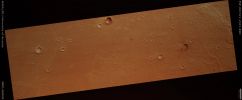
PSP_001521_2025_RED_abrowse-00.jpgThe Viking Lander 1 Landing Site - Thomas Mutch Memorial Station (ctx frame - Natural Colors; credits: Lunar Explorer Italia)58 visiteViking Lander 1 (VL1) touched down in Western Chryse Planitia on July 20, 1976.
The Lander, which has a diameter of about 3 meters, has been precisely located in the HiRISE orbital image, and likely locations have been found for the Heat-Shield, Backshell and Parachute attached to the Backshell.
The Lander location has been confirmed by overlaying the lander-derived topographic contours on the HiRISE image, which provides an excellent match. VL1 was one element of an ambitious mission to study Mars, with a 4-spacecraft flotilla consisting of 2 Orbiters and 2 Landers.MareKromiumFeb 09, 2009
|
|
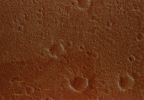
PSP_001521_2025_RED_abrowse-01.jpgThe Viking Lander 1 Landing Site - Thomas Mutch Memorial Station (edm - Natural Colors; credits: Lunar Explorer Italia)56 visiteM.L.T.: 15:20 (early afternoon)
Latitude (centered): 22,3° North and Longitude 312,1° East
Range to target site: 303,3 Km (approx. 189,5 miles)
Original image scale range: 30,3 cm/pixel (with 1 x 1 binning) so objects ~91 cm across are resolved
Map projected scale: 25 cm/pixel and North is up
Map projection: EQUIRECTANGULAR
Emission angle: 21,2°
Phase angle: 68,5°
Solar Incidence Angle: 48°, with the Sun about 42° above the Local Horizon
Solar Longitude: 139,4° (Northern Summer)MareKromiumFeb 09, 2009
|
|

PSP_001501_2280_RED_abrowse-00.jpgThe Viking Lander 2 Landing Site - Gerald Soffen Memorial Station (ctx frame - Natural Colors; credits: Lunar Explorer Italia)60 visiteViking Lander 2 (VL2) landed on Mars on 3 September 1976, in Utopia Planitia. The Lander, which has a diameter of about 3 meters, has been precisely located in the HiRISE image, and likely locations have been found for the Heat-Shield and Backshell.
The Lander location has been confirmed by overlaying the lander-derived topographic contours on the HiRISE image, which provides an excellent match.
VL2 was one element of an ambitious mission to study Mars, with a 4-spacecraft flotilla consisting of 2 Orbiters and 2 Landers.
Large Boulders, Dunes and other features visible in Lander images can be located in the HiRISE image. The polygonal pattern of the Surface is typical at these latitudes and may be due to the presence of deep subsurface ice.
As chance would have it, this image is blurred in some places due to the abrupt motion associated with the restart of the High Gain Antenna tracking during the very short image exposure. This is the first time after acquiring hundreds of pictures that an image has been unintentionally smeared, but the overall performance has been excellent.
A prime motivation for early viewing of these Viking sites is to calibrate what we see from space with the data previously acquired by the Landers. In particular, determining what sizes of rocks can be seen from MRO aids the interpretation of data now being taken to characterize sites for future landers.MareKromiumFeb 09, 2009
|
|

PSP_001501_2280_RED_abrowse-01.jpgThe Viking Lander 2 Landing Site - Gerald Soffen Memorial Station (edm - Natural Colors; credits: Lunar Explorer Italia)60 visiteM.L.T.: 15:14 (early afternoon)
Latitude (centered): 47,7° North and Longitude 134,3° East
Range to target site: 310 Km (approx. 193,8 miles)
Original image scale range: 31 cm/pixel (with 1 x 1 binning) so objects ~93 cm across are resolved
Map projected scale: 25 cm/pixel and North is up
Map projection: EQUIRECTANGULAR
Emission angle: 11,7°
Phase angle: 62,1°
Solar Incidence Angle: 51°, with the Sun about 39° above the Local Horizon
Solar Longitude: 138,7° (Northern Summer) MareKromiumFeb 09, 2009
|
|

ESP_011618_1885_RED_abrowse-00.jpgRecent Double-Impact (ctx frame - possible Natural Colors; credits: Lunar Explorer Italia)68 visiteMars Local Time: 15:46 (middle afternoon)
Coord. (centered): 8,6° North Lat. and 46,8° East Long.
Spacecraft altitude: 273,6 Km (such as about 171,0 miles)
Original image scale range: 27,4 cm/pixel (with 1 x 1 binning) so objects ~82 cm across are resolved
Map projected scale: 25 cm/pixel
Map projection: EQUIRECTANGULAR
Emission Angle: 5,9°
Phase Angle: 64,1°
Solar Incidence Angle: 58° (meaning that the Sun is about 32° above the Local Horizon)
Solar Longitude: 193,2° (Northern Autumn)
Credits: NASA/JPL/University of Arizona
Additional process. and coloring: Lunar Explorer ItaliaMareKromiumFeb 05, 2009
|
|

ESP_011618_1885_RED_abrowse-01.jpgRecent Double-Impact (edm - possible Natural Colors; credits: Lunar Explorer Italia)69 visiteThe MRO Context Imager (CTX) team has been discovering many new impact events on Mars, and then they request HiRISE follow-up imaging to confirm an impact origin and to identify and measure the craters.
Crater clusters are common as these small (typically less than 1 meter diameter) objects break up in the thin Martian air and separate a little bit to make crater clusters up to a few hundred meters wide. The example shown here is the result of an impact that occurred between May 2003 and September 2007.
It was first discovered as a dark spot in a CTX image acquired in March 2008, but later found to be partly visible at the very edge of a CTX image acquired in September 2007.
A dark spot is not present in the previous image of this location with sufficient resolution to have detected it, acquired by the visible THEMIS camera on Mars Odyssey in May 2003. Thus the impact might have formed anytime between May 2003 and September 2007. The dark markings are created by removing or disturbing the surficial dust cover, and so far new impact sites have been discovered only in dust-covered regions of Mars.
Although small Martian crater clusters are common, this example is unusual because there is a dark line between the two largest craters. We hypothesize that atmospheric breakup coincidentally made two nearly equal-size objects that impacted close together in space and time so the air blasts interacted with each other to disturb the dust along this line.
Hundreds of these small objects (mostly asteroid fragments) impact Mars per year. A comparable number of small objects impact Earth each year, but explode in the upper reaches of our atmosphere and have no effect on the surface, fortunately for those of us who live here.MareKromiumFeb 05, 2009
|
|

ESP_011292_1720_RED_abrowse.jpgLayering at Ganges Chasma (possible Natural Colors; credits: Lunar Explorer Italia)61 visiteMars Local Time: 15:42 (middle afternoon)
Coord. (centered): 8,1° South Lat. and 307,5° East Long.
Spacecraft altitude: 258,6 Km (such as about 161,6 miles)
Original image scale range: 28,7 cm/pixel (with 1 x 1 binning) so objects ~86 cm across are resolved
Map projected scale: 25 cm/pixel
Map projection: EQUIRECTANGULAR
Emission Angle: 25,4°
Phase Angle: 81,1°
Solar Incidence Angle: 56° (meaning that the Sun is about 34° above the Local Horizon)
Solar Longitude: 178,7° (Northern Autumn)
Credits: NASA/JPL/University of Arizona
Additional process. and coloring: Lunar Explorer ItaliaMareKromiumFeb 05, 2009
|
|
| 2237 immagini su 187 pagina(e) |
 |
|
|
|
|
132 | |
|
|
|
|





