| Ultimi arrivi - Mars Reconnaissance Orbiter (MRO) |
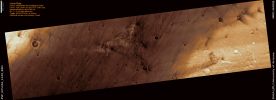
PSP_005456_1650_RED_abrowse-00~0.jpgHome Plate from Orbit (CTX Frame - Enhanced Natural Colors - elab. Lunexit)57 visitenessun commentoMareKromiumFeb 18, 2009
|
|
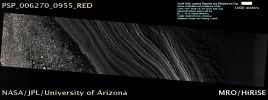
PSP_006270_0955_RED_abrowse~0.jpgSouth Polar Layered Deposits and Residual Ice Cap (natural colors; credits: Lunexit)71 visiteA wide variety of South Polar Terrains are on display in this spectacular HiRISE image. The reddish material on the left of the image is the SPLD. These deposits are a stack of layered, dusty water ice. Scientists believe that these layers record previous climatic conditions on Mars, much like terrestrial ice-sheets provide a record of climate change on the Earth.
This image shows the face of one of the many scarps or shallow cliffs that cut into the SPLD. These scarps expose the internal layers within the SPLD. You can see these climate-recording layers in the last2/3rds of the image, left side, running from lower-left to upper-right.
The terrain in the last third of the image is quite different in both appearance and composition. The bright, white-ish material is a thin covering of CO2 ice draped over the flat areas of the SPLD. This covering of CO2 is being eroded away by expanding flat-floored pits. Parts of the floors of these pits show the reddish brown coloring of the underlying SPLD.
These pits have eroded the CO2 ice layer to such an extent that only isolated mesas remain today and even these shrink in extent by a few meters each year.
These mesas also have several layers within them, indicting that they likely contain a climatic record, albeit a much shorter one than preserved in the SPLD.
Most of the isolated mesas have white-ish tops; however, some (near the foot of the SPLD scarp) have reddish tops. This may either be due to bright CO2 ice thinning to reveal the older (and darker) CO2 ice that makes up the main body of the mesa, or perhaps dust has settled out of the atmosphere to cover the brighter frost.
Remember that there was a large Martian Dust Storm earlier this year which could have caused either effect.MareKromiumFeb 18, 2009
|
|

PSP_005574_1720_RED_abrowse-00~0.jpgLayers and Slope-Streaks within Valleys along the Highland-Lowland Boundary (context frame - MULTISPECTRUM; credits: Lunexit)61 visiteThis image shows Slope Streaks and Layering on the walls of a valley along the border between the Martian Southern Highlands and Northern Lowlands (see the extra-detail mgnf. At the bottom of the valley and in the lower portion of the valley walls are many large dunes.
The Slope Streaks generally start at a point source and widen downslope as a single streak or branch into multiple streaks. Some of the Slope Streaks show evidence that downslope movement is being diverted around obstacles, such as large boulders. In particular, several of the Slope Streaks in this image appear to be diverting around individual dunes, with downslope movement occurring in the low troughs between the dunes. The darkest Slope Streaks are youngest and cross cut and lie on top of the older and lighter-toned Streaks.
The lighter-toned Streaks are believed to be dark streaks that are lightening with time as new dust is deposited on their surface.MareKromiumFeb 18, 2009
|
|

PSP_005392_0995_RED_abrowse-00~0.jpgImpact Crater on the South Polar Layered Deposits (context frame; MULTISPECTRUM - credits: Lunexit)57 visiteThis image covers a portion of the ice-rich SPLD.
Layers in the Mars Polar Regions are of great interest because layers in ice on the Earth, as in the Antarctic and Greenland ice caps, are known to contain records of past atmospheric, environmental, and climate conditions. By studying Mars Polar Layers, we hope to be able to understand the past climate and history of water on the Red Planet.MareKromiumFeb 18, 2009
|
|

PSP_005571_0950_RED_abrowse-00~0.jpgSouth Polar Residual Cap Margin (context frame; MULTISPECTRUM - elab. Lunexit)57 visiteThis scene is about 2,7 Km (approx. 1,7 miles) long and shows part of the edge of the South Polar Residual Cap (...).
The relatively bright, grayish areas are the Residual Cap, and the darker, reddish areas are mostly likely covered by dust. The South Polar Residual Cap is made, for the most part, of Carbon Dioxide ice (commonly called "dry ice") and dust, with a little water ice in some places.MareKromiumFeb 18, 2009
|
|

PSP_005748_1075_RED_abrowse~0.jpgBuried Crater in the SPLD (natural colors; credits: Lunexit)59 visiteThis image of the SPLD shows some of the layers cut off against other layers below and right of center. Geologists call this an “angular unconformity” because the layers do not conform to each other across this boundary.
In this case, the angular unconformity was probably caused by erosion of the SPLD followed by deposition of new SPLD on top of the eroded surface, but faulting could also have caused the observed unconformity.
Near the unconformity is an impact crater, one of dozens found on the SPLD. The presence of these craters implies that the surface of the SPLD has been relatively stable (i.e., little erosion or deposition) in the past few million years.
This is in stark contrast to the NPLD, on which craters are very rare, implying very recent erosion/deposition.MareKromiumFeb 18, 2009
|
|
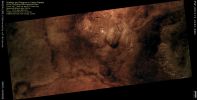
PSP_007173_2245_RED_abrowse-00~0.jpgScallops and Polygons in the Utopia Planitia Region (context frame - MULTISPECTRUM; credits: Lunexit)61 visiteThis image shows a portion of the Utopia Planitia, marked by polygonal features bounded by cracks and depressions in the mantle that possess scalloped edges.
Scalloped pits are typical features of the Martian mid-latitude mantle. Their presence has led to hypotheses of the removal of subsurface material, possibly interstitial ice, by sublimation (ice going directly from the solid state to the gas state). Their formation most likely involves development of oval- to scalloped-shaped depressions that may coalesce together, leading to the formation of large areas of pitted terrain. Scalloped pits typically have a steep pole-facing scarp and a gentler equator-facing slope.
On the surface surrounding the scalloped depressions is a polygonal pattern of fractures. This is commonly associated with scalloped terrain, and indicates that the surface has undergone stress, potentially caused by subsidence (sinking), desiccation (drying out), or thermal contraction. These polygon features are similar to permafrost polygons that form in polar and high alpine regions on Earth by seasonal-to-annual contraction of the subsoil. On Earth, such polygon features are indicative of the presence of ground ice.MareKromiumFeb 17, 2009
|
|
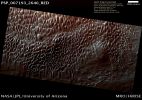
PSP_007193_2640_RED_abrowse-00~0.jpgDefrosting Northern Dunes (context frame - MULTISPECTRUM; credits: Lunexit)57 visiteIn Northern Winter a Seasonal Polar Cap composed of Carbon Dioxide (CO2) ice (dry ice) forms in the North Polar Region. This Cap covers a vast sea of dunes at high Northern Latitudes. In the spring the ice sublimates (evaporates directly from ice to gas) and this active process loosens and moves tiny dust particles.MareKromiumFeb 17, 2009
|
|

PSP_009905_2650_RED.jpgNorth Polar Layered Deposits (NPLD) and Dunes in Chasma Boreale (natural colors; credits: Lunexit)67 visiteThis image shows a steep, layered slope and flatter, dune-covered plains in Mars’ North Polar Region. The layers are composed of varying contents of water ice and dust.
On Earth, icy layers like these in Greenland and Antarctica are important because they contain a record of past climate conditions. By looking at the detailed sequence of Polar Layers on Mars, scientists hope to be able to discover the types of variations that Mars’ climate may have experienced.
The lowest section in the stack of light layers is noticeably darker because of the presence of dark, sandy material. Erosion of this dark material is thought to provide the sand making up the large dunes on the plains.
Several exceptionally well-developed barchan (crescent-shaped) dune forms up to approximately 50 meters (160 feet) across are present in the center of the image.MareKromiumFeb 17, 2009
|
|
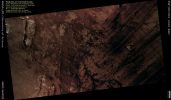
PSP_007095_2020_RED_abrowse~0.jpgInverted Dendritic Stream Channels in Antoniadi Crater (MULTISPECTRUM; credits: Lunexit)60 visiteThis observation is centered within Antoniadi Crater. This crater, even prior to the MRO mission, was identified as a likely ancient lake (now dry) that was supplied by both surface water and ground water.
The image provides further tantalizing evidence of a water-rich past. Most of the flat parts of the image have a polygonal texture, which commonly forms when mud dries. In the center of the image are branched (“dendritic”) features that connect Southward to a larger trunk-shaped landform; the branches resemble stream channels on Earth. Unlike active channels with water, these features are “inverted”, or elevated above the surrounding terrain.
Again, in analogy with such features seen on our Planet, these probably formed when materials deposited by the streams, such as coarse gravel, or chemical cementation after removal of the water, caused the channel bottoms to become resistant. Over time, natural erosion from wind and other processes left the inverted channels elevated above the surrounding terrain.
The branched features are probably remnants of small tributary streams that fed the larger trunk-shaped stream. It appears that the inverted streams lie on top of, and are therefore younger, than the polygons. This area may have first had a lake that later dried to form the polygons, followed by episodes of stream flow and erosion.MareKromiumFeb 17, 2009
|
|
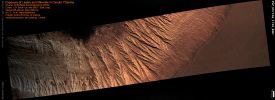
PSP_007166_1740_RED_abrowse-00~0.jpgExposure of Layers and Minerals in Candor Chasma (MULTISPECTRUM; credits: Lunexit)57 visiteScanning across several kilometers of relief, this image shows a cliff along a light-toned layered deposit in Valles Marineris. This particular cliff was targeted because of the excellent exposure of layering and the identification of the minerals Kieserite (a mineral containing Magnesium) and Hematite (an Iron Oxide).
The Hematite appears in the darker low-lying region of the image and the Kieserite is associated with the light-toned layers.
The fact that these minerals are found here with a layered deposit suggests that water may have been involved in the deposition of these minerals and the layers.
Erosion by wind has carved V-shaped patterns along the edges of many of the layers. The layers appear friable (easy to erode) so this is why wind can carve deep grooves along a steep cliff such as visible here.
The top of the layered deposit (lower part of image) is smooth and relatively dark because it is covered by debris laid down by the wind, dust and other fine materials.
The cliff has stronger winds flowing up and down it, plus the effects of gravity, so airborne debris can be shed downslope to expose the fresh brighter layered deposit.MareKromiumFeb 17, 2009
|
|

PSP_006820_1760_RED_abrowse~0.jpgPeri-Equatorial "Sand-Patches" on a Crater Floor (MULTISPECTRUM; credits: Lunexit)58 visiteThis image shows part of the floor of a large crater in Arabia Terra, near Mars’ Equator. A notable feature on this crater floor is a region of "Dark Patches" up to about 100 mt (330 feet) across. These Dark Patches sit in an area of connected small ridges and spurs and bury them, filling in the low areas and piling up. In several places light ridge crests protrude through the dark material.
The dark patches appear to be collections of wind-blown sand. Sand on Mars is often dark, likely because it is fragments of a volcanic rock called basalt. (Sand on Earth is most often light-toned quartz). Sand may tend to collect in patches that can ultimately evolve into large dunes if more sand gathers. The patches of sand here are not big enough to form such large structures, but small-scale regular texture due to blowing wind is visible on the surface.
The relatively dark tone which can be seen around the Sand Patches (compared with the surrounding material) is probably due to small amounts of additional sand. In some places this collects at the bottom of troughs.MareKromiumFeb 17, 2009
|
|
| 2237 immagini su 187 pagina(e) |
 |
|
|
|
|
131 | |
|
|
|
|





