| |

| Ultimi arrivi - Mars Reconnaissance Orbiter (MRO) |

PIA11809.jpgColumnar Jointing (Natural Colors; credits for the additional process. and color.: Dr Paolo C. Fienga - Lunar Explorer Italia)59 visiteThis image from the High Resolution Imaging Science Experiment (HiRISE) on NASA's Mars Reconnaissance Orbiter shows an exposure of layered rock that exhibits a type of fracturing - called Columnar Jointing - that results when cooling lava contracts.
The observation is cited in a report, "Discovery of Columnar Jointing on Mars", publisged in the February 2009 issue of the journal Geology. The Authors propose that flooding by water was likely what caused a quick cooling of lava to result in this jointing.
The image, taken Oct. 31, 2007, shows a portion of an Unnamed Crater about 16 Km (such as approx. 10 miles) in diameter and centered at 21,52° North Latitude and 184,35° East Long.
Shown here is a section about 1 Km (0,6 mile) wide from the image catalogued by the HiRISE team as PSP_005917_2020. The column-forming fractures resemble textures common on Earth in locations such as the Colombia River Basalt Group and in the Colorado Plateau.MareKromiumFeb 26, 2009
|
|

ESP_011341_0980_RED_abrowse.jpgStarburst Fans, or: the Arthur Clarke Trees (Natural Colors; credits: Lunar Explorer Italia)79 visiteQuante volte, su Siti (fanta/pseudo) Scientifici avete visto e letto degli "Alberi Marziani" (che sono anche - e meglio - noti al Pubblico come "Arthur Clarke Trees", in omaggio al Creatore della Saga di "2001 - Odissea nello Spazio")?
Sicuramente tante volte.
Oggi (in realtà esistevano già altre riprese sufficientemente chiare, ma facciamo finta che non lo fossero...), grazie a questa splendida immagine ottenuta dalla Sonda MRO, il "mistero" degli Alberi Marziani possiamo dire che è definitivamente risolto (anche se, a nostro avviso, queste Surface Features non erano mai state un VERO mistero): si tratta di Fans a forma di "stella che esplode".
E come si sono generati questi Fans (---sbuffi)? Ce lo spiega la NASA stessa:"During the Martian Winter a layer of Carbon Dioxide Ice (CO2, or Dry Ice) forms a seasonal cap over the South Polar Region. In the Spring — when the Sun starts to warm the ice and the surface below — gas escapes from beneath the ice layer, carrying dust with it.
The dust is deposited on top of the ice in Fans, with an orientation determined by the prevailing wind direction. In this Region, the gas flows along radial channels, so that when it emerges we see a circular set of Dust Fans. These inspire the “starburst” description".
La "morale" è sempre la stessa: i Misteri - su Marte e nel resto di Sistema Solare e del Cosmo - ci sono, esistono e sono grandi ed affascinanti.
Non serve quindi "inventarne" di sana pianta (se non per consentire a qualcuno di mettersi soldi e facile notorietà in tasca): basta osservare, studiare ed infine - credeteci - di motivi per sognare e per comprendere che "non siamo soli", ne troverete a milioni.
"Piramidi", "Sfingi" e "Parabole"? NO, grazie!
Mars Local Time: 17:06 (middle afternoon)
Coord. (centered): 81,8° South Lat. and 76,1° East Long.
Spacecraft altitude: 246,9 Km (such as about 154,3 miles)
Original image scale range: 49,4 cm/pixel (with 1 x 1 binning) so objects ~1,48 mt across are resolved
Map projected scale: 50 cm/pixel
Map projection: EQUIRECTANGULAR
Emission Angle: 0,2°
Phase Angle: 88,0°
Solar Incidence Angle: 88° (meaning that the Sun is about 2° above the Local Horizon)
Solar Longitude: 180,8° (Northern Autumn)
Credits: NASA/JPL/University of Arizona
Additional process. and coloring: Lunar Explorer ItaliaMareKromiumFeb 26, 2009
|
|

ESP_011635_1510_RED_abrowse.jpgRitchey Crater's Central Uplift (Natural Colors; credits: Lunar Explorer Italia)74 visiteThe Natural Color image of this observation includes some interesting features in and near the central uplift of Ritchey Crater.
At the top is an ancient streambed, above center are very bright rocks and minerals can be seen in the Central Uplift. Large impact craters are unstable when they are formed, because their Walls are so steep.
Gravity causes the Walls to collapse toward the center of the Crater, colliding to form an Uplift or Peak. This process of Central Uplift formation can bring rocks from deep in the Crater Walls up to the surface. The angular bright blocks near the center of this image show that this process breaks the wall rocks into fragments as the Central Uplift is formed.
Mars Local Time: 16:00 (middle afternoon)
Coord. (centered): 28,5° South Lat. and 309,1° East Long.
Spacecraft altitude: 264,8 Km (such as about 165,5 miles)
Original image scale range: 26,5 cm/pixel (with 1 x 1 binning) so objects ~79 cm across are resolved
Map projected scale: 25 cm/pixel
Map projection: EQUIRECTANGULAR
Emission Angle: 15,1°
Phase Angle: 46,9°
Solar Incidence Angle: 61° (meaning that the Sun is about 29° above the Local Horizon)
Solar Longitude: 194,0° (Northern Autumn)
Credits: NASA/JPL/University of Arizona
Additional process. and coloring: Lunar Explorer ItaliaMareKromiumFeb 26, 2009
|
|

ESP_011287_2165_RED_abrowse.jpgFresh Impact Crater in Utopia Planitia (Natural Colors; credits: Lunar Explorer Italia)60 visiteThis fresh Unnamed Crater is located in the Northern Mid-Latitudes. It is designated as fresh because of its very sharp rim.
The Crater has experienced some modification since it formed, including a few tiny craters on the South Wall.
The rough texture of the floor is suggestive of ground ice, which is expected to exist in the Mid-Latitudes. Ground ice aids gravity in moving material from the Crater Walls towards the center. Material is visible slumping off the North-Western Crater Wall in this fashion. The wavy texture of the center of the Crater floor suggests that material has been transported from the walls and merged in the center.
Mars Local Time: 15:42 (middle afternoon)
Coord. (centered): 36,0° North Lat. and 80,5° East Long.
Spacecraft altitude: 292,7 Km (such as about 182,9 miles)
Original image scale range: 58,6 cm/pixel (with 1 x 1 binning) so objects ~1,76 mt across are resolved
Map projected scale: 50 cm/pixel
Map projection: EQUIRECTANGULAR
Emission Angle: 2,9°
Phase Angle: 59,7°
Solar Incidence Angle: 62° (meaning that the Sun is about 28° above the Local Horizon)
Solar Longitude: 178,5° (Northern Summer)
Credits: NASA/JPL/University of Arizona
Additional process. and coloring: Lunar Explorer ItaliaMareKromiumFeb 26, 2009
|
|

PSP_003492_1405_RED_abrowse~0.jpgUnnamed Southern Mid-Latitude Crater with "unusually bright" Gullies (MULTISPECTRUM; credits: Lunexit)58 visiteThis image shows a Southern Mid-Latitude (unnamed) crater: it has bright landslides on its South-East and West walls, some of which have noticeable boulder tracks where boulders rolled down the slopes.
The most noticeable features of this crater are the gullies on the North wall. A couple of small gullies appear to emanate from an overhang.
The others originate at or near layers up-slope.
The layers are sturdy and resistant from erosion: the layers that appear to be decaying into resolvable boulders, instead of particles easily moved by the wind, are evidence of this.MareKromiumFeb 24, 2009
|
|
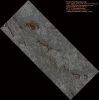
PSP_005095_0935_RED_browse~0.jpgSouth Pole Residual Cap (Swiss-Cheese Terrain Monitoring) - (Natural Colors; credits: Lunar Explorer Italia)58 visitenessun commentoMareKromiumFeb 24, 2009
|
|

PSP_010854_1325_RED_abrowse.jpgProctor Crater Dunes (Natural Colors; credits: Lunar Explorer Italia)71 visiteIn the winter the dunes in Proctor Crater are covered with seasonal carbon dioxide frost (dry ice). In the spring, the frost gradually evaporates but lingers in protected regions. In this color image bright ice deposits in sheltered areas highlight the ripples on the dunes.
These dunes were imaged during the first year of MRO’s mission. Images taken now in the second Martian spring can be compared to the previous year to study interannual variability.
Mars Local Time: 15:59 (middle afternoon)
Coord. (centered): 47,2° South Lat. and 34,0° East Long.
Spacecraft altitude: 254,5 Km (such as about 159,1 miles)
Original image scale range: 50,9 cm/pixel (with 1 x 1 binning) so objects ~1,53 mt across are resolved
Map projected scale: 50 cm/pixel
Map projection: EQUIRECTANGULAR
Emission Angle: 8,2°
Phase Angle: 70,3°
Solar Incidence Angle: 77° (meaning that the Sun is about 13° above the Local Horizon)
Solar Longitude: 160,1° (Northern Summer)
Credits: NASA/JPL/University of Arizona
Additional process. and coloring: Lunar Explorer ItaliaMareKromiumFeb 20, 2009
|
|

ESP_011631_1515_RED_abrowse.jpgInside Hellas Basin (Natural Colors; credits: Lunar Explorer Italia)88 visiteThis image shows part of the floor of an impact crater on the Northern Rim of the giant Hellas Basin.
Hellas includes the lowest elevations on Mars, and may have once held lakes or seas; layered rock outcrops occur around much of the edge of the basin. At this site, a large impact crater (about 90 kM across) was partly filled by layered rocks. These rocks on the crater floor are now eroding and forming strange pits.
Here, the layers are mostly exposed on a steep slope which cuts across much of the image. On this slope, they crop out as rocky stripes, some continuous and others not. The material between the stripes is mostly covered by debris, but some areas of exposed rock are visible. The slope is capped by a thick, continuous layer that armors it against erosion; once this cap is gone, the lower material is removed rapidly, forming the steep slope. At the base of this slope, rocks on the floor of the pit appear bright and heavily fragmented by cracks known as joints. The variation in rock types suggests that the rocks here were deposited by multiple processes or in different environments. Sites like this may preserve a record of conditions on early Mars.
Mars Local Time: 15:55 (middle afternoon)
Coord. (centered): 28,4° South Lat. and 57,1° East Long.
Spacecraft altitude: 256,9 Km (such as about 160,6 miles)
Original image scale range: 25,7 cm/pixel (with 1 x 1 binning) so objects ~51,4 cm across are resolved
Map projected scale: 25 cm/pixel
Map projection: EQUIRECTANGULAR
Emission Angle: 0,3°
Phase Angle: 60,1°
Solar Incidence Angle: 60° (meaning that the Sun is about 30° above the Local Horizon)
Solar Longitude: 193,8° (Northern Autumn)
Credits: NASA/JPL/University of Arizona
Additional process. and coloring: Lunar Explorer ItaliaMareKromiumFeb 20, 2009
|
|

ESP_011351_0945_RED_abrowse.jpgFans on Ice (Natural Colors; credits: Lunar Explorer Italia)58 visiteEvery Southern Winter the South Polar Region of Mars is covered with an approximately 1 meter deep layer of frozen CO2 (dry ice). In the Spring, when the Sun begins to warm the surface below the translucent ice, gas flow under the ice carries loose dust from the surface up onto the top.
The dust falls to the surface in "Fans", whose orientation is determined by the direction of the local wind flow. Fans from one source region pointing in multiple directions show how the wind direction has changed. Narrow Fans pointing in just one direction are the most recent. Alternatively, the vent from the surface may have re-annealed, such that these Fans were formed over a very limited time span.
Mars Local Time: 18:19 (sunset - early evening)
Coord. (centered): 85,2° South Lat. and 181,6° East Long.
Spacecraft altitude: 247,4 Km (such as about 154,6 miles)
Original image scale range: 99,0 cm/pixel (with 1 x 1 binning) so objects ~2,97 mt across are resolved
Map projected scale: 1 mt/pixel
Map projection: EQUIRECTANGULAR
Emission Angle: 4,2°
Phase Angle: 86,4°
Solar Incidence Angle: 90° (meaning that the Sun is about 0° on the Local Horizon)
Solar Longitude: 181,2° (Northern Autumn)
Credits: NASA/JPL/University of Arizona
Additional process. and coloring: Lunar Explorer ItaliaMareKromiumFeb 20, 2009
|
|

PSP_005424_1700_RED_abrowse~0.jpgAurorae Chaos (MULTISPECTRUM; credits: Lunexit)57 visiteThis observation shows a portion of Aurorae Chaos, chaotic terrain East of the Vallis Marineris Canyon System. Aurorae Chaos extends from Capri and Eos Chasmata on the West, into Hydraotes and Aureum Chaos on the North and East.
Chaotic terrain is thought to form from subsurface collapse following volatile release. It is possible that the Martian crust was at one time enriched in ices that became gases or liquid at relatively low temperatures upon encountering a heat source or was violently shaken. These ices existed in spaces between soil particles. If a large volume of volatiles is suddenly released, then there is a large portion of the soil volume missing. The soil cannot support itself, so it collapses.
Since chaotic terrain is often located at the head of the Martian outflow channels (giant flood plains), it is also possible that the Chaotic Regions are the source of the fluids that formed the outflow channels.
Aurorae Chaos connects to outflow channels via other Chaotic Regions.MareKromiumFeb 18, 2009
|
|
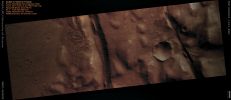
PSP_006695_1415_RED_abrowse~0.jpgGullies in Sirenum Fossae (MULTISPECTRUM; credits: Lunexit)57 visiteThis image shows parts of Sirenum Fossae that are southwest of Gorgonum Chaos. Some of the troughs (Fossae) have gullies on their walls. Gullies are incised slope features that are thought to have formed by liquid water flowing down the slopes.
It is unknown whether the water came from the subsurface or above the surface. The plains around the troughs have a number of mesas and hills that might have formed from erosion of a once-larger rock unit.
The left side of the image shows some dark linear features which MIGHT BE Dust Devil Tracks.MareKromiumFeb 18, 2009
|
|
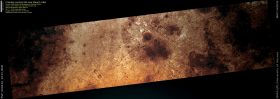
PSP_006610_2035_RED_abrowse~0.jpgPotential MSL Landing Site near Mawrth Vallis (MULTISPECTRUM; credits: Lunexit)57 visiteMawrth Vallis contains clay minerals that formed by chemical alteration of rocks by water. It is one of the short list of potential sites that the Mars Science Laboratory Rover will land at, and the HiRISE team is working to find a safe place to land in this area.
This observation shows a wide variety of scientifically interesting terrains as well as some potential hazards for landing. The central part of the image is dominated by light-toned materials with curving fractures of many different sizes. These fractures do not have a preferred orientation, indicating that they did not form in response to some regional stress pattern.
Instead, they formed by some more uniform process, possibly the drying of a thick mud deposit or the gradual rebound of the area as the overlying material was eroded away. The scattered mounds and sand dunes may or may not prove to be a danger, but it is reassuring to see that many of the impact craters have been smoothed out with a filling of wind-blown sand.MareKromiumFeb 18, 2009
|
|
| 2237 immagini su 187 pagina(e) |
|
|
|
|
|
130 | |
|
|
|
|
|
|





