| |

| Ultimi arrivi - Mars Reconnaissance Orbiter (MRO) |
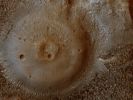
Mud_Volcano-MRO.jpgMud Volcanoes on Mars? (Natural Colors; credits: Lunar Explorer Italia)59 visiteDa "NASA - Picture of the Day" del giorno 30 Marzo 2009:"Is this a Mud Volcano on Mars? If so, could it be dredging up Martian Microbes? This strange possibility has been suggested recently and seems to fit several recent observations of Mars.
First of all, hills like this seem to better resemble Mud Volcanoes on Earth than Lava Volcanoes and Impact Craters on Mars.
Next, the pictured dome has an unusually textured surface consistent with fractured ice. Infrared images from space indicate that hills like this cool more quickly than surrounding rock, consistent with a dried mud composition.
The hills also reflect colors consistent with a composition that formed in the presence of water.
Finally, unusual plumes of gas containing Methane have been found on Mars with unknown origin. These gas plumes could conceivably have been liberated by Mud Volcanoes, were the initially warm mud to contain Methane-producing microbes drifting in a previously unobservable underground lake.
A candidate mud volcano over 100 meters across is pictured above in the Northern Plains (Vastitas Borealis Region) of Mars".MareKromiumMar 30, 2009
|
|

ESP_011496_1100_RED_abrowse.jpgJeans Crater's Dunefield Seasonal Monitoring (Natural Colors; credits: Lunar Explorer Italia)59 visiteMars Local Time: 16:25 (middle afternoon)
Coord. (centered): 69,6° South Lat. and 153,3° East Long.
Spacecraft altitude: 251,1 Km (such as about 156,9 miles)
Original image scale range: 50,2 cm/pixel (with 1 x 1 binning) so objects ~ 1,51 mt across are resolved
Map projected scale: 50 cm/pixel
Map projection: EQUIRECTANGULAR
Emission Angle: 9,5°
Phase Angle: 71,0°
Solar Incidence Angle: 79° (meaning that the Sun is about 11° above the Local Horizon)
Solar Longitude: 187,7° (Northern Autumn)
Credits: NASA/JPL/University of Arizona
Additional process. and coloring: Lunar Explorer ItaliaMareKromiumMar 28, 2009
|
|

ESP_011290_1800_RED_abrowse.jpgFresh Crater Chain in Meridiani Planum (Natural Colors; credits: Lunar Explorer Italia)74 visiteMars Local Time: 15:47 (middle afternoon)
Coord. (centered): 0,0° Lat. and 2,6° East Long.
Spacecraft altitude: 271,1 Km (such as about 169,4 miles)
Original image scale range: 27,1 cm/pixel (with 1 x 1 binning) so objects ~ 81 cm across are resolved
Map projected scale: 25 cm/pixel
Map projection: EQUIRECTANGULAR
Emission Angle: 7,3°
Phase Angle: 64,0°
Solar Incidence Angle: 57° (meaning that the Sun is about 33° above the Local Horizon)
Solar Longitude: 178,6° (Northern Summer)
Credits: NASA/JPL/University of Arizona
Additional process. and coloring: Lunar Explorer ItaliaMareKromiumMar 28, 2009
|
|

ESP_011386_2065_cut.jpgCollapse Pit in Tractus Fossae (edm - Vertical View - Natural Colors; credits: Lunar Explorer Italia)60 visiteThis HiRISE image shows a collapse pit in Tractus Fossae, a Region of large Ridges and Troughs created by Tectonic Activity.
The Fossae occur on the Tharsis Volcanic Rise, a giant region of enhanced volcanic activity that includes the 3 large volcanoes Ascraeus Mons, Pavonis Mons and Arsia Mons.
The Pit in this image has very steep walls, and so only a narrow arc is illuminated by Sunlight. The rest of the Pit is in dark shadow.
However, a stretched version of the image shows details of the pit floor, due to a small amount of scattered Sunlight.
Pits like this form by collapse into underground voids, such as those left by propagating magma-filled dikes.
They may sometimes have overhanging walls, although in this case the walls can be seen and appear nearly vertical. Some similar features are found on Earth: Devil’s Throat, in Hawaii, is one example.
Other similar examples have been imaged on Mars as well.MareKromiumMar 28, 2009
|
|

SouthPolarSpiders-PIA11857.jpgSouth Polar Fans (Natural Colors; credits: Lunar Explorer Italia)57 visiteCaption NASA:"Every Winter, Mars' Polar Region is covered with a layer of seasonal CO2 (Carbon Dioxide ice - a.k.a. "dry ice"). In the Spring, jets of gas carry dust from the ground up through openings in the ice.
The dust gets carried downwind by the prevailing wind and falls on top of the Seasonal Ice Layer in a fan-shaped deposit. Many jets appear to be active at the same time since numerous Fans are all deposited in the same direction.
This image from the High Resolution Imaging Science Experiment (HiRISE) camera on NASA's Mars Reconnaissance Orbiter appears to show several times at which jets were active. At the top of this image the Fans are oriented in one direction while at the bottom they are going in a different direction. This suggests that as the ice layer thins, a set of gas jets becomes active, they die down, then further away another set starts up at a later time with a different prevailing wind direction.
This is a reduced-resolution image from the HiRISE Observation observation catalogued as ESP_011934_0945, taken on Feb. 11, 2009. The observation is centered at 85,4° South Latitude and 104,0° East Longitude.
The image was taken at a Local Mars Time of 18:12 and the scene is illuminated from the West, with a Solar Incidence Angle of 79° (meaning that the Sun was about 11° above the Local Horizon).
At a Solar Longitude of 207,9°, the season on Mars is Northern Autumn".MareKromiumMar 28, 2009
|
|

SouthPolarSpiders-PIA11858.jpgStarburst Spiders (Natural Colors; credits: Lunar Explorer Italia)59 visiteCaption NASA:"Mars' Seasonal Cap of Carbon Dioxide (CO2) ice has eroded many beautiful terrains as it sublimates (meaning that goes directly from ice to vapor) every Spring.
In the region where the High Resolution Imaging Science Experiment (HiRISE) camera on NASA's Mars Reconnaissance Orbiter took this image, we see Troughs (---> canali) that form a Starburst Pattern (---> disegno a forma di stella che esplode). In other areas these Radial Troughs have been refered to as "Spiders", simply because of their shape. In this Region the pattern looks more dendritic as channels branch out numerous times as they get further from the center.
The Troughs are believed to be formed by gas flowing beneath the seasonal ice to openings where the gas escapes, carrying along dust from the surface below. The dust falls to the surface of the ice in fan-shaped deposits.
This image, covering an area of about 1 Km (approx. 0,6 mile) across, is a portion of the HiRISE observation catalogued as ESP_011842_0980, and taken on Feb. 4, 2009.
The observation is centered at 81,8° South Latitude and 76,2° East Longitude. MLT was 16:56 and the scene is illuminated from the West with a Solar Incidence Angle of 78° (meaning that the Sun was about 12° above the Local Horizon).
At a Solar Longitude of 203,6°, the season on Mars is Northern Autumn".MareKromiumMar 28, 2009
|
|

ESP_011526_0980_RED_abrowse.jpgMonitor Seasonal Changes at a South Polar Cracked and Gullied Site (Natural Colors; credits: Lunar Explorer Italia)59 visiteMars Local Time: 17:10 (middle afternoon)
Coord. (centered): 81,7° South Lat. and 66,3° East Long.
Spacecraft altitude: 246,5 Km (such as about 154,1 miles)
Original image scale range: 49,3 cm/pixel (with 1 x 1 binning) so objects ~ 1,48 mt across are resolved
Map projected scale: 50 cm/pixel
Map projection: EQUIRECTANGULAR
Emission Angle: 2,6°
Phase Angle: 82,3°
Solar Incidence Angle: 84° (meaning that the Sun is about 6° above the Local Horizon)
Solar Longitude: 189,1° (Northern Autumn)
Credits: NASA/JPL/University of Arizona
Additional process. and coloring: Lunar Explorer ItaliaMareKromiumMar 26, 2009
|
|
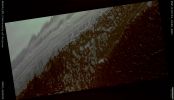
PSP_010716_2640_RED_abrowse.jpgNorth Polar Cavi Scarp with Unconformity (Natural Colors; credits: Lunar Explorer Italia)88 visiteMars Local Time: 14:14 (early afternoon)
Coord. (centered): 83,9° North Lat. and 165,7° East Long.
Spacecraft altitude: 322,0 Km (such as about 201,3 miles)
Original image scale range: 64,4 cm/pixel (with 1 x 1 binning) so objects ~ 1,93 mt across are resolved
Map projected scale: 50 cm/pixel
Map projection: EQUIRECTANGULAR
Emission Angle: 3,5°
Phase Angle: 71,4°
Solar Incidence Angle: 74° (meaning that the Sun is about 16° above the Local Horizon)
Solar Longitude: 154,4° (Northern Summer)
Credits: NASA/JPL/University of Arizona
Additional process. and coloring: Lunar Explorer ItaliaMareKromiumMar 25, 2009
|
|
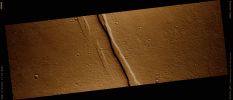
PSP_010491_1570_RED_abrowse.jpgGraben in Memnonia Fossae (Natural Colors; credits: Lunar Explorer Italia)70 visiteMars Local Time: 15:41 (middle afternoon)
Coord. (centered): 23,0° South Lat. and 219,6° East Long.
Spacecraft altitude: 258,7 Km (such as about 161,7 miles)
Original image scale range: 51,8 cm/pixel (with 1 x 1 binning) so objects ~ 1,55 mt across are resolved
Map projected scale: 50 cm/pixel
Map projection: EQUIRECTANGULAR
Emission Angle: 9,9°
Phase Angle: 73,9°
Solar Incidence Angle: 66° (meaning that the Sun is about 24° above the Local Horizon)
Solar Longitude: 145,4° (Northern Summer)
Credits: NASA/JPL/University of Arizona
Additional process. and coloring: Lunar Explorer ItaliaMareKromiumMar 24, 2009
|
|
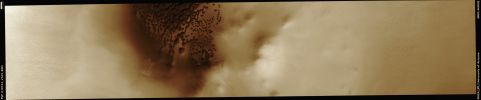
PSP_010512_2505_RED_abrowse.jpgImpact Crater with possible Summer Ice in Vastitas Borealis (Natural Colors; credits: Lunar Explorer Italia)80 visiteMars Local Time: 15:13 (early afternoon)
Coord. (centered): 70,0° North Lat. and 352,1° East Long.
Spacecraft altitude: 317,9 Km (such as about 198,7 miles)
Original image scale range: 63,6 cm/pixel (with 1 x 1 binning) so objects ~ 1,61 mt across are resolved
Map projected scale: 50 cm/pixel
Map projection: EQUIRECTANGULAR
Emission Angle: 2,0°
Phase Angle: 62,1°
Solar Incidence Angle: 64° (meaning that the Sun is about 26° above the Local Horizon)
Solar Longitude: 146,3° (Northern Summer)
Credits: NASA/JPL/University of Arizona
Additional process. and coloring: Lunar Explorer ItaliaMareKromiumMar 24, 2009
|
|
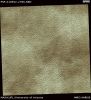
PSP_010492_2780_RED_abrowse.jpgColor and Morphology of the North Polar Residual Cap (Natural Colors; credits: Lunar Explorer Italia)73 visiteMars Local Time: 04:49 (night hours)
Coord. (centered): 82,0° North Lat. and 20,0° East Long.
Spacecraft altitude: 318,7 Km (such as about 199,2 miles)
Original image scale range: 31,9 cm/pixel (with 1 x 1 binning) so objects ~ 96 cm across are resolved
Map projected scale: 25 cm/pixel
Map projection: EQUIRECTANGULAR
Emission Angle: 3,0°
Phase Angle: 76,2°
Solar Incidence Angle: 79° (meaning that the Sun is about 11° above the Local Horizon)
Solar Longitude: 145,5° (Northern Summer)
Credits: NASA/JPL/University of Arizona
Additional process. and coloring: Lunar Explorer ItaliaMareKromiumMar 23, 2009
|
|
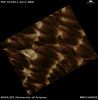
PSP_010501_2615_RED_abrowse.jpgAbalos Undae (Natural Colors; credits: Lunar Explorer Italia)70 visiteMars Local Time: 14:25 (early afternoon)
Coord. (centered): 81,6° North Lat. and 279,6° East Long.
Spacecraft altitude: 318,7 Km (such as about 199,2 miles)
Original image scale range: 63,8 cm/pixel (with 1 x 1 binning) so objects ~ 1,91 mt across are resolved
Map projected scale: 50 cm/pixel
Map projection: EQUIRECTANGULAR
Emission Angle: 0,1°
Phase Angle: 69,6°
Solar Incidence Angle: 70° (meaning that the Sun is about 20° above the Local Horizon)
Solar Longitude: 145,8° (Northern Summer)
Credits: NASA/JPL/University of Arizona
Additional process. and coloring: Lunar Explorer ItaliaMareKromiumMar 23, 2009
|
|
| 2237 immagini su 187 pagina(e) |
|
|
|
|
|
125 | |
|
|
|
|
|
|





