| Ultimi arrivi - Mars Reconnaissance Orbiter (MRO) |

ESP_011894_1455_RED_abrowse.jpgAlluvial Features in Hellas Planitia (Natural Colors; credits: Lunar Explorer Italia)58 visitenessun commentoMareKromiumMag 29, 2009
|
|

ESP_011711_0930_RED_abrowse.jpgSouth Polar Spiders (Natural Colors; credits: Lunar Explorer Italia)58 visitenessun commentoMareKromiumMag 29, 2009
|
|

ESP_011732_1595_RED_abrowse-00.jpgLarge Cluster of Small Craters near Maadim Vallis (ctx frame - Natural Colors; credits: Lunar Explorer Italia)58 visitenessun commentoMareKromiumMag 29, 2009
|
|

ESP_011917_1790_RED_abrowse.jpgEmbayed Crater in Elysium Planitia (Natural Colors; credits: Lunar Explorer Italia)59 visitenessun commentoMareKromiumMag 29, 2009
|
|

ESP_011930_1875_RED_abrowse.jpgLong Fissure in Cerberus Fossae (Natural Colors; credits: Lunar Explorer Italia)59 visitenessun commentoMareKromiumMag 26, 2009
|
|

ESP_012195_1750_RED_abrowse.jpgMartian Grand Canyon! (Natural Colors; credits: Lunar Explorer Italia)60 visitenessun commentoMareKromiumMag 26, 2009
|
|

ESP_012226_1815_RED_abrowse.jpgDark Sands Deposits or Surfacing Hydrocarbons? (Natural Colors; credits: Lunar Explorer Italia)71 visitenessun commentoMareKromiumMag 26, 2009
|
|

ESP_012302_0985_RED_abrowse.jpgCryptic Region Type "B" (Natural Colors; credits: Lunar Explorer Italia)60 visitenessun commentoMareKromiumMag 26, 2009
|
|

ESP_012265_0950_RED_abrowse.jpgGiza Region (Natural Colors; credits: Lunar Explorer Italia)59 visitenessun commentoMareKromiumMag 26, 2009
|
|

ESP_012251_0935_RED_abrowse.jpgJust like Magnetic Fields (Natural Colors; credits: Lunar Explorer Italia)60 visitenessun commentoMareKromiumMag 26, 2009
|
|
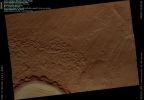
PSP_010100_2165_RED_abrowse.jpgEjecta Blanket (Natural Colors; credits: Lunar Explorer Italia)58 visiteThis image of a crater in the Utopian Region can be described as what happens when heat produced from an impact comes into contact with Mars’ icy Surface.
Since the Surface Temperature of Mars is well below the freezing point of water, Mars’ soil is a mixture of soil and permafrost. When this impact occurred, a great deal of energy in the form of heat was released onto the Surface, creating a melted feature in the bright icy soil. This melting and then refreezing of the ice (as the impact cooled) caused what is known as a "Periglacial Formation". This is depicted towards the middle of the image where the Ejecta Blanket lays.
This is likely a geologically newer surface since the only impacts disrupting the image are a few small craters that are mostly towards the bottom left-hand side of the full image.
The fact the Ejecta Blanket is still intact and not fully collapsed supports the idea that is it a newer surface feature as it has not been affected by erosional processes.MareKromiumMag 23, 2009
|
|

ESP_011610_0935_RED_abrowse.jpgSawtooth Pattern in Carbon Dioxide Ice (Natural Colors; credits: Lunar Explorer Italia)60 visitenessun commentoMareKromiumMag 23, 2009
|
|
| 2237 immagini su 187 pagina(e) |
 |
|
|
|
|
120 | |
|
|
|
|





