| Ultimi arrivi - Mars Reconnaissance Orbiter (MRO) |

ESP_011910_1825_RED_abrowse.jpgUnnamed Crater with Layering in Meridiani Planum (Natural Colors; credits: Lunar Explorer Italia)58 visitenessun commentoMareKromiumMag 31, 2009
|
|
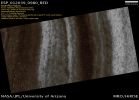
ESP_012039_0980_RED_abrowse.jpgOmega Sublimation Study Area (Natural Colora; credits: Lunar Explorer Italia)60 visitenessun commentoMareKromiumMag 31, 2009
|
|

ESP_012075_1015_RED_abrowse.jpgPossible Hydration in High Southern Latitudes' Region (Natural Colors; credits: Lunar Explorer Italia)59 visitenessun commentoMareKromiumMag 31, 2009
|
|

ESP_011898_1535_RED_abrowse.jpgPossible MSL Landing Site in Holden Crater (Natural Colors; credits: Lunar Explorer Italia)57 visitenessun commentoMareKromiumMag 31, 2009
|
|

ESP_011913_1720_RED_abrowse.jpgLight-Toned Layering along Plains South of Ius Chasma (Natural Colors; credits: Lunar Explorer Italia)56 visitenessun commentoMareKromiumMag 31, 2009
|
|

ESP_012271_0940_RED_abrowse.jpgSouth Polar "Swiss-Cheese Surface Features" (Natural Colors; credits: Lunar Explorer Italia)61 visiteThis image represents a Martian Terrain containing "Swiss Cheese" features. This Terrain is found only within the residue of the Southern Polar Cap, which comprises of mostly frozen CO2 and H2O.
These particular features are flat-floored, circular depressions that are believed to form from different rates in the seasonal changes of the CO2 and H2O ices. Varying rates in sublimation (when these ices change directly to vapors upon heat and back to deposited solids upon cooling) produces these rimmed depressions from the flat polar ice plane. It is hypothesized that the depression areas are made up of dry ice - such as Carbon Dioxide - and the material below consists of the water ice.
This Carbon Dioxide solid rises and slightly evaporates into the thin Atmosphere in the Summer while the water layer remains in place. As the South Pole cools with seasonal change, the "Swiss Cheese" formation is obtained with risen CO2 rimmed depressions and flat water mesas.
The Martian North Pole will evaporate all of its CO2 in the Summer; however the South Pole is colder and this may explain why this Terrain is only found in this area.
Some of the circular features in the full image show distinct cusps that point in the direction of the Pole. These cusps suggest insolation, a measure of solar radiation that is pushing the movement/formation of these depressions away from the Pole. There is also an observed lateral outward growth of the features at the rate of about 1-to-3 meters a year, indicating to scientists that the depressions must form in a CO2 medium.MareKromiumMag 31, 2009
|
|

ESP_011898_2175_RED_abrowse.jpgUnnamed Crater with Gullies in Acidalia Planitia (Natural Colors; credits: Lunar Explorer Italia)76 visitenessun commentoMareKromiumMag 30, 2009
|
|

ESP_012853_1480_RED_abrowse-01.jpgTerra Cimmeria (edm - Natural Colors; credits: Lunar Explorer Italia)59 visiteOn the right side of this edm, is a valley filled with dark material and a central, bright ridge. If the valley was carved by liquid water, then this ridge may mark a former stream channel where coarse-grained sediment was deposited, which has survived erosion more effectively than the finer-grained sediment in the valley outside the channel.
Similar "Inverted Channel Deposits" are visible elsewhere on Mars, and some examples in the Southern Highlands have been inferred to contain chloride salts (similar to table salt).
The color and texture of the possible Inverted Channels in this image are similar to those inferred to contain chlorides, which may have been deposited when salty water evaporated.
Considered together, the features in this image attest to a history of water-related activity at this location on Mars.MareKromiumMag 30, 2009
|
|

ESP_012252_1245_RED_abrowse.jpgDust Devils Tracks (Natural Colors; credits: Lunar Explorer Italia)78 visiteThis image is located in a crater in the Hellespontus region that displays dunes and dust devil tracks.
The larger barchan-like dunes are surrounded by linear ripples and dark coarse material. The dunes are composed of basaltic sands that have accumulated in the troughs of the dunes. The dunes themselves run in a northeast to southwest direction. The steep west facing slip face indicates that the dune is controlled by a southeasterly direction and that the winds here tend to blow from left to right.
Both the sandy and rough textured surfaces are crisscrossed by the tracks of dust devils. These tracks form when dust devils abrade the surface exposing the underlying darker surface. The tracks appear to be clustered since dust devils frequently form in areas that have been previously scoured. The lighter tracks are older tracks that are fading or have been overprinted by other dust devils.
It is possible that the dunes are stable as many of the dust devils appear to be going to the southeast direction (based on scallop patterns- dust devil leaves behind dark circular patterns and erase the frost as it moves forward by local winds). This is an indication of change of wind especially since the dune field is in a crater.
MareKromiumMag 30, 2009
|
|

ESP_012853_1480_RED_abrowse-00.jpgTerra Cimmeria (ctx frame - Natural Colors; credits: Lunar Explorer Italia)62 visiteThis image shows a network of small valleys in the Terra Cimmeria Region of the Martian Southern Highlands. This location is approx. 1000 Km (about 600 miles) South of Gusev Crater, the Landing Site of the Mars Exploration Rover Spirit.
The valleys in this image are carved into light-toned bedrock exhibiting a range of colors, which likely reflect a range of mineralogical compositions. The bedrock is pervasively fractured, and some of the fractures appear to be filled with material of a different color, possibly composed of minerals that crystallized or were cemented together when fluids (perhaps water) circulated through the fractures.MareKromiumMag 30, 2009
|
|

ESP_011896_1570_RED_abrowse.jpgSouthern Crater Field (Natural Colors; credits: Lunar Explorer Italia)58 visitenessun commentoMareKromiumMag 30, 2009
|
|

ESP_012202_1390_RED_abrowse.jpgDunes in Western Nereidum Montes (Extremely Enhanced Natural Colors; credits: Lunar Explorer Italia)59 visitenessun commentoMareKromiumMag 30, 2009
|
|
| 2237 immagini su 187 pagina(e) |
 |
|
|
|
|
119 | |
|
|
|
|





