| Ultimi arrivi - Mars Reconnaissance Orbiter (MRO) |
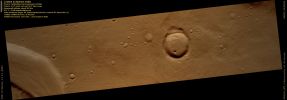
PSP_010630_2115_RED_abrowse-00.jpgCraters and possible "Pingo" in Mamers Vallis (ctx frame - Natural Colors; credits: Lunar Explorer Italia)70 visiteThis image was suggested by Mr. Dennis Mitchell's 8th grade NASA team, Evergreen Middle School, Cottonwood, CA, as part of the HiRISE Quest Student Image Challenge.
They write: "Located near Mamers Valles, this image shows numerous fluvial features that indicate this area was once rich with water. The lineated valley fill suggests an ice-rich soil. [Of particular interest] is a small cone-like feature [located on the floor of a 2 Km-diameter] impact crater in the center of the ctx frame.MareKromiumGiu 11, 2009
|
|
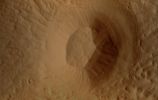
PSP_010630_2115_RED_abrowse-01.jpgCraters and possible "Pingo" in Mamers Vallis (edm - Natural Colors; credits: Lunar Explorer Italia)89 visite"At first this resembles a cinder cone volcano on Earth. However, when magnified, it reveals a feature [found in Arctic regions] on Earth called "Pingo". These are caused by ice protruding through the soil creating a positive-relief geologic feature. If you examine the smaller craters in the surrounding terrain you'll see a checkerboard pattern in each one. These closely resemble melted Pingos on Earth, again suggesting an area of Mars that was once rich with water."
While the student's suggestion that the mound-like structure is a Pingo is reasonable, there is yet no scientific consensus for the origin of these interesting structures.
Nota Lunexit: con tutto il rispetto per le brillanti intuizioni dei ragazzini "sponsorizzati" dalla NASA, l'idea del "Pingo" non stà - davvero - nè in cielo, nè in Terra. Eppure, come leggete, anche a queste boutades (perchè provengono da fanciulli - probabilmente - "quotati" a tutti i livelli), viene dato spazio. Poi però, se chiedi ai Signori di Pasadena o della University of Arizona, ad esempio, cosa potrebbe essere la Silver Sphere (o altri rilievi anomali simili, a parer nostro - e NON SOLO nostro - MOLTO più intriganti dello "pseudo Pingo")...Ecco che cala il silenzio più totale.
Che tristezza...MareKromiumGiu 11, 2009
|
|

ESP_013049_0950_RED_abrowse.jpgSouth Polar Spiders (Natural Colors; credits: Lunar Explorer Italia)59 visiteThis image is part of an ongoing seasonal monitoring effort in this location in the Southern Polar Region of Mars.
Mars’ South Polar Region changes significantly during the Martian Year. During the Southern Hemisphere’s Winter, the Polar Cap increases dramatically as the lowered temperatures make a large portion of the Atmosphere freeze out into ice.
As Spring approaches and the Polar Region begins to warm once again, the Cap recedes revealing terrains like those visible in this image. The polygonal features in this image are termed “Spiders” and their origin is still unknown (although there are several hypotheses).
One possible hypothesis for the black fan-shaped features is that they may be formed by a geyser-like process. As the Sun heats the ground layer below the Carbon Dioxide ice, the ice on the bottom begins to sublimate, or turn directly from a solid to a gas.
This gas then builds up in pressure as more of it sublimates, until a critical pressure is achieved and it erupts through the ice layer much as a geyser would, spewing the debris that is thought to make up the dark fan shaped features.MareKromiumGiu 05, 2009
|
|

ESP_012926_1365_RED_abrowse.jpgLohse Crater (Natural Colors; credits: Lunar Explorer Italia)61 visiteThis image is of the Eastern half of the Central Peak of Lohse Crater located in the Southern Hemisphere.
The crater itself is highly degraded and is roughly 80 miles in diameter. Of specific interest are the pristine looking Gullies that appear to have sourced from layers below the top of this uplifted region.
Smaller Gullies appear to emanate in all directions from the uplifted region, but of special interest is the larger Gully located on the northern most slope of the Central Peak. This Gully has a larger alcove and a better developed debris apron than surrounding Gullies. This implies that either this gully formed over a longer time period or that more fluid was involved in its formation.
Gullies are present on many slopes on Mars, especially between the latitudes of 30 and 70° in both Hemispheres. Gullies are formed by fluids and have three distinct parts to them: an eroded “alcove” at the top, a sometimes sinuous “channel” section, and finally a large “debris apron” where the material eroded by the Gully is deposited.MareKromiumGiu 05, 2009
|
|
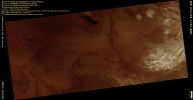
ESP_011728_1735_RED_abrowse.jpgFerric Oxide and Sulphates (Natural Colors; credits: Lunar Explorer Italia)56 visitenessun commentoMareKromiumGiu 05, 2009
|
|

ESP_012997_1445_RED_abrowse.jpg"8"! (Natural Colors; credits: Lunar Explorer Italia)68 visiteThis image shows two craters in the Southern Hemisphere just South of Sirenum Fossae.
The Northern Crater (the one that is an upper position) is smaller, appears more degraded, and is partially filled with sediments that form a hummocky surface. Dunes have formed subsequently on this Surface. Some incipient gully-like features have formed midway along the Southern Crater Wall and expose Layers that are more resistant to erosion.
The larger crater to the South is eroded by Gullies on its Northern Slope while the Southern Slope Region lacks them. Most Gullies in this scene appear to emanate from more resistant Layers, although the larger Gullies have eroded back almost to the Crater Rim.
The nature of the Layers and their connection to the water that formed the Gullies is unknown.
Gullies typically form when flowing water erodes sediments and soft rocks in a channelized flow. Because Mars is very cold and dry, it is unknown where the water came from to form the Gullies.MareKromiumGiu 05, 2009
|
|
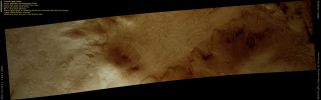
ESP_013071_1365_RED_abrowse.jpgCentral Peak Gullies (Natural Colors; credits: Lunar Explorer Italia)61 visitenessun commentoMareKromiumGiu 05, 2009
|
|

ESP_011775_2230_RED_abrowse.jpgDome and Crater (Natural Colors; credits: Lunar Explorer Italia)58 visitenessun commentoMareKromiumGiu 05, 2009
|
|

ESP_011886_1130_RED_abrowse.jpgDark Southern Dunefield (Natural Colors; credits: Lunar Explorer Italia)58 visitenessun commentoMareKromiumGiu 02, 2009
|
|

ESP_012198_0975_RED_abrowse.jpgSouth Polar Icy Features (Natural Colors; credits: Lunar Explorer Italia)59 visitenessun commentoMareKromiumGiu 02, 2009
|
|

ESP_011903_1465_RED_abrowse.jpgOld Features (Natural Colors; credits: Lunar Explorer Italia)58 visitenessun commentoMareKromiumGiu 02, 2009
|
|

ESP_012080_0990_RED_abrowse.jpgPossible Hydration in High Southern Latitudes' Region (Natural Colors; credits: Lunar Explorer Italia)59 visitenessun commentoMareKromiumMag 31, 2009
|
|
| 2237 immagini su 187 pagina(e) |
 |
|
|
|
|
118 | |
|
|
|
|





