| Ultimi arrivi - Mars Reconnaissance Orbiter (MRO) |
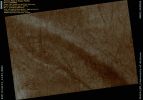
ESP_014272_1245_RED_abrowse.jpgEsker in Southern Argyre Planitia (Natural Colors; credits: Lunexit)63 visiteThough a variety of origins have been proposed, this sinuous, layered, boulder-filled deposit in the Southern Argyre Planitia is likely an "Esker".
"Eskers" form in wet-based glaciers, when water flows inside or below the glaciers and deposits sediment. After the ice melts, the sediment is left behind as a ridge.
Because the material is deposited by flowing water, the sediment in Eskers is sorted: larger rocks, pebbles, sand grains, etc. are deposited first, and smaller sediment - such as smaller pebbles, sand, or clay - are deposited further from the source and on top of the coarser material.
Several factors (including the amount of sediment available, the speed and volume of the flowing water, and the slope over which it flowed) determine how much sediment is deposited and how large the dominant grain size is. There may be many of these sequences preserved within an Esker.
Eskers look a little like Inverted River Beds. One relatively simple way to differentiate between the two is that IRBs record flow in a downhill direction along their entire length.
Eskers, on the other hand, can record flow both down- and uphill. This is possible because water flowing through the ice tunnels in glaciers is under pressure, just like water in a hose.
This particular Esker is part of a branching and braided network of Ridges in the Southern Argyre Basin.
The boulders are on the order of 1-3 meters (about 3-10 feet) in diameter.MareKromiumSet 21, 2009
|
|
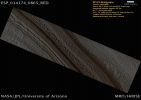
ESP_014174_0865_RED_abrowse.jpgSouth Polar Layered Deposits' (SPLD) Stratigraphy (Natural Colors; credits: Lunexit)61 visitenessun commentoMareKromiumSet 21, 2009
|
|

ESP_012625_1720_RED_abrowse.jpgSulfate Strata in Ius Chasma (Natural Colors; credits: Lunexit)63 visite...Ed ora, dato che al peggio ed al ridicolo non c'è mai fine, ci aspettiamo che qualcuno trovi una "Scritta", da qualche parte, che indichi questi depositi di Solfati...MareKromiumSet 21, 2009
|
|
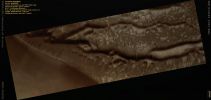
ESP_014185_1095_RED_abrowse.jpgUSGS Dune Database Entry Number 1784-704 (Natural Colors; credits: Lunexit)58 visitenessun commentoMareKromiumSet 21, 2009
|
|
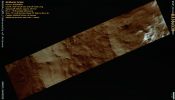
ESP_014324_0955_RED_abrowse.jpgSnow-Streaks on McMurdo Crater (Natural Colors; credits: Lunexit)69 visiteThe SPLD are a stack of ice and dust about 3 Km (a little less than 2 miles) thick. The many layers that make up this feature are of great interest to planetary scientists because, just as with ice sheets on Earth, they are thought to contain a record of the Planet’s climate in previous times.
As with the rest of Mars, impact craters form continuously on these Polar Deposits.
Rarely, a very large impact will occur and the crater will excavate all the way through this ice-sheet to the rocky terrain underneath. This is what happened in the case of McMurdo, a crater roughly 20 Km (about 12,5 miles) across which punched through the ice-sheet in the past.
This HiRISE image shows the wall of this Crater, only half of which has been preserved until current times.
You can see the many layers that comprise the SPLD exposed here.
Scientists study exposures like this to try to understand the length of the climatic record that is recorded in the icy material at the Poles of Mars.MareKromiumSet 21, 2009
|
|
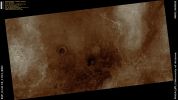
ESP_014178_1765_RED_abrowse1.jpgMeridiani Planum, Southern Boundary (Natural Colors; credits: Lunexit)59 visitenessun commentoMareKromiumSet 17, 2009
|
|

ESP_014077_0930_RED_abrowse.jpgSouth Polar Residual Cap Monitoring (Natural Colors; credits: Lunexit)60 visitenessun commentoMareKromiumSet 17, 2009
|
|

ESP_014111_1130_RED_abrowse.jpgPityhusa Patera Caldera (Natural Colors; credits: Lunexit)62 visitenessun commentoMareKromiumSet 17, 2009
|
|

ESP_014114_0935_RED_abrowse.jpgSouth Polar Residual Cap Monitoring (Natural Colors; credits: Lunexit)62 visitenessun commentoMareKromiumSet 17, 2009
|
|
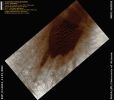
ESP_014041_1145_RED_abrowse.jpgUnusually-looking Dunefield (Natural Colors; credits: Lunexit)62 visitenessun commentoMareKromiumSet 17, 2009
|
|

ESP_014072_1380_RED_abrowse.jpgStratigraphy exposed in Crater Slope (Natural Colors; credits: Lunexit)60 visitenessun commentoMareKromiumSet 17, 2009
|
|

ESP_014126_2120_RED_abrowse.jpgNorthern Crater with Windstreak (Natural Colors; credits: Lunexit)63 visitenessun commentoMareKromiumSet 17, 2009
|
|
| 2237 immagini su 187 pagina(e) |
 |
|
|
|
|
110 | |
|
|
|
|





