| Ultimi arrivi - Mars Reconnaissance Orbiter (MRO) |
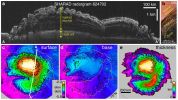
PIA12200.jpgRadar Mapping of Icy Layers Under Mars' North Pole58 visiteThis composite graphic illustrates the use of the Shallow Radar instrument on NASA's Mars Reconnaissance Orbiter for mapping underground ice-rich layers of the North Polar Layered Deposits existing on the North Pole of Mars.
The picture on top of the image-composite, is a radargram from the instrument, showing a cross-section of Mars' North Polar Cap, based on time lags of radio-wave echoes returning from different layers.
The penetrating radar reveals icy layered deposits overlying a basal unit in some areas.
The vertical dimension in the cross section is exaggerated one-hundred-fold compared with the horizontal dimension. The vertical scale bar is one kilometer (3281 feet).
The horizontal scale bar is 100 Km (62 miles).
The Shallow Radar instrument was provided by the Italian Space Agency. Its operations are led by the University of Rome and its data are analyzed by a joint U.S.-Italian science team. NASA's Jet Propulsion Laboratory, a division of the California Institute of Technology in Pasadena, manages the Mars Reconnaissance Orbiter for the NASA Science Mission Directorate, Washington. Lockheed Martin Space Systems, Denver, is the prime contractor for the project and built the spacecraft. The High Resolution Imaging Science Experiment is operated by the University of Arizona, Tucson, and the instrument was built by Ball Aerospace & Technologies Corp., Boulder, Colo.
MareKromiumSet 25, 2009
|
|
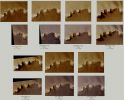
ESP_013954_1780_RED_abrowse-03~0.jpgFading Rover-Tracks near Victoria Crater62 visiteIn this composite image, we show a close-up of the Rover Tracks, as well as 6 previous HiRISE views acquired since June 2007, shortly after Opportunity’s drive.
The span encompasses over a full Mars year, from Southern Spring to the following Summer. Both the Natural Color images at the top of each sequence and the False Color below show a progressive fading of the Tracks over time.
It seems that the Tracks were initially fairly red and then become bluer; this curious effect of color-change might have been due to the weight of the Rover which caused its wheels to push dark granules of rocks and dust into the relatively bright and orangish Martian Soil.
Since then, dark sand has blown out of Victoria and partially covered the Tracks, darkening the Surface.MareKromiumSet 25, 2009
|
|

ESP_013954_1780_RED_abrowse-00~0.jpgVictoria Crater (CTX Frame - Natural Colors; credits: Lunexit)61 visiteThis image has an interesting perspective because of the oblique viewing geometry. In addition, the Tracks left by the Opportunity Rover are visible just North of Victoria.MareKromiumSet 25, 2009
|
|

ESP_013954_1780_RED_abrowse-02.jpgVictoria Crater (EDM - Natural Colors; credits: Lunexit)61 visiteVictoria Crater was explored by Opportunity Rover for more than a Mars year; HiRISE images have supported surface exploration and contributed to joint scientific studies.
HiRISE stereo data were used to measure slopes and help select safe paths for the intrepid Rover. The most interesting exposures of geologic strata are in the steep walls of the Crater, difficult to image from the overhead perspective of orbiting spacecraft like MRO. However, MRO can point to the sides, and did so in this case to get a better view of layers in the West-facing and sunlit slopes of the Crater.
Especially prominent is a bright band near the top of the Crater Wall, interpreted by some MER scientists as having formed by diagenesis (chemical and physical changes in sediments after deposition). This bright band separates the bedrock from the impact ejecta deposits of Victoria Crater.MareKromiumSet 25, 2009
|
|
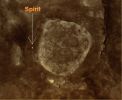
Home_Plate-PIA12205.jpgSpirit at Home Plate61 visiteIn this view from orbit, the pale circular shape in the center is a low plateau called "Home Plate", about 80 meters (about 260 feet) across. The bright dot just to the left of Home Plate at the 9 o'clock position is NASA's MER Spirit. North is toward the top.
The view is a portion of an image taken on June 13, 2009, by the High Resolution Imaging Science Experiment (HiRISE) camera on NASA's Mars Reconnaissance Orbiter. At that date, Spirit had been embedded for more than a month in a patch of soft soil called "Troy".
During the subsequent 3 months, Spirit studied the unusually layered soil at the site while engineers used test rovers at NASA's Jet Propulsion Laboratory to assess possible maneuvers for getting Spirit away from Troy.
The site is at 14,6° South Latitude and 175,5° East Longitude. Home Plate is in the inner basin of the Columbia Hills range, inside Mars' Gusev Crater. Spirit has been exploring the Columbia Hills and nearby features since January 2004.MareKromiumSet 23, 2009
|
|

ESP_014103_2485_RED_abrowse.jpgMonitoring of Phoenix Landing Site (Natural Colors; credits: Lunexit)60 visitenessun commentoMareKromiumSet 22, 2009
|
|

ESP_014083_0945_RED_abrowse-00.jpgActive Geyser on Mars: the "Region" (Natural Colors; credits: Lunexit)63 visiteCoord.: 85,4° South Lat. and 104,0° East Long.
Spacecraft altitude: about 248 Km
M.L.T.: 16:08 (middle afternoon)
S.I.A.: 69° (with the Sun about 21° above the Local Horizon)
Credits: NASA/JPL/Univ. of Arizona
Additional process. and color.: Lunexit
Attività geotermica su Marte? La risposta, detta quasi sussurrando, ci arriva direttamente dalla NASA ed è "Si": su Marte si manifesta ancora CERTAMENTE un quantum (residuale?) di attività geotermica e la prova è nelle bocche ancora attive di una serie di geysers che vediamo nelle Regioni Sud-Polari (le Regioni che sembrano ospitarne di più, ma certo non le uniche Regioni ancora "vive" di Marte).
Dietro questa semplice (ed affascinante) ammissione, si apre un universo di possibilità, tutte quante accomunate da una circostanza: il sottosuolo di Marte è ancora "vivo" ed è ancora abbastanza "caldo e vivace" da sostenere la verificazione di eventi eruttivi (di modesta scala, ma non per questo di modesta importanza).
A quando la notizia che nel sottosuolo di Marte esistono ancora e, nelle ere, si sono sviluppate ed evolute delle Forme Vitali Indigene?...MareKromiumSet 22, 2009
|
|

ESP_014083_0945_RED_abrowse-01.jpgActive Geyser on Mars: the "Geysers' Field" (Natural Colors; credits: Dr M. Faccin & Lunexit)71 visitenessun commentoMareKromiumSet 22, 2009
|
|

ESP_014083_0945_RED_abrowse-02.jpgActive Geyser on Mars: the "Mouth" (Natural Colors; credits: Dr M. Faccin & Lunexit)59 visitenessun commentoMareKromiumSet 22, 2009
|
|

ESP_014007_2030_RED_abrowse1.jpgMawrth Vallis (Blue Filter OFF - Red Filter ON - Natural Colors; credits: Lunexit)61 visiteCon un semplice "scambio" di Filtri/Colore, ecco che un paesaggio - pur rimanendo in Colori Naturali - cambia radicalmente di aspetto.
Questo è solo un piccolissimo esempio di quanto sia facile alterare la realtà, pur rimanendo - se non altro formalmente - nell'ambito della Colorizzazione Naturale (e cioè quella colorizzazione fatta rispettando le linee RGB proprie del frame, e finalizzata a dare all'Osservatore un'idea di come il paesaggio ripreso gli apparirebbe "ad occhio nudo", e cioè senza l'ausilio di supporti idonei ad amplificare lo Spettro della Luce - normalmente - Visibile ad un essere umano).MareKromiumSet 22, 2009
|
|

ESP_014007_2030_RED_abrowse.jpgMawrth Vallis (Blue Filter ON - Red Filter OFF - Natural Colors; credits: Lunexit)60 visitenessun commentoMareKromiumSet 22, 2009
|
|
ESP_014123_0930_RED_abrowse.jpgDry Ice (Natural Colors; credits: Lunexit)61 visitenessun commentoMareKromiumSet 22, 2009
|
|
| 2237 immagini su 187 pagina(e) |
 |
|
|
|
|
109 | |
|
|
|
|





