| Ultimi arrivi - Mars Reconnaissance Orbiter (MRO) |

ESP_014351_1995_RED_abrowse.jpgSanta Fé Crater (Natural Colors; credits: Lunexit)60 visitenessun commentoMareKromiumSet 28, 2009
|
|

ESP_014139_2070_RED_abrowse-00.jpgPhyllosilicates Deposit North Mawrth Vallis (Natural Colors)65 visitenessun commentoMareKromiumSet 28, 2009
|
|
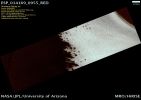
ESP_014169_0955_RED_abrowse.jpgSouthern Patchy Ice (Natural Colors; credits: Lunexit)105 visitenessun commentoMareKromiumSet 28, 2009
|
|
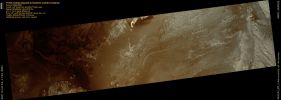
ESP_014154_1730_RED_abrowse.jpgFerric Oxide-Rich Deposit in East Candor Chasma (Natural Colors; credits: Lunexit)60 visitenessun commentoMareKromiumSet 28, 2009
|
|

ESP_014100_1600_RED_abrowse.jpgPossible Inverted Meanders (Natural - but enhanced - Colors; credits: Lunexit)59 visitenessun commentoMareKromiumSet 27, 2009
|
|

SubsurfaceIce-PIA12214.jpgSubsurface Ice is EVERYWHERE!59 visiteThis map shows five locations where fresh impact cratering has excavated water ice from just beneath the Surface of Mars (sites 1 through 5) and the Viking Lander 2 Landing Site (VL2), in the context of color coding to indicate estimated depth to ice.
The map covers an area from 40 to 60° North Latitude and from 130 to 190° East Longitude. Estimates of the depth to water-ice come from a computer model and observations of the brightness and temperature of the Surface. The model matches the ice-exposing crater observations by NASA's Mars Reconnaissance Orbiter and data from the neutron spectrometer on NASA's Mars Odyssey Orbiter.
Analysis of the observations of ice-exposing fresh craters at sites 1 through 5, reported by Byrne et al. in a Sept. 25, 2009, paper in the journal Science, leads the paper's authors to calculate that if NASA's Viking Lander 2 had been able to dig slightly deeper than the 10-to 15-centimeter-deep (4-to-6-inch-deep) trench that it excavated in 1976, it would have hit water ice.
The color coding indicates depths to the top of a water-ice-containing layer, ranging from 1 cm (about 0,5") in dark-blue coded locations to 10 meters (33 feet) in red-coded locations.MareKromiumSet 26, 2009
|
|
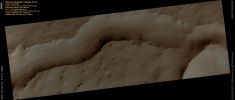
ESP_014124_1975_RED_abrowse.jpgSinuous Channel in Arabia Terra (Natural Colors; credits: Lunexit)60 visitenessun commentoMareKromiumSet 26, 2009
|
|

ESP_014176_1810_RED_abrowse.jpgCentral Uplift of an Unnamed Impact Crater (Natural Colors; credits: Lunexit)60 visitenessun commentoMareKromiumSet 26, 2009
|
|

SubsurfaceIce-PIA12217.jpgSubsurface Ice (Natural Colors; credits: Lunexit)59 visiteThe High Resolution Imaging Science Experiment camera on NASA's Mars Reconnaissance Orbiter took these images of a fresh, 6-meter-wide (20-foot-wide) crater on Mars on Oct. 18, 2008, (left) and on Jan. 14, 2009. Each image is about 35 meters (115 feet) across.
This crater's depth is estimated to be 1,33 meters (4,4 feet).
Images (not shown here) taken by the Thermal Emission Imaging System camera on NASA's Mars Odyssey orbiter and by the Context Camera on the Mars Reconnaissance Orbiter show that the impact that excavated this crater occurred sometime between Dec. 22, 2008 and July 5, 2008.
The impact exposed water ice from below the Surface. It is the bright material visible in this pair of images. The change in appearance from the earlier image to the later one resulted from some of the ice sublimating away during the Martian Northern-Hemisphere Summer, leaving behind dust that had been intermixed with the ice. The thickening layer of dust on top obscured the remaining ice.
This crater is at 43,28° North Latitude and 164,22° East Longitude.MareKromiumSet 25, 2009
|
|

SubsurfaceIce-PIA12218.jpgSubsurface Ice (Natural Colors; credits: Lunexit)57 visiteThis 6-meter-wide (20-foot-wide) Impact Crater located in Mid-Latitude Northern Mars was created by an impact that occurred between Jan. 22, 2008, and Sept. 15, 2008, as bracketed by before-and-after images (not shown here).
The images shown here were taken by the High Resolution Imaging Science Experiment camera on NASA's Mars Reconnaissance Orbiter on Oct. 29, 2008, (left) and on Jan. 4, 2009. Each image is about 35 meters (115 feet) across.
The crater's depth is estimated to be 1,76 meters (5,8 feet).
The impact that dug the Crater excavated water ice from beneath the Surface. It is the bright material visible in this pair of images. A change in appearance from the earlier image to the later one resulted from some of the ice sublimating away during the Northern-Hemisphere Summer, leaving behind dust that had been intermixed with the ice. The thickening layer of dust on top obscured some of the remaining ice.
This crater is at 45,05° North Latitude and 164,71° East Longitude.MareKromiumSet 25, 2009
|
|
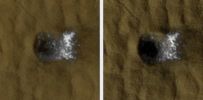
SubsurfaceIce-PIA12219.jpgSubsurface Ice (Natural Colors; credits: Lunexit)59 visiteThis 12-meter-wide (39-foot-wide) Impact Crater located in Mid-Latitude Northern Mars was created by an impact that occurred between July 3, 2004, and June 28, 2008, as bracketed by before-and-after images (not shown here).
The images shown here were taken by the High Resolution Imaging Science Experiment camera on NASA's Mars Reconnaissance Orbiter on Nov. 19, 2008, (left) and on Jan. 8, 2009. Each image is about 35 meters (115 feet) across.
The impact that dug the Crater excavated water ice from below the Surface. It is the bright material visible in this pair of images. This Crater is at 46,16° North Latitude and 188,51° East Longitude.MareKromiumSet 25, 2009
|
|
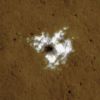
SubsurfaceIce-PIA12220.jpgMaterial excavated by a "Fresh Impact" is identified as Water Ice (Natural Colors; credits: Lunexit)56 visiteThe bright material conspicuous in this image was excavated from below the Surface and deposited nearby by a 2008 impact that dug a crater about 8 meters (26 feet) in diameter.
The extent of the bright patch was large enough for the Compact Reconnaissance Imaging Spectrometer for Mars, an instrument on NASA's Mars Reconnaissance Orbiter, to obtain information confirming the material to be water ice.
This image, covering an area 50 meters (164 feet) across, was taken on Nov. 1, 2008, by the High Resolution Imaging Science Experiment on the same Orbiter. The time frame for the crater-forming impact to have occurred was bracketed by before-and-after images (not shown) taken by the Thermal Emission Imaging System camera aboard NASA's Mars Odyssey Orbiter on Jan. 26, 2008, and by the Context Camera on the Mars Reconnaissance Orbiter on Sept. 18, 2008.
This Crater is at 55,57° North Latitude and 150,62° East Longitude (Vastitas Borealis Region). MareKromiumSet 25, 2009
|
|
| 2237 immagini su 187 pagina(e) |
 |
|
|
|
|
108 | |
|
|
|
|





