| Ultimi arrivi - Mars Reconnaissance Orbiter (MRO) |
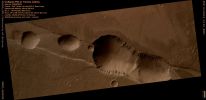
ESP_014432_2110_RED_abrowse.jpgCollapse Pits in Tractus Catena (Natural Colors; credits: Lunexit)67 visitenessun commentoMareKromiumOtt 07, 2009
|
|
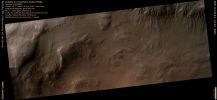
ESP_014187_2230_RED_abrowse.jpgGullies in a Northern Crater Walls (Natural Colors; credits: Lunexit)58 visitenessun commentoMareKromiumOtt 06, 2009
|
|
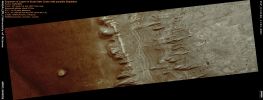
ESP_014186_1745_RED_abrowse.jpgExposures of Layers in South Gale Crater (Natural Colors; credits: Lunexit)59 visitenessun commentoMareKromiumOtt 05, 2009
|
|
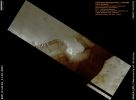
ESP_014190_1130_RED_abrowse.jpgUSGS Dune Database Entry Number 0403-669 (Natural Colors; credits: Lunexit)59 visitenessun commentoMareKromiumOtt 05, 2009
|
|

ESP_014139_2070_RED_abrowse-01.jpgFumes, North of Mawrth Vallis (Natural Colors; credits: Dr M. Faccin)112 visiteUna splendida ed affascinante (nonchè ECCEZIONALE) visione di "fumi" che si sollevano da una regione di modeste dimensioni situata a Nord della famosa Mawrth Vallis. La scoperta - perchè di scoperta si tratta - è del nostro Marco Faccin; la NASA, purtroppo, sebbene da noi sollecitata al riguardo, non ha - evidentemente... - ancora trovato il tempo di rispondere e di darci qualche delucidazione su quello che staremmo guardando.
Il dettaglio in oggetto non è assolutamente visibile/distinguibile osservando il full-frame MRO in formato JPEG, ma bisogna aprire il file in JP2 e "mettersi a cercare".
I "fumi" che vedete in questa colorizzazione (fatta al TOP delle nostre possibilità, miscelando la tecnica di colorizzazione in Colori Naturali STD con la Tecnica MULTISPECTRUM) sono stati da noi identificati come tali (e NON, quindi, come nebbie) in quanto riteniamo di aver individuato i punti esatti di emanazione.
Lo spettacolo che stiamo osservando, quindi ed a nostro parere, potrebbe costituire l'evidenza oggettiva di una Caldera Attiva (simile, concettualmente, alle cosiddette "Solfatare" di Pozzuoli - NA).
Morale: Marte è tutt'altro che morto...MareKromiumOtt 05, 2009
|
|
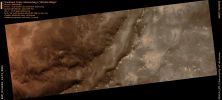
ESP_014260_1675_RED_abrowse.jpgUnnamed Crater intersecting a "Wrinkle Ridge" (Natural Colors; credits: Lunexit)86 visiteWrinkle Ridges are topographic structures produced by Subsurface faulting; they are commonly found on both the Moon and Mars.
This image shows a site where a Wrinkle Ridge intersects a Crater; the Ridge is a large feature and extends well outside this observation. The spur just inside the Crater Rim is roughly in line with the Wrinkle Ridge structure and probably represents enhanced crater collapse along the fault line.
An alternative possibility is that this spur was created by movement of the Wrinkle Ridge fault after the Crater formed, but this is unlikely because the Outer Rim of the Crater is not cut. Observations like this help constrain the relative timing of events on Mars.MareKromiumOtt 05, 2009
|
|

ESP_014181_0920_RED_abrowse.jpgThe South Polar Residual Cap (Natural Colors; credits: Lunexit)58 visitenessun commentoMareKromiumOtt 05, 2009
|
|
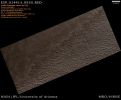
ESP_014413_0930_RED_abrowse-00.jpgRadial Channels carved by CO2 - a.k.a.: The "Spiders" (CTX Frame - Natural Colors; credits: Lunexit)58 visiteMars’ Carbon Dioxide-based Atmosphere partially condenses every Winter to form Polar Caps of Dry Ice (CO2). In the Spring, the evaporation/sublimation of the ice is a dynamic process and carves Channels into the ground as it escapes back into the Atmosphere.
Often these Channels are radial in nature and are colloquially refered to as “Spiders” although the prefered term for these radially-organized channels is “Araneiform” (which means spider-like).MareKromiumOtt 05, 2009
|
|
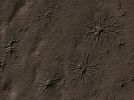
ESP_014413_0930_RED_abrowse-01.jpgRadial Channels carved by CO2 - a.k.a.: The "Spiders" (EDM - Natural Colors; credits: Lunexit)58 visiteIn this EDM we can see, now that all the seasonal frost is gone, the actual appearence of the "Spiders" and we can both use stereo images (when available) or shadows (if any) to measure the depth of the Channels carved into the ground (which, by the way, are usually 1 or 2 meters deep).MareKromiumOtt 05, 2009
|
|
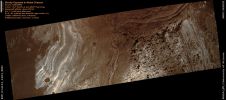
ESP_014141_1665_RED_abrowse.jpgPossible Blocky Deposits in Melas Chasma (Natural Colors; credits: Lunexit)60 visitenessun commentoMareKromiumOtt 05, 2009
|
|
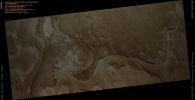
ESP_014167_1300_RED_abrowse.jpgExposures of Layered Rocks in Argyre Planitia (Natural Colors; credits: Lunexit)60 visitenessun commentoMareKromiumOtt 05, 2009
|
|

SubsurfaceIce-PIA12216.jpgFading Fresh Craters with Subsurface Ice (Natural Colors; credits: Lunexit)57 visiteThis series of images spanning a period of 15 weeks shows a pair of fresh, middle-latitude craters on Mars in which some bright, bluish material apparent in the earliest images disappears by the later ones. Each panel is 75 meters (246 feet) across. The two craters are each about 4 meters (13 feet) in diameter and half a meter (1,5 feet) deep.
The bright material is water ice that was uncovered by the meteorite impact that excavated these small craters less than 15 weeks before the initial image of this series. Sublimation of the ice during the Martian Summer leaves behind a dust layer that gradually thickens to the point where it obscures the ice.
The High Resolution Imaging Science Experiment (HiRISE) camera on NASA's Mars Reconnaissance Orbiter took these images of this site at 46,33° North Latitude and 176,90° East Longitude. The HiRISE camera's targeting of the site was prompted by two earlier images from the Context Camera on the Mars Reconnaissance Orbiter, which showed that the impact responsible for these craters had not yet occurred by June 4, 2008, but had occurred by Aug. 10, 2008.
The dates when these six HiRISE images were taken were (left to right, top row; then left to right, bottom row): Sept. 12, 2008; Sept. 28, 2008; Oct. 9, 2008; Oct. 14, 2008; Nov. 22, 2008; and Dec. 25, 2008. The span of time corresponded to a period from mid to late Summer in Mars' Northern Hemisphere. The images are subframes of the observations made on those dates.
The full-frame images are online (same order) at http://hirise.lpl.arizona.edu/PSP_009978_2265;
http://hirise.lpl.arizona.edu/PSP_010189_2265; http://hirise.lpl.arizona.edu/PSP_010334_2265;
http://hirise.lpl.arizona.edu/PSP_010400_2265; http://hirise.lpl.arizona.edu/PSP_010901_2265; and
http://hirise.lpl.arizona.edu/ESP_011323_2265.MareKromiumSet 30, 2009
|
|
| 2237 immagini su 187 pagina(e) |
 |
|
|
|
|
107 | |
|
|
|
|





