| Ultimi arrivi - Mars Reconnaissance Orbiter (MRO) |

ESP_014188_1320_RED_abrowse.jpgUSGS Dune Database Entry Number 0894-475 (Natural Colors; credits: Lunexit)66 visitenessun commentoMareKromiumOtt 11, 2009
|
|
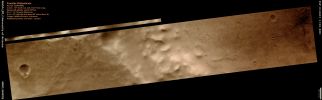
ESP_014447_1720_RED_abrowse.jpgPossible Phillosilicate (Natural Colors; credits: Lunexit)59 visitenessun commentoMareKromiumOtt 11, 2009
|
|
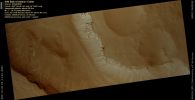
ESP_014178_1330_RED_abrowse.jpgNorth-Western Side of Asimov Crater (Natural Colors; credits: Lunexit)61 visitenessun commentoMareKromiumOtt 11, 2009
|
|
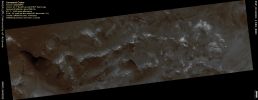
ESP_014430_1580_RED_abrowse.jpgUnnamed Crater S/W of Vinogradov Crater (Natural Colors; credits: Lunexit)59 visitenessun commentoMareKromiumOtt 11, 2009
|
|

ESP_014353_1685_RED_abrowse-01.jpgLight-Toned Deposits in Noctis Labyrinthus (EDM - Natural Colors; credits: Lunexit)59 visiteCRISM observations of this Region of the Noctis Labyrinthus formation have shown indications of Iron-bearing Sulfates and Phyllosilicate (such as "clay" ----> argilla) minerals.
HiRISE observations have revealed exposed layers which are possibly the sources of the signatures seen by CRISM.
In this image, the layering can be seen on the right side of the image.
On the lower left, instead, a large Dunefield which covers other beds can also be seen.MareKromiumOtt 09, 2009
|
|

ESP_014348_1345_RED_abrowse.jpgUSGS Dune Database Entry Number 0419-449 (Natural Colors; credits: Lunexit)59 visitenessun commentoMareKromiumOtt 09, 2009
|
|

ESP_014436_0920_RED_abrowse-00.jpgIcy Impact (CTX Frame - Natural Colors; credits: Lunexit)59 visiteA thick (approx. 3 Km or a little less than 2 miles) sequence of ice and dust, stacked like a layer cake, covers the South Pole of Mars. Impact craters that form here experience slightly different processes of modification and degradation than those that form in rocky areas.
One example of such a process is sublimation. Most of the material that makes up an icy crater is volatile, meaning it can melt or sublimate (change directly from a solid to a gas) if heated. Sublimation is more common on Mars because of its thin and dry Atmosphere.
Crater walls facing the Sun receive more direct light than their surroundings, and are therefore more easily warmed. If the ice in the walls sublimates, the rim structure of the crater becomes degraded.MareKromiumOtt 09, 2009
|
|
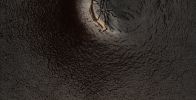
ESP_014436_0920_RED_abrowse-01.jpgIcy Impact (EDM - Natural Colors; credits: Lunexit)69 visiteThe Impact Crater in this image is roughly 900 meters (a little over 0,5 mile) across.
The remaining Raised Rim of the Crater is illuminated from the bottom right of the image, causing preferential heating of the interior of the Rim structure.
The ice appears thin here (more brown material is exposed), with an even thinner cover on the remaining exterior Rim.
This could be caused by a number of possibilities: perhaps the Exterior Wall is steeper than the Interior Wall, resulting in more direct exposure to sunlight, causing more efficient sublimation when the Sun shines on that Wall.
Once ice begins to melt, darker dustier material is exposed. The darker material absorbs more heat than white ice (just like standing in the Sun wearing a black shirt makes you warmer than wearing a white shirt, which reflects the Sun's light), causing more and more ice to sublimate near the dark material.MareKromiumOtt 09, 2009
|
|

ESP_014298_1105_RED_abrowse.jpgUSGS Dune Database Entry Number 3327-692 (Natural Colors; credits: Lunexit)82 visitenessun commentoMareKromiumOtt 09, 2009
|
|

ESP_014334_0945_RED_abrowse.jpgPolar Layered Deposits Stratigraphy near Chasma Australe (Natural Colors; credits: Lunexit)59 visitenessun commentoMareKromiumOtt 09, 2009
|
|

ESP_014183_1645_RED_abrowse.jpgWindstreaks (Natural Colors; credits: Lunar Explorer Italia)59 visitenessun commentoMareKromiumOtt 07, 2009
|
|

ESP_014432_1685_RED_abrowse.jpgTerraced Unnamed Crater (Natural Colors; credits: Lunexit)68 visitenessun commentoMareKromiumOtt 07, 2009
|
|
| 2237 immagini su 187 pagina(e) |
 |
|
|
|
|
106 | |
|
|
|
|





