| Ultimi arrivi - Mars Reconnaissance Orbiter (MRO) |

ESP_014426_1580_RED_abrowse.jpgTerra Sabaea and Terra Tyrrhena Boundary (Natural Colors; credits: Lunexit)62 visitenessun commentoMareKromiumOtt 24, 2009
|
|

PSP_004650_0975_RED_abrowse.jpgExposure of South Polar Layered Deposits (Natural Colors; credits: Lunexit)57 visiteExtensive Layered Deposits are found in both Polar Regions of Mars and are thought to contain evidence of recent climate changes like ice ages on Earth.
Radar observations suggest that the NPLD - as well as the SPLD - are composed mostly of water ice, but many layered exposures, including this one, appear to be covered by a layer of dust that protects the underlying water ice from further erosion. The SPLD are more extensive than the NPLD, and have generally been less active recently.
The greater age of the SPLD is indicated by the higher density of craters on its Surface; as a matter of fact, a cluster of small craters is visible above center in this image. Also visible are widespread polygonal fractures, evidence of water ice expansion/contraction below the Surface.MareKromiumOtt 22, 2009
|
|

ESP_014401_1360_RED_abrowse.jpgAeolian Features Monitoring (Natural Colors; credits: Lunar Explorer Italia)62 visitenessun commentoMareKromiumOtt 22, 2009
|
|
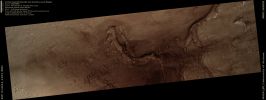
ESP_014414_2205_RED_abrowse.jpgEroded Layered Deposits near Ismenius Lacus Region (Natural Colors; credits: Lunexit)59 visitenessun commentoMareKromiumOtt 22, 2009
|
|
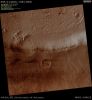
ESP_014266_1385_RED_abrowse.jpgUnnamed Southern Crater with Gullies (Natural Colors; credits: Lunexit)58 visiteTitolo originale del frame:"Context for MOC Image E13-01405 View of Gullied Crater".MareKromiumOtt 22, 2009
|
|
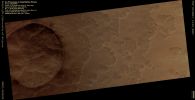
PSP_004867_1220_RED_abrowse-00.jpgIce Processes in Amphitrites Patera (CTX Frame - Natural Colors; elab. Lunexit)86 visiteThis image captures an impact crater on the surface of Amphitrites Patera, an ancient volcano on the southern margin of the giant Hellas Basin. The Hellas Basin was formed by a very large impact into the Southern Highlands early in the geologic history of Mars. The basin has a number of volcanoes along its margin, perhaps because magma could take advantage of the deep cracks in the crust that resulted from the impact.
Amphitrites Patera is far enough South to approach the Martian Antarctic and there is evidence for large amounts of ice in the ground. As in the Polar Regions of Earth, the icy ground (permafrost) is able to move and be modified by a variety of processes. In this case, the rim of the small impact crater is filled with a honeycomb of cracks. These are likely to have formed where dust- and soil-covered ice or ice cemented soil was cracked by thermal contraction in the winter. Subsequently, the underlying ice was able to escape into the atmosphere (sublimate) allowing the ground along the cracks to collapse. The only place where large boulders are visible is along the rim of the crater; this is probably where the boulders were not so deeply buried by the icy layer. MareKromiumOtt 18, 2009
|
|
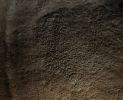
PSP_004867_1220_RED_abrowse-01.jpgIce Processes in Amphitrites Patera (EDM - Natural Colors; elab. Lunexit)58 visiteThe Martian Atmosphere was dusty at the time this image was acquired, so small imperfections in the processing are very visible in the standard image products.
MareKromiumOtt 18, 2009
|
|

ESP_014333_1715_RED_abrowse.jpgTerra Tyrrhena: Unnamed Crater with Central Uplift and Hydrated Minerals (Natural Colors; credits: Lunexit)56 visitenessun commentoMareKromiumOtt 17, 2009
|
|

ESP_014339_1710_RED_abrowse.jpgLight-Toned Units along the Wallrock and Floor of Melas Region (Natural Colors; credits: Lunexit)57 visitenessun commentoMareKromiumOtt 17, 2009
|
|
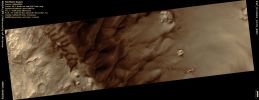
ESP_014426_2070_RED_abrowse.jpgNorthern Dunes (Natural Colors; credits: Lunexit)57 visitenessun commentoMareKromiumOtt 17, 2009
|
|
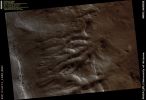
ESP_014271_1480_RED_abrowse.jpgSouthern Gullies (Natural Colors; credits: Lunexit)57 visitenessun commentoMareKromiumOtt 15, 2009
|
|

ESP_014097_1120_RED_abrowse.jpgDisappearing Craters (Natural Colors; credits: Lunar Explorer Italia)64 visiteImpact Craters that form at High Latitudes often disappear faster than those that form in Equatorial Regions. The craters in this image are only barely detectable.
Over time, craters in ice, particularly large craters, "relax".
Their depth-to-diameter ratio decreases as the bowl of the crater gets shallower with time. The craters slowly appear softer and smoother, fading into the surrounding landscape, until they remain only as circular patterns on flat ground, before they eventually disappear altogether. The larger the crater, the faster it will relax.
The reason for the crater degradation is partly due to in-filling by snow or dust and slumping off of the crater walls, and also partly from processes that produce the patterned ground you see in this HiRISE image. But the primary reason for the shallowing is because the ground at High Latitudes on Mars is ice-rich, and ice is not very strong. At warmer temperatures found in the Inner Solar System, ice generally flows more easily than rock, so ice cannot support the structure of the crater as well as rock. The crater relaxes as the ice begins to flow back to a level surface.
All of the processes listed above have likely acted on these craters, and recently, they have also been swept by Dust Devils, which left dark streaks in their wake.MareKromiumOtt 15, 2009
|
|
| 2237 immagini su 187 pagina(e) |
 |
|
|
|
|
105 | |
|
|
|
|





